
OpenAI Software Engineer Interview Process(2026): Comprehensive Guide
Let's be honest,OpenAI isn't your average tech interview. They're building AGI. The bar is ridiculous. But people do get hired. Here's what separates them from everyone else.
The OpenAI Interview Process
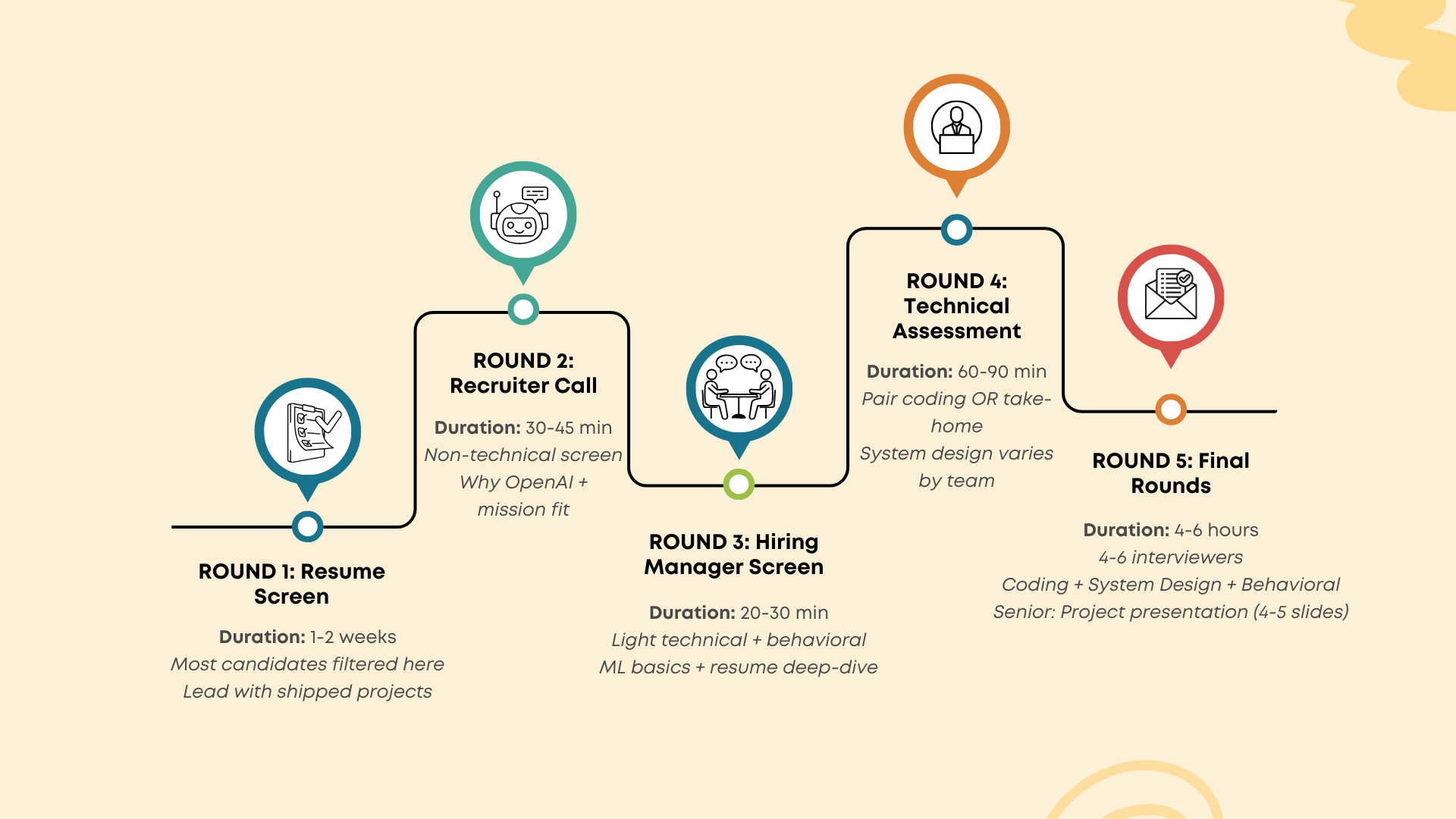
The full process runs 4-8 weeks depending on team and scheduling. Five rounds. Each one filters hard.
Round 1: Resume Screen
This is where most candidates disappear. OpenAI gets thousands of applications,your resume needs to pop immediately. Lead with impact: meaningful projects, open-source contributions, systems you've actually built and shipped. Generic "proficient in Python" bullet points won't cut it. They're looking for builders who've solved real problems, not credential collectors.
Round 2: Recruiter Call (30-45 min)
Entirely non-technical, but don't underestimate it. The recruiter is assessing whether you understand what OpenAI is trying to do,and whether you actually care. They'll ask about your background, why you want to work here specifically, and what excites you about AI's future. Read the OpenAI Charter before this call. Know their recent product launches and research directions. Generic enthusiasm gets you nowhere.
Round 3: Hiring Manager Screen (20-30 min)
Now it gets real. This is a mix of light technical probing and behavioral deep-dives. Expect questions on basic ML theory (how transformers work, gradient descent intuition) and a thorough walkthrough of something significant you've built. They want to see how you think through problems and make decisions,not just what you know. Know your resume inside out. If you listed it, you should be able to explain it under pressure.
Round 4: Technical Assessment
Format varies by team; it could be a 60-90 minute pair coding session, a take-home project with a few-day deadline, or a focused system design discussion. What doesn't change: they're testing whether you can build production-quality systems. Clean code. Thoughtful trade-offs. Practical problem-solving over algorithmic gymnastics. If you're used to grinding LeetCode hard problems, recalibrate. OpenAI cares more about engineering judgment than trick solutions.
Round 5: Final Rounds (4-6 hours)
The marathon. You'll meet 4-6 interviewers across multiple sessions, coding, system design, and behavioral. The coding problems are harder here, focused on code quality and efficiency rather than just getting to a solution. System design questions often involve AI infrastructure: serving LLMs at scale, distributed training, and real-time inference pipelines. For senior roles, you'll also give a 4-5 slide project presentation covering something you shipped, problem context, your decisions, trade-offs, and lessons learned. This is where they see if you can articulate complex work clearly.
Real OpenAI Coding Questions (From Recent Interviews)
Coding Rounds:
- - "Implement a time-based key-value store with get and set operations."
- - "Build a multithreaded web crawler that respects rate limits."
- - "Design an LRU cache with O(1) operations."
System Design Rounds:
- - "How would you architect a real-time inference API serving GPT-4 to millions of users?"
- - "Design a distributed training system with fault tolerance across GPU clusters."
- - "Build a content moderation pipeline that integrates with LLM outputs."
Behavioral Questions:
- - "Walk me through a technical decision you made that didn't pan out. What did you learn?"
- - "Tell me about a time you disagreed with a senior engineer. How did you handle it?"
- - "What's your view on AI safety, and how does it influence your work?"
What OpenAI Actually Evaluates
Forget the checkbox skills. Here's what gets you through:
- 1. Practical problem-solving: They want engineers who ship, not algorithm artists
- 2. System-level thinking: Can you reason about scale, latency, and trade-offs?
- 3. Mission alignment: Do you genuinely care about beneficial AI, or is this just a resume line?
- 4.Clear communication: If you can't explain your reasoning to cross-functional teams, you won't last long here
How to Prepare
Start with OpenAI's official interview guide, which tells you exactly what they expect. Then practice systematically.
For question patterns, check OpenAI Software Engineer questions on Interviewbee to see what's actually being asked.
Run mock interviews until explaining your thought process feels automatic. Interviewbee's mock interviewer gives you real-time feedback so you're not learning lessons during the actual interview.
Brush up on PyTorch, distributed systems, and LLM fundamentals. If you can't explain how a transformer works at a high level, you're not ready.
The Bottom Line
OpenAI compensation is elite, $700K-$1M+ total comp for mid-level engineers. But the process is designed to filter brutally. If you're serious, prepare like it.