
McKinsey Business Analyst Interview Guide (2026)
The McKinsey Business Analyst interview is designed to assess whether you can solve ambiguous business problems, communicate clearly, and learn quickly in a client-facing environment. A strong candidate does more than memorise case frameworks: they turn an unclear prompt into a structured, evidence-based recommendation and explain their reasoning with confidence.
This guide explains the core stages McKinsey publicly describes for consulting applicants, the skills those stages test, representative practice questions, and a focused preparation plan for Business Analyst candidates.
What Does a McKinsey Business Analyst Do?
Business Analysts work on client problems across strategy, operations, organisation, growth, and transformation. The role typically requires you to gather and interpret evidence, develop hypotheses, build analyses, communicate conclusions, and collaborate with a case team and client stakeholders.
In an interview, this translates into five signals:
- Structured problem solving: Can you break an ambiguous question into manageable analyses?
- Quantitative reasoning: Can you work accurately with charts, estimates, and business maths?
- Clear communication: Can you state a view, support it, and summarise the implication?
- Personal impact: Can you show leadership, collaboration, and resilience through specific examples?
- Adaptability: Can you absorb new information and adjust your thinking without losing direction?
McKinsey Business Analyst Interview Process
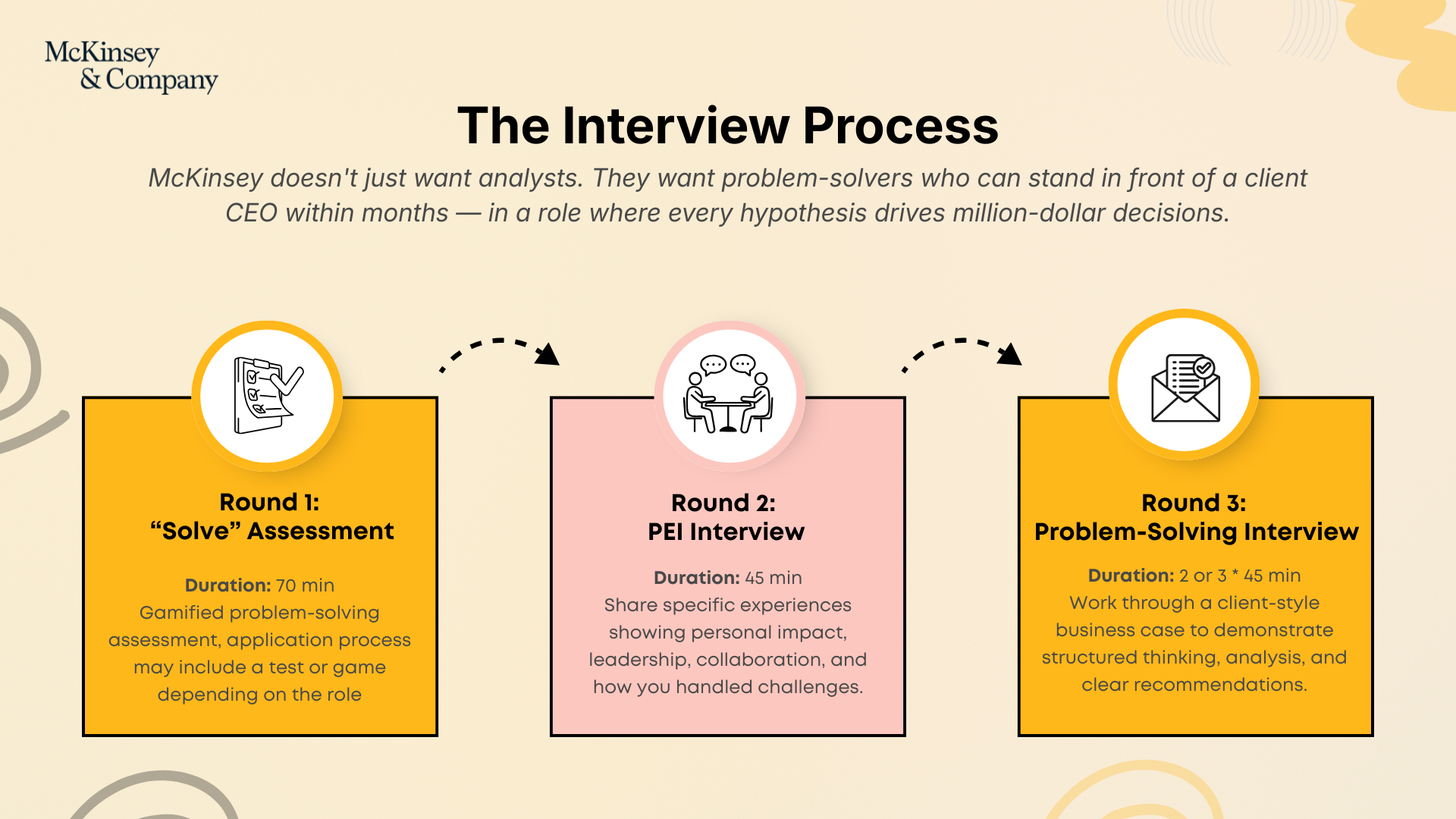
The exact process can vary by office, recruiting channel, and candidate profile. McKinsey's current careers guidance says that applicants for most consulting roles may encounter Solve, its gamified problem-solving assessment, and that most client-facing interviews include a Personal Experience Interview (PEI) followed by a Problem-Solving Interview, commonly called a case interview. Your recruiter will confirm the process for your application.
1. Application Review and Possible Solve Assessment
McKinsey describes Solve as a gamified assessment intended to help evaluate natural problem-solving abilities. It may be included during the application process for consulting roles. Because the format and invitation details are communicated directly to candidates, prepare by following the official instructions carefully and completing the assessment independently.
What this stage can assess:
- Reasoning through unfamiliar information
- Decision making under constraints
- Pattern recognition and problem-solving approach
2. Personal Experience Interview (PEI)
The PEI focuses on experiences in which your own actions drove an outcome. McKinsey advises candidates to prepare detailed personal examples that show impact across the themes discussed in its interview guidance. The strongest responses are not broad summaries of a team project; they make your decision, your actions, and the result unmistakable.
Representative PEI practice prompts:
- Tell me about a time you led others through a difficult challenge.
- Describe a situation where you influenced a decision without formal authority.
- Tell me about a time you dealt with conflict while still delivering an outcome.
- Describe a setback that required you to change your approach.
- Tell me about a time you created measurable impact in a team or organisation.
How to prepare your stories:
- Choose examples where the stakes, obstacles, and your ownership are clear.
- Explain the specific judgment call you made, not only the sequence of events.
- Quantify results where possible, and be ready for detailed follow-up questions.
- Prepare more than one example so you can match the interviewer's theme naturally.
3. Problem-Solving Interview (Case Interview)
In the problem-solving interview, McKinsey presents a business situation and evaluates how you analyse it. The goal is not to recite a named framework. Instead, you should clarify the objective, build a tailored structure, work through evidence and calculations, identify the central insight, and recommend a practical path forward.
Typical skills assessed in a case interview:
- Defining the client's objective and relevant success measure
- Breaking a problem into logical, prioritised components
- Interpreting exhibits and performing calculations accurately
- Generating practical ideas supported by analysis
- Synthesising findings into a direct recommendation
Representative Case Practice Questions
The following prompts are original practice examples designed to reflect common consulting problem types. They are not represented as past McKinsey interview questions.
- An Indian consumer-goods company has increased revenue over three years, but operating margin has declined. How would you diagnose the cause and recommend a response?
- A global pharmaceutical company is considering expansion into India's generic medicines market. How would you determine whether it should enter?
- A hospital network wants to improve profitability without opening or acquiring new hospitals. Which levers would you assess first?
- A private equity investor is evaluating the acquisition of a regional airline. What would you analyse before giving a recommendation?
- A public-sector client wants to increase tax collection without increasing tax rates. How would you structure the problem?
A Strong Case Interview Approach
Step 1: Clarify the Objective
Confirm what success means before structuring the problem. For a profitability case, ask whether the client cares about margin, absolute profit, a time horizon, or strategic constraints such as market share or service levels.
Step 2: State a Working Hypothesis
Offer a reasoned starting point that your analysis can test. For example: "My initial hypothesis is that margin pressure is driven by rising input or distribution costs rather than falling demand, because revenue has continued to grow. I would test this by separating price, volume, and unit-cost movements."
Step 3: Build a Tailored Structure
Keep the structure specific to the prompt. A margin decline might require revenue decomposition, cost analysis, competitive or customer shifts, and feasible corrective actions. A market-entry case would require market attractiveness, ability to win, economics, risks, and entry mode.
Step 4: Analyse Data Carefully
Explain what you are calculating, work cleanly, sanity-check the result, and interpret what the number means for the client's decision. A calculation is not complete until you connect it back to the problem.
Step 5: Synthesize and Recommend
Give a direct answer supported by the strongest evidence, acknowledge the most important risk, and identify an immediate next step. A useful conclusion sounds like a decision, not a recap of everything discussed.
What Interviewers Are Looking For
- Hypothesis-led reasoning: You establish a sensible direction and refine it as the evidence develops.
- Structured communication: Your points are mutually distinct, ordered by importance, and connected to a clear implication.
- Comfort with numbers: You calculate accurately, communicate assumptions, and use numbers to make better decisions.
- Coachability: You respond constructively when the interviewer introduces a new fact or redirects the analysis.
- Personal ownership: In PEI answers, you demonstrate what you personally decided, did, learned, and delivered.
How to Prepare for the McKinsey Business Analyst Interview
Build a Case Practice Routine
- Practise cases across profitability, growth, market entry, operations, and public-sector topics.
- After each case, record where your structure, maths, or synthesis became unclear.
- Practise exhibit interpretation and mental maths separately so case time is spent on insight.
Prepare PEI Stories in Depth
- Select experiences involving leadership, difficult collaboration, change, and impact.
- Rehearse the context briefly, then spend most of the answer on your actions and judgment.
- Expect probing questions about alternatives, resistance, trade-offs, and lessons learned.
Practise Executive-Style Synthesis
At the end of every practice case, deliver a short recommendation: answer first, two or three supporting reasons, one risk, and one next step. This improves both case performance and the clarity expected in a client-facing role.
Common Mistakes to Avoid
- Starting with a memorised framework: First understand the client's decision, then build the structure needed for that decision.
- Doing calculations without interpretation: Always explain how the result changes your conclusion.
- Waiting for a prompt to synthesise: Periodically summarise what the analysis shows and what you want to test next.
- Underpreparing for PEI: Your experiences must be as carefully prepared as your cases, while still sounding natural and reflective.
- Presenting unverified interview claims as facts: Use official process guidance for the format, and treat third-party practice material as practice rather than proof of the actual interview sequence.
Frequently Asked Questions
Does McKinsey use a PST for Business Analyst applications in 2026?
McKinsey's current public careers guidance highlights Solve, its gamified assessment, for most consulting roles and notes that assessments can depend on the role. Follow the instructions provided for your specific application rather than assuming an older assessment format applies.
What interviews should a Business Analyst candidate prepare for?
McKinsey states that most client-facing roles include a Personal Experience Interview and a Problem-Solving Interview. The number and scheduling of interviews can vary, so confirm the exact process with your recruiter.
Should I memorise consulting frameworks?
Learn the business concepts behind common case types, but practise building a structure tailored to the question. Interviewers are evaluating your reasoning, not your ability to name a standard framework.
How should I prepare for PEI questions?
Prepare detailed examples in which you personally made decisions, worked through obstacles, and achieved or learned from measurable outcomes. Be ready to explain your reasoning under follow-up questioning.
Official McKinsey Interview Resources
Frequently Asked Questions
Does McKinsey use a PST for Business Analyst applications in 2026?
McKinsey's current public careers guidance highlights Solve, its gamified assessment, for most consulting roles and notes that assessments can depend on the role. Follow the instructions provided for your specific application rather than assuming an older assessment format applies.
What interviews should a Business Analyst candidate prepare for?
McKinsey states that most client-facing roles include a Personal Experience Interview and a Problem-Solving Interview. The number and scheduling of interviews can vary, so confirm the exact process with your recruiter.
Should I memorise consulting frameworks?
Learn the business concepts behind common case types, but practise building a structure tailored to the question. Interviewers are evaluating your reasoning, not your ability to name a standard framework.
How should I prepare for PEI questions?
Prepare detailed examples in which you personally made decisions, worked through obstacles, and achieved or learned from measurable outcomes. Be ready to explain your reasoning under follow-up questioning.