
Google TPM Interview Guide: Complete Preparation Strategy (2026)
Landing a Technical Program Manager role at Google requires understanding their rigorous interview process. This guide covers the Google TPM interview in 2026.
Google TPM Interview Process
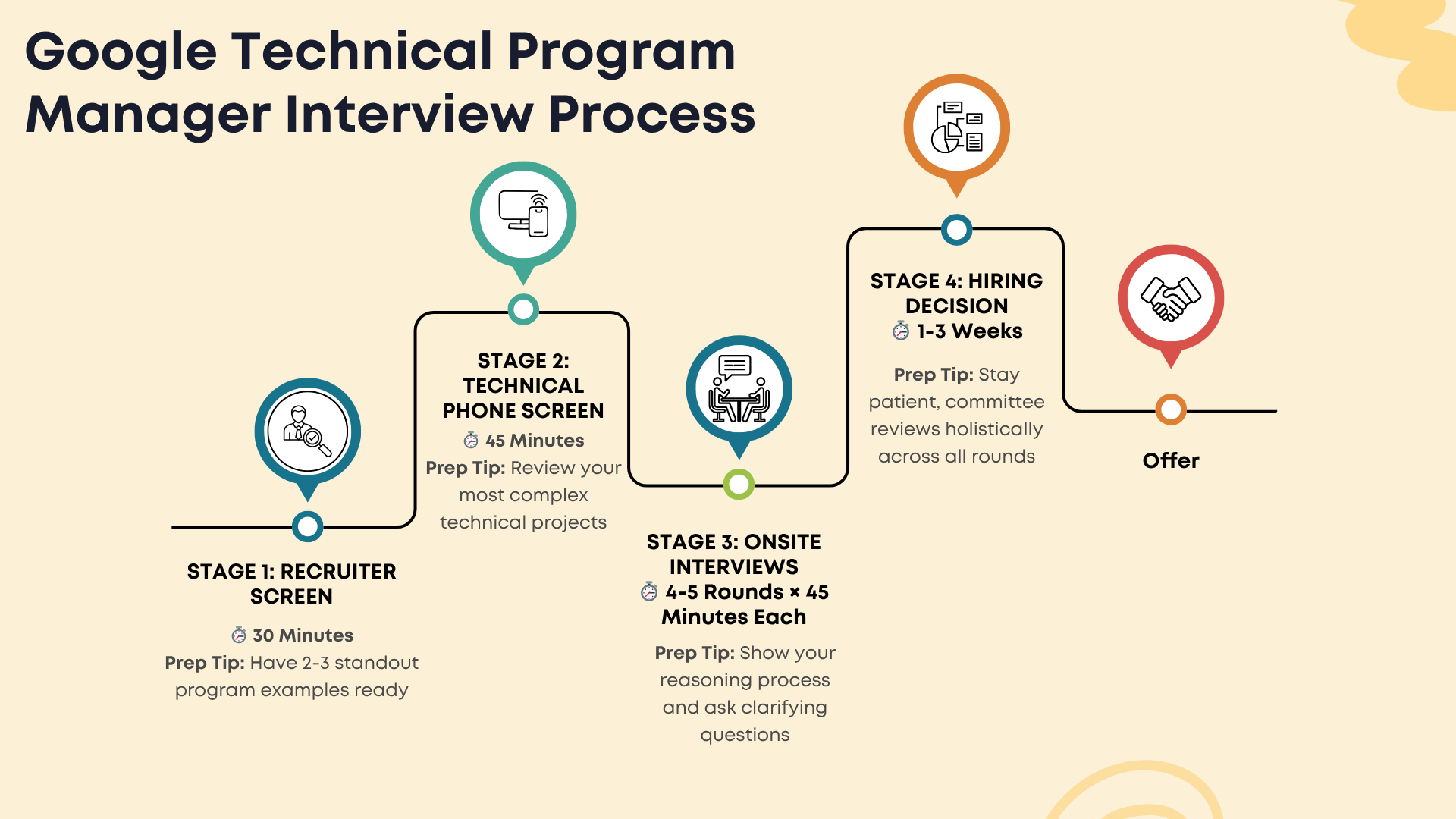
The Google TPM interview spans 4–6 weeks, with multiple stages that evaluate technical depth, program execution, and leadership.
Recruiter Screen (30 minutes)
Initial conversation focuses on background, motivation, and role alignment. Discuss previous programs, technical challenges, and why Google. Prepare 2–3 standout examples with measurable impact.
Technical Phone Screen (45 minutes)
A Google TPM or engineering manager tests your technical thinking and program management. Expect questions about complex programs, cross-team dependencies, and system architecture fundamentals.
Onsite Interview Loop (4–5 rounds, 45 minutes each)
Round 1: System Design & Technical Architecture
Design scalable systems (URL shorteners, notification systems, AI model infrastructure). Cover distributed systems, load balancing, caching, database sharding, and cloud architecture. Discuss technical trade-offs explicitly.
Sample Question: How would you design a system to handle millions of queries per second for a global product?
Round 2: Coding & Technical Fundamentals
Solve algorithm problems or write pseudocode. Expect data structures (arrays, hash tables, trees, graphs), complexity analysis, and scenarios like log analysis or cycle detection.
Sample Question: Write a function to find the most frequently accessed pages from server logs. How would you optimize it for large datasets?
Round 3: Program Execution & Delivery
Explain planning and executing large-scale programs. Cover breaking down ambiguous projects, managing dependencies, handling priority shifts, risk mitigation, and stakeholder alignment with specific measurable outcomes.
Sample Question: Tell me about a time you improved an inefficient process in a large-scale program. What was your approach and what were the results?
Round 4: Program Sense & Strategy
Demonstrate strategic thinking on roadmaps, prioritization, and execution at scale. Discuss recovering delayed programs, managing unclear requirements, and executive communication.
Sample Question: What are your first steps when joining an ongoing program that's behind schedule? How do you assess the situation and get it back on track?
Round 5: Leadership & Googleyness
Showcase leadership style and cultural fit. Topics include influencing without authority, resolving conflicts, championing ideas, learning from failure, and staying current with technology.
Sample Question: Tell me about a time when you had to influence a technical decision without having direct authority over the engineers. How did you approach it?
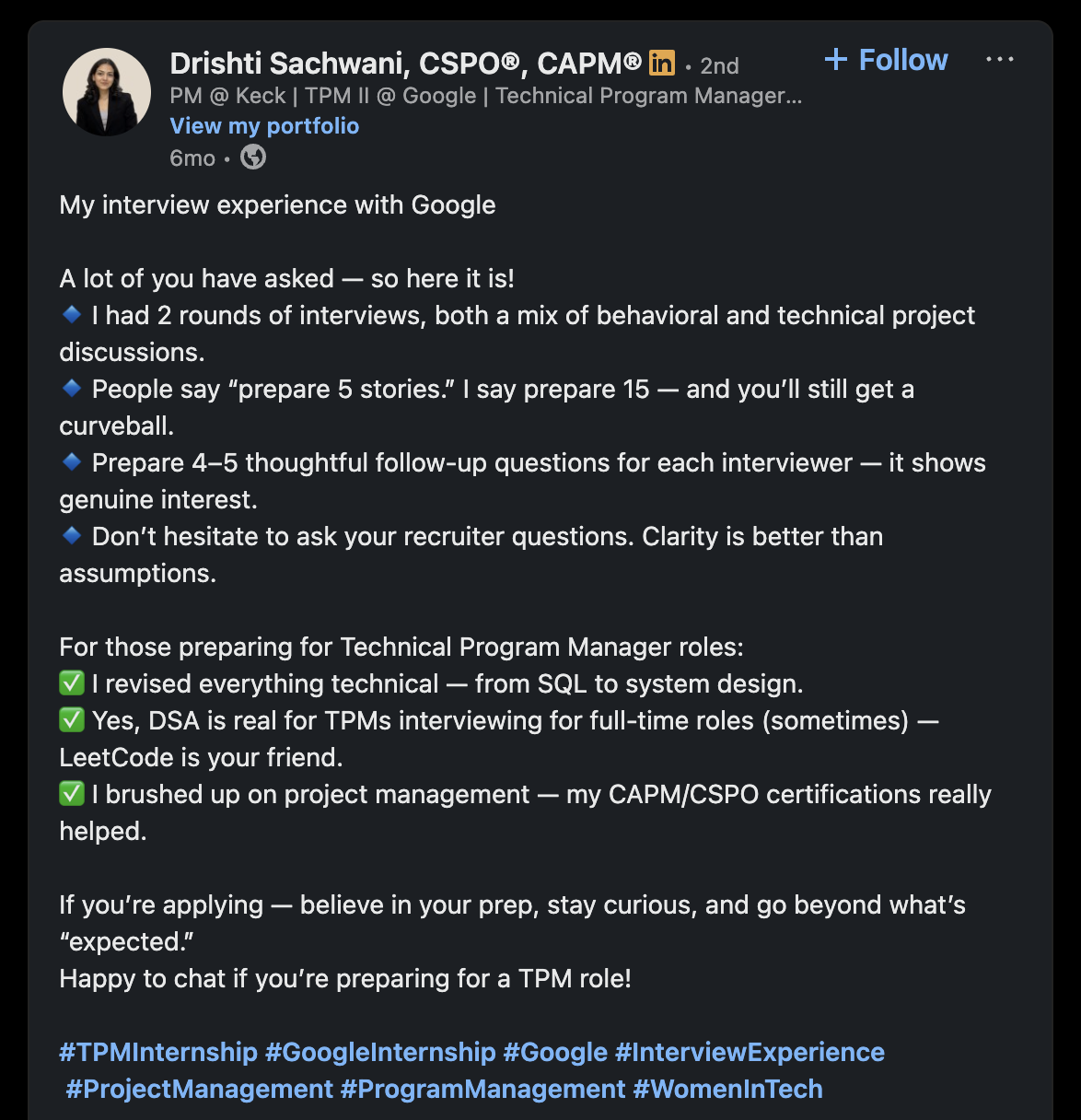
Real Google TPM candidate shares interview preparation insights and experience.
Common Interview Questions
System Design (45–60 minutes each)
- Design a server infrastructure for Gmail (1B+ users, 99.9% uptime).
- Design a global system to upgrade software on 100,000 machines with phased rollout.
- Design a file transfer system moving 100 PB from US East to West Coast.
- Design a multi-region failover system for Search (5B searches/day, 99.99% availability).
- Design Google Docs with real-time collaboration and conflict resolution.
Program Management (10–15 minutes each)
- "Tell me about the most complex design project you've worked on" (scope, timeline, teams).
- "How would you structure and roll out a new service to a market?" (alpha to GA).
- "How would you plan data center migration during Black Friday with heavy loads?"
- "How would you decide on a KPI for a large-scale system and improve it?"
- "If your project is over budget, what steps do you take?"
Leadership & Googleyness (3–5 minutes, STAR format)
- "Tell me about a time you failed" (must show learning and behavior change).
- "Tell me about a time you had to influence without authority" (core TPM skill).
- "Tell me about a time working with a difficult stakeholder."
- "Tell me about a time opposing views ended up having positive results."
- "How do you handle situations where all stakeholders disagree?"
Technical Depth & Fundamentals
- "What's the difference between TCP and UDP?" (reliability vs speed trade-offs).
- "Explain CAP theorem trade-offs" (Consistency vs Availability vs Partition Tolerance).
- "How would you handle a 10x traffic spike?" (auto-scaling, caching, rate limiting).
- "Design SLOs/SLIs and error budgets for this system" (99.9% uptime = 43 min/month downtime).
- "Explain your scalability approach from 1K users to 1B users" (phased architecture evolution).
Product Sense & Strategy
- "How would you launch a machine-learning product?" (alpha/beta/GA with A/B testing).
- "Feature prioritization using RICE framework" (Reach × Impact × Confidence / Effort).
- "What is your favorite app and how would you improve it?" (user pain points + metrics).
- "How would you improve Google Maps ETA calculation?" (predictive ML, real-time events, weather).
- "Working with PMs and engineering leads scenarios" (conflicting priorities, TPM mediation).
Estimation Questions (show methodology, not just numbers)
- "Estimate storage needs for YouTube uploads" (~300 PB/year with multiple resolutions).
- "Calculate bandwidth for 1,000 street view cars" (hardware, operations, infrastructure costs).
- "Estimate number of packages delivered daily in US" (~25M packages/day).
- "How much storage does Gmail use?" (100M users × 10K emails × 50KB average size).
Preparation Strategy
Technical
Study distributed systems (load balancing, caching, sharding), architecture patterns (microservices, serverless), AI/ML infrastructure, and containerization. Refresh data structures, algorithms, and complexity. Review Google's published research papers on infrastructure.
Program Management
Build 8–10 story examples demonstrating large-scale delivery, cross-functional leadership, technical problem-solving, and navigating ambiguity. Use the STAR method (Situation, Task, Action, Result) with quantifiable outcomes.
Practice with AI
Use InterviewBee's Mock AI Interviewer to practice TPM questions with instant feedback.
Cultural Fit
Understand Google's values: innovation, user focus, collaboration, data-driven decisions, technical excellence, responsible AI, and sustainability.
Interview Tips
- Ask clarifying questions before answering.
- Think aloud to show reasoning.
- Discuss trade-offs explicitly.
- Be specific and quantify impact.
- Keep answers to 2–3 minutes.
- Show authenticity and self-awareness.
After the Interview
Interviewers submit detailed feedback to form your candidate packet. A hiring committee of senior TPMs reviews holistically across technical depth, execution, leadership, and culture. Senior leadership provides final approval. Expect 1–3 weeks for decisions.
Success Factors
- Demonstrate technical credibility, earning engineers' respect.
- Show structured thinking, breaking complex problems into manageable pieces.
- Communicate clearly across technical and non-technical audiences.
- Emphasize collaborative partnership over hierarchy.
- Be authentic — Google values genuine cultural fit.
Explore current expectations at Google's official careers page.
Frequently Asked Questions
Frequently Asked Questions
How many rounds are in the Google TPM interview?
The Google TPM interview typically consists of 4-5 rounds after the initial recruiter screen and phone screen. The onsite includes: System Design & Technical Architecture, Coding & Technical Fundamentals, Program Execution & Delivery, Program Sense & Strategy, and Leadership & Googleyness. Each round lasts 45 minutes and tests different competencies required for the TPM role.
Do Google TPMs need to code during interviews?
Yes, Google TPM candidates should expect coding questions. Round 2 focuses on coding fundamentals where you'll solve algorithm problems or write pseudocode. Topics include data structures (arrays, hash tables, trees, graphs), complexity analysis, and optimization. While not as intensive as software engineering interviews, LeetCode practice is essential for TPM interviews.
How long does the Google TPM interview process take?
The complete Google TPM interview process typically takes 4-6 weeks from initial recruiter contact to final decision. This includes the recruiter screen (30 minutes), technical phone screen (45 minutes), onsite interviews (4-5 rounds), and hiring committee review (1-3 weeks). Timeline may vary based on scheduling and committee availability.
What is the most challenging round in the Google TPM interview?
Most candidates find the System Design & Technical Architecture round most challenging. You'll need to design scalable systems handling millions of queries, discuss distributed systems, load balancing, caching strategies, and cloud architecture. Strong preparation in system design fundamentals and practicing real-world scenarios like designing notification systems or AI model infrastructure is crucial.
How should I prepare for Google TPM behavioral interviews?
Prepare 15+ STAR format stories (Situation, Task, Action, Result) covering large-scale program delivery, cross-functional leadership, conflict resolution, and influencing without authority. Focus on quantifiable outcomes and lessons learned. Round 5 (Leadership & Googleyness) evaluates cultural fit, so demonstrate collaboration, adaptability, and Google's values: innovation, technical excellence, and responsible AI development.