


Why 8 Rejections in a Row Doesn't Mean You're Bad at Interviews (And What to Fix Instead)
- Author: InterviewBee Team
- Published On: Jul 21, 2026
- Category:Interview Tips
You check your email before you've even opened your eyes properly. Nothing. You check again at lunch. Still nothing. Then the message arrives — the one that starts with "Thank you for taking the time" — and you already know how it ends before you've read the second sentence.
Eight rejections. Maybe more. And somewhere around rejection four or five, the story you tell yourself stops being "that one didn't work out" and becomes "I'm bad at this." Not bad at that interview. Bad at interviews. Bad, period.
That story is almost never true, and it's also not useful — because it points you at the wrong fix. If you genuinely believe you're just "bad at interviews," the only response is more general anxiety and more generic practice. But rejection after rejection is data, not a verdict, and data can be sorted into categories. Once you know which category you're actually in, you know what to fix.
Rejection Has Three Different Sources — And They Need Different Fixes
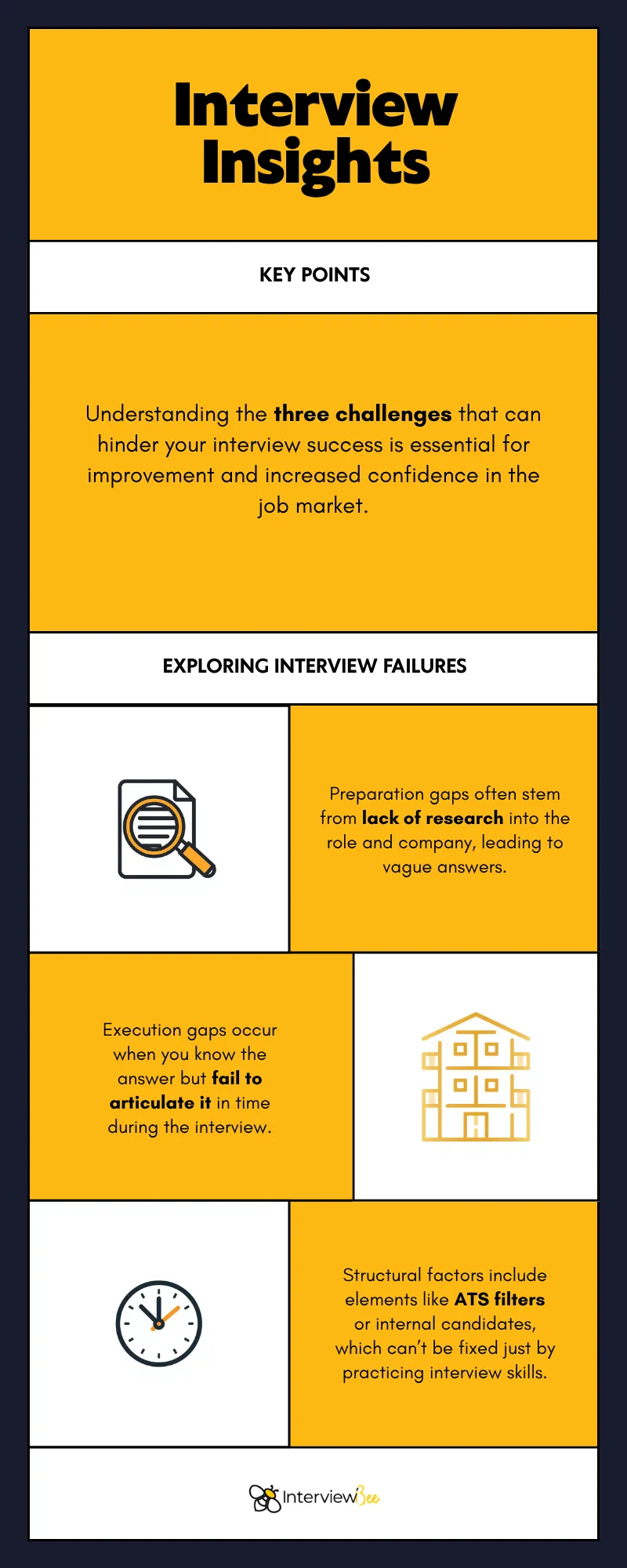
Most job seekers collapse every rejection into one bucket: "I didn't perform well enough." That's sometimes true. But it's worth separating out three distinct failure points, because the fix for each is completely different.
Preparation gaps. You walked in without a clear read on the role, without rehearsed answers to the questions you knew were coming, or without a real point of view on why this company. This shows up as vague, generic answers — technically fine, forgettable.
Execution gaps. You did the prep. You knew your STAR stories. But under live pressure, something didn't land — you rambled, froze on a follow-up, or the delivery didn't match the substance. This is the gap between what you know and what you can produce in the room, in real time, while being watched.
Structural factors. Sometimes the interview isn't the problem at all. An ATS filter, a role that was never really open, an internal candidate already lined up, budget freezes after the req was posted — none of this is about your performance, and no amount of interview practice fixes it.
The mistake most people make is assuming every rejection is an execution gap, because that's the one that feels most personal and most fixable through sheer effort. But if you've had eight rejections and you haven't asked which bucket each one falls into, you're probably solving the wrong problem for at least some of them.
A Quick Way to Sort Your Last Few Rejections
Go back through your last five or six interviews and ask, honestly:
Did you get past the first round consistently, or are you losing people early? Early drop-off across multiple applications at similar seniority often points to structural mismatch — the roles weren't as open as they looked, or your resume isn't clearing initial screens for reasons unrelated to interviewing at all.
Did you feel like you had good answers but they didn't come out that way live? That's an execution gap. You'll often remember the better version of your answer on the drive home. That delay — knowing the right answer five minutes too late — is the single clearest signal of an execution problem, not a knowledge problem.
Did you struggle to answer questions you genuinely hadn't thought through? That's preparation. It's the easiest to fix and the easiest to spot, because it feels like being caught off guard rather than freezing.
Most people in a rejection streak are living with a mix of two — usually a real execution gap wearing a "I'm just bad at interviews" story on top of it.
Fixing the Execution Gap Is Different From Fixing Knowledge
If your honest read is execution — you know the material, but performance under live conditions keeps letting you down — more research and more list-reading won't move the needle. What closes that gap is rehearsal under conditions that resemble the real thing: being asked a question live, having to respond without a script, getting a follow-up you didn't expect, and doing this enough times that your first live attempt at a new question stops being the interview itself.
This is exactly the gap InterviewBee's Mock AI Interviewer is built to close. Instead of reading interview questions and imagining your answer, you practice out loud, get adaptive follow-up questions the way a real interviewer would push you, and get feedback benchmarked against what actually works for your target role — not generic tips. It won't fix a structural mismatch, and it won't write your STAR stories for you. What it does is give you enough real reps that the live version of you starts sounding like the prepared version of you.
If your pattern points more toward preparation gaps, the same tool works differently: role-specific mock sessions surface exactly which questions you don't have a real answer for yet, before a real interviewer does.
The Real Fix Starts With the Right Diagnosis
Eight rejections doesn't mean you're bad at interviews. It means you have eight data points, and most people never actually look at them closely enough to know what they're telling you. Sort them. Some will be structural — let those go. Some will be preparation — those are fast to close. And if a real pattern of execution gaps shows up, that's not a character flaw, it's a rehearsal problem, and rehearsal problems respond to rehearsal.
Practice this with InterviewBee's AI mock interviewer — free to start.