




The Psychology of Interview Questions: How to Make a Good Impression at a Job Interview
- Author: Anshika
- Published On: Feb 22, 2026
- Modified Date: Oct 3, 2026
- Category:Career Advice
A candidate walks out of an interview feeling great. She answered every question. She smiled. She made eye contact. Two days later, she gets the rejection email.
Sound familiar? The problem is rarely the answers themselves. Most candidates answer what was asked, not what was meant. Once you understand the psychology of interview questions, and how interviewers form opinions, the whole game changes.
By the end of this post you will know how to make a good impression at a job interview, how to decode interviewer intent, how interviewer bias psychology shapes decisions (and how to work with it), and how to deliver answers that hit the scoring criteria interviewers use, whether they realise it or not.
The Psychology of Interview: What Is Really Happening in the Room
An interview feels like a conversation, but psychologically it is a rapid judgment task. The interviewer has limited time, incomplete information and usually several candidates to compare. So they rely on mental shortcuts, structured questions and gut feeling at the same time.
That is the core of interview psychology: every question is a probe, every pause is data, and every impression is being filed against a few quiet criteria. Candidates who understand this stop trying to sound impressive and start trying to be clear, relevant and easy to hire.
First Impression in Interview: It Starts Earlier Than You Think
Research on "thin-slice" judgments shows people form impressions of warmth and competence within seconds, often before a word of substance is spoken. In an interview, that first impression in interview settings acts like an anchor: later answers are interpreted through it.
The first impression begins before the interview itself, with your application, your email and your LinkedIn profile, then continues through your greeting, your posture and your opening answer.
How to Make a First Impression in Interview: A Practical Checklist
- Arrive early and settle. On time for in-person; logged in 5 minutes early for video, with camera and audio tested.
- Open with warmth. A genuine smile, a clear greeting and the interviewer's name.
- Use a strong first 60 seconds. Prepare a short "Tell me about yourself" that links your background to this role.
- Match their energy, not their volume. Calm, steady and curious beats loud and rehearsed.
- Look the part for the company. Research the dress code and go one notch above it.
- For video: eye level camera, light in front of you, plain background, notifications off.
Create the Best Impression With an Interview Application
Most candidates forget that the application is the first interview. To create the best impression with an interview application:
- Mirror the job description's language in your resume summary and skills (this also helps ATS filtering).
- Lead each bullet with an outcome and a number, not a duty.
- Use a professional email address and a LinkedIn profile that matches your resume.
- Write a short, specific cover note that explains why this company, not just why a job.
- Proofread twice. Small errors are read as signals of carelessness.
Try the CV-JD Matching Tool to check how well your resume lines up with the role before you apply.
Interviewer Bias Psychology: The Shortcuts Shaping Hiring Decisions
Interviewers are trained to be objective, but they are human. Understanding interviewer bias psychology helps you control what you can and not take the rest personally.
| Bias | What happens | What you can do |
|---|---|---|
| First-impression (primacy) bias | An early positive or negative impression colours everything after | Nail the first 2 minutes: greeting, opening answer, energy |
| Halo effect | One strong trait (e.g. a famous employer on your CV) makes everything look good | Back claims with specific results so the halo is earned |
| Horn effect | One weak moment (e.g. a nervous start) makes everything look worse | Recover calmly; a strong second answer resets the story |
| Similarity bias | Interviewers favour people who seem like them | Build rapport through shared interests and genuine curiosity about the team |
| Confirmation bias | Interviewers look for evidence that supports their early view | Make your best evidence easy to find: lead with the result |
| Contrast effect | You are judged relative to the previous candidate | Be memorable and specific; do not try to guess the competition |
You cannot remove bias from the process, but you can make your strongest signals unmissable. Structured interviews with consistent questions reduce bias, which is one reason companies ask the same questions to every candidate.
Psychological Interview Questions and Answers From the Interviewer's Perspective
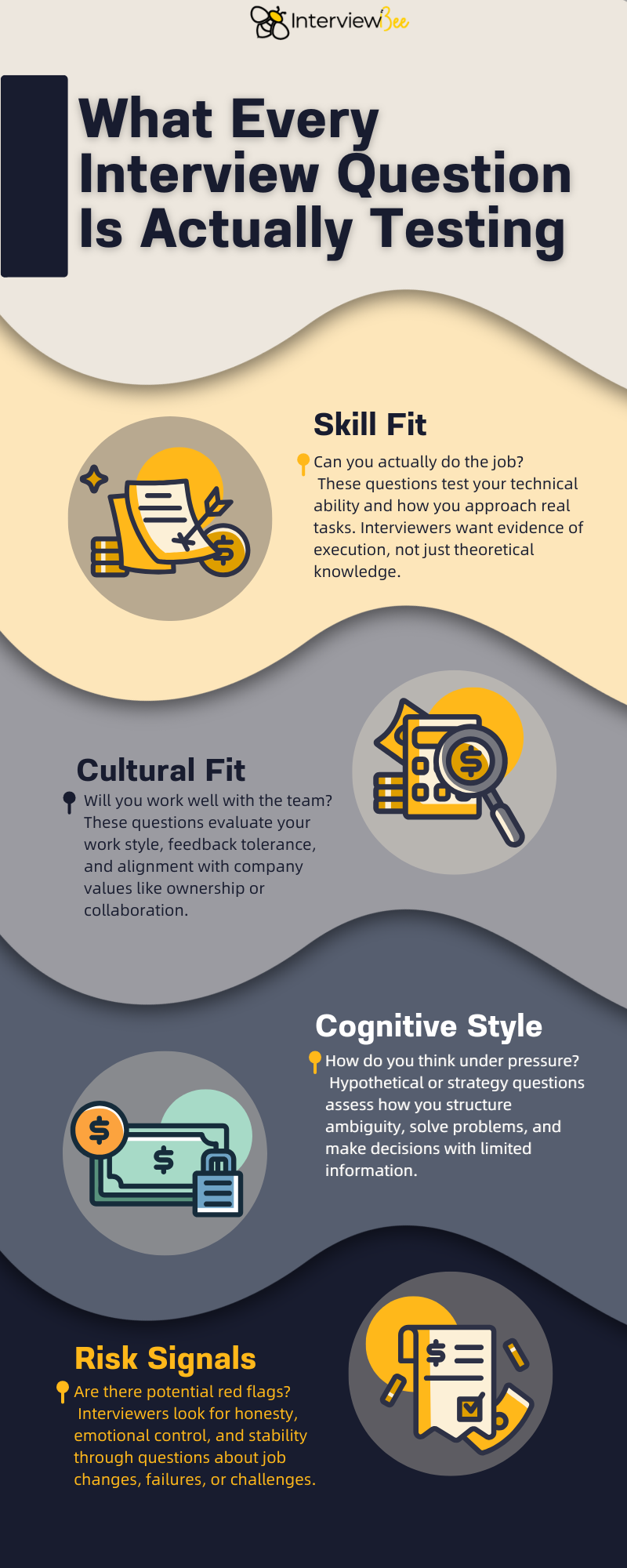
Every question an interviewer asks serves at least one of four purposes. These are the psychological interview questions and answers you should be ready to decode, seen from the interviewer's side.
- Skill fit: Can you actually do the job? Example: "Walk me through how you would manage a project with three competing deadlines." The interviewer is testing technical competence and process thinking. They want evidence, not theory.
- Cultural fit: Will you thrive here? Example: "How do you handle feedback from a manager you disagree with?" The interviewer is checking whether your working style aligns with the team's norms.
- Cognitive style: How do you think? Example: "If you were starting our marketing from scratch, where would you begin?" The interviewer wants to see how you structure ambiguity.
- Risk signals: Are there red flags? Example: "Why did you leave your last role so quickly?" The interviewer is checking for instability or defensiveness.
When you hear a question, ask yourself which of these four intents is driving it. That single habit changes how you answer everything.
Common Psychological Questions Decoded
| Question | What the interviewer is really asking | How to answer |
|---|---|---|
| Tell me about yourself. | Can you communicate clearly and link your story to this role? | 60 to 90 seconds: present, past, why this role |
| Why do you want this job? | Are you motivated, and did you do your research? | Name one specific thing about the company and tie it to your strengths |
| What is your biggest weakness? | Are you self-aware and coachable? | Real weakness + what you are doing about it + current progress |
| How do you handle conflict? | Can you disagree without damaging relationships? | A short STAR story that ends in a resolution |
| Why are you leaving your current job? | Any red flags: negativity, instability? | Stay positive and forward-looking |
| Where do you see yourself in five years? | Will you stay and grow here? | Link your growth to the role's path |
| Tell me about a time you failed. | Do you own mistakes and learn? | Use STARR; see our guide to failure questions |
| Do you have any questions for us? | How curious and prepared are you? | Ask two role-specific questions about success metrics or team challenges |
The Most Common Question Types and What They Really Mean
- Behavioral questions ("Tell me about a time...") force candidates to move from claims to evidence. Interviewers use them because past behavior is a strong predictor of future behavior. Use the STAR framework with a Reflection: Situation (brief context), Task (your responsibility), Action (what you actually did), Result (quantified outcome) and Reflection (what you learned).
Example: "We had a product launch delayed by a vendor. I renegotiated directly with the decision-maker and recovered six days, saving roughly $40K. I learned to escalate faster next time."
- Strengths and weaknesses test self-awareness and emotional intelligence, not modesty or bragging. Weak answers: "I work too hard" or "I care too much about quality." Strong answers: an honest weakness, awareness, action and current state.
- Hypothetical and case questions test how you think, not whether you land on the perfect answer. Use four steps: clarify the goal, state assumptions, walk through your logic and acknowledge trade-offs.
Job Interview Tips: How to Make a Great Impression
These job interview tips on how to make a great impression work because they line up with what interviewers are scoring:
- Research the company, the role and your interviewers before you walk in.
- Prepare 5 to 6 STAR stories that can flex across many questions.
- Listen fully before answering and pause for a second; composure reads as confidence.
- Answer the intent, not only the words, using the four intents above.
- Keep answers for 60 to 90 seconds and stop once you have answered.
- Use specifics: numbers, names of tools, timelines.
- Show enthusiasm for the role in your tone, not only your words.
- Be warm to everyone you meet, including reception and the recruiter.
- Ask thoughtful questions at the end.
- Send a short thank-you note within 24 hours that references something specific from the conversation.
Psychological Traps Candidates Fall Into
Trap 1: Rehearsed answers — Prepare themes, not scripts.
Trap 2: Oversharing — Stop once you've answered the question.
Trap 3: Defensive tone — Pause before answering hard questions.
Trap 4: Ignoring job context — Tailor examples to the role.
Quick Prep Template
10-Minute Daily Prep
- Read one company or industry update
- Bullet one interview answer
- Review one job description
1-Hour Role Study
- Map role requirements to past work
- Identify top five achievements
2-Hour STAR Practice
- Write five STAR stories
- Time each to 90 seconds
Practise out loud with the Mock AI Interviewer to get feedback on clarity, structure and tone.
Frequently Asked Questions
Why do interviewers ask the same questions?
Standardized questions allow fair comparison and reduce bias across candidates.
How long should answers be?
Most answers should be 60-90 seconds. Beyond two minutes risks losing attention.
Is it okay to pause before answering?
Yes. A short pause signals composure and thoughtfulness.
What if I lack direct experience?
Be honest, then bridge to the closest relevant experience you have.
Biggest interview mistake?
Answering what was asked instead of what was meant.
How do I make a good impression at a job interview?
Prepare thoroughly, start warmly, give specific and relevant answers, and show curiosity about the role and team.
How much does first impression matter in an interview?
A lot, because it anchors how the rest of your answers are heard. But a strong, specific middle of the interview can still recover a shaky start.
Can I reduce interviewer bias?
You cannot control it, but clear, evidence-backed answers and genuine rapport make your strongest signals easy to see.