



Why Good Communicators Will Beat Technically Skilled Candidates in the AI Era
- Author: Anshika
- Published On: Apr 20, 2026
- Category:Interview Tips
Why Good Communicators Will Beat Technically Skilled Candidates in the AI Era
LinkedIn's 2024 Future of Work Report ranked communication as the most in-demand skill globally, ahead of machine learning, cloud computing, and data analysis.
That should tell you something about where hiring is heading.
AI can write code, analyse data, and automate workflows. What it cannot do is build trust in a room, explain a complex decision to a non-technical stakeholder, or lead a team through uncertainty. That is still a human job, and companies are starting to hire for it.
Technical Skills Are No Longer a Differentiator
Knowing Python or SQL used to set candidates apart. Today, tools like GitHub Copilot and ChatGPT can produce functional code and debug logic faster than most junior developers. Technical proficiency has become the floor, not the ceiling.
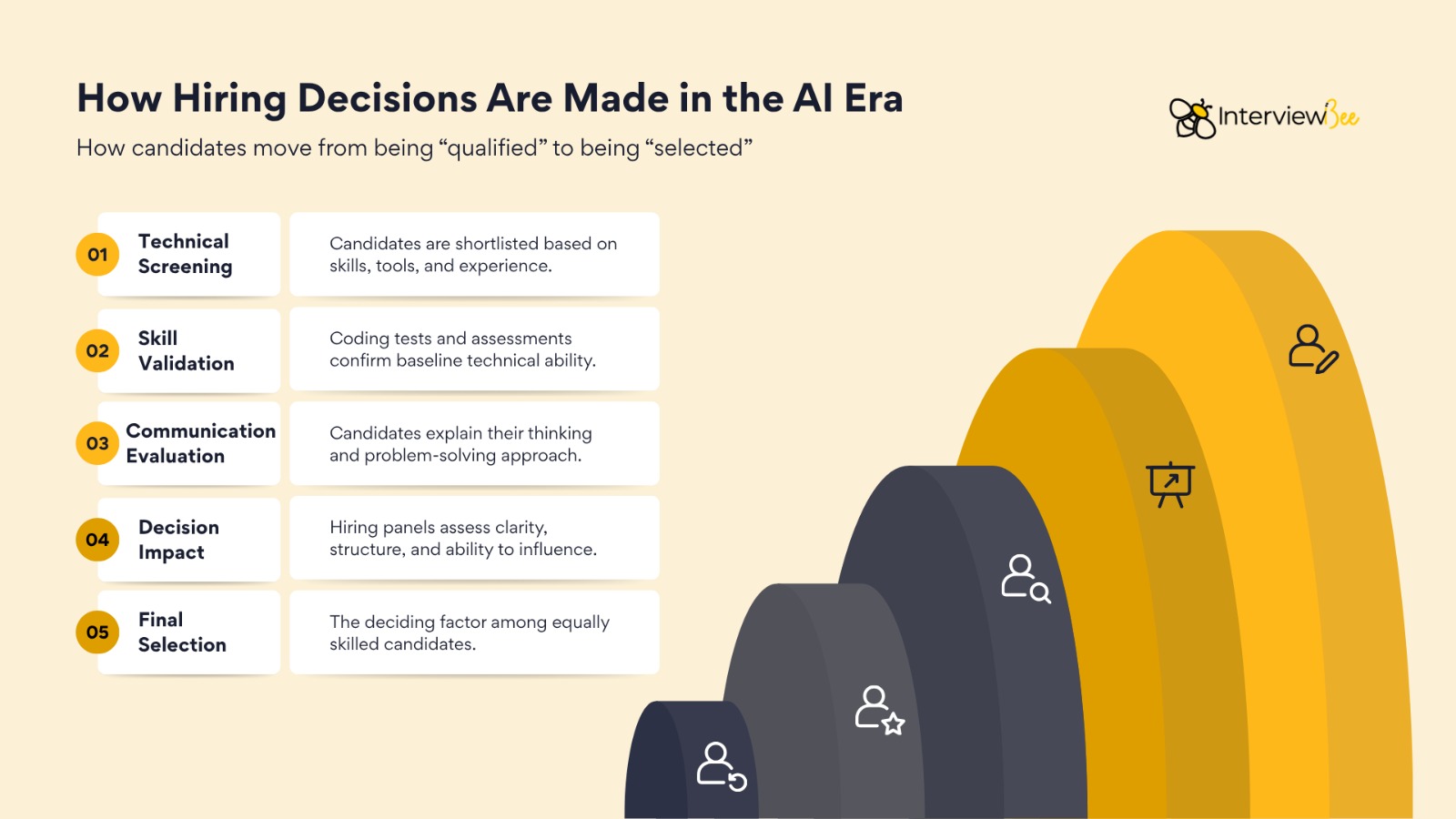
The result? Recruiters are surfacing more qualified candidates than ever through AI-powered screening, but offer rates are falling. The most common feedback from hiring panels: "They had the skills, but couldn't communicate them."
What Recruiters Are Actually Looking For Now
The shift is not away from technical skill. It is toward candidates who can do both: deliver results and articulate their thinking clearly.
Companies like Google, Amazon, and Microsoft have built communication-heavy evaluation into their processes for years. Amazon assesses candidates through narrative responses tied to its Leadership Principles. Microsoft tests how candidates walk through ambiguous problems out loud. These are not soft assessments. They are high-signal filters for long-term performance.
The logic is simple. A developer who cannot explain an architecture decision creates friction at every sprint. An analyst who cannot frame findings as a story produces reports no one acts on. Technical skill creates output. Communication skill creates impact.
The Numbers Back This Up
| Factor | Technical Skills | Communication Skills |
|---|---|---|
| Screening Stage | High weight | Low weight |
| Interview Stage | Moderate weight | Increasingly decisive |
| Offer Decision | Often assumed | Frequently the tipping point |
| Promotion Potential | Moderate predictor | Strong predictor |
| AI Replicability | High and rising | Low, structurally human |
| Interview Type | Traditional | Communication-Focused |
|---|---|---|
| Primary Signal | Resume and credentials | Clarity of thought |
| Format | Skills tests, technical rounds | Behavioural, situational |
| Bias Risk | High, credential-led | Lower, competency-led |
| Predictive Validity | Moderate | Stronger for long-term fit |
How AI Is Exposing the Gap
Interview intelligence platforms now transcribe conversations, measure response coherence, and flag patterns that human interviewers miss, including vague answers, circular reasoning, and inconsistent narratives.
Candidates who relied on strong resumes to carry them are now more exposed than ever in live and async video interviews. The tools are precise, and they surface communication gaps quickly.
This is also raising the bar for candidates preparing for interviews. Structured, intentional practice is no longer a bonus. It is the entry requirement.
What This Means for You
If you are a recruiter or hiring manager:
Build communication into your evaluation from the first interview stage, not as an afterthought at the final round. Define what strong communication looks like for each specific role. A client-facing account manager needs different skills than a backend engineer. Use structured behavioural questions, score them consistently, and use interview intelligence tools to reduce bias.
If you are a candidate:
Technical preparation is necessary but not sufficient. Practice explaining your work to someone outside your field. Build a clear narrative around every project on your resume. Use the STAR framework without sounding formulaic. Treat communication as a trainable skill, because in 2026, it is the one skill AI cannot replace.
The Risk of Ignoring This
Hiring purely on technical credentials builds teams that are capable but disconnected. MIT Sloan research found that communication quality within teams is a stronger predictor of performance than individual IQ or technical skill.
Low-communication environments produce slower decisions, higher conflict, and weaker output across functions. As AI handles more of the execution, the human premium shifts entirely to judgment, synthesis, and the ability to influence others.
The Bottom Line
The future of recruitment is not anti-technical. It is post-technical. Technical skills will be assumed. The real competition will happen at the layer of human capability that no tool can replicate.
Hiring trends in 2026 point clearly toward evaluating communication, adaptability, and collaborative thinking alongside credentials. The companies building for this now will hire better, retain longer, and outperform competitors who are still filtering on skills alone.
For candidates, the question is straightforward. Are you preparing for the hiring process that existed five years ago, or the one being built right now?
Frequently Asked Questions
Q1. Are technical skills becoming irrelevant in hiring?
No. Technical skills are still essential, but they are increasingly treated as a baseline requirement rather than a differentiator. As AI tools handle more of the execution work, recruiters are placing greater weight on communication, judgment, and collaboration to separate candidates who are otherwise technically equal.
Q2. Why are companies prioritizing communication skills over technical skills in 2026?
Because the gap between technically qualified candidates has narrowed significantly. AI-powered screening surfaces dozens of qualified applicants for every role. What separates offer recipients from the rest is their ability to explain their thinking, collaborate across teams, and communicate complex ideas clearly to non-technical stakeholders.
Q3. How can candidates improve their communication skills for interviews?
Start by practicing structured responses using the STAR framework (Situation, Task, Action, Result). Work on explaining your technical projects in plain language. Record yourself answering common interview questions and review for clarity, filler words, and logical flow. Platforms like InterviewBee offer AI mock interviews that give real-time feedback on exactly these areas.
Q4. How should recruiters evaluate communication skills in interviews?
Move away from gut-feel assessments. Build a structured communication rubric into every interview scorecard with specific dimensions such as clarity, conciseness, and problem narration. Use behavioural and situational questions consistently across all candidates. Interview intelligence platforms can help score and compare responses objectively, reducing unconscious bias in the process.
Q5. What is the risk of hiring for technical skills alone?
Teams built purely on technical credentials tend to struggle with cross-functional collaboration, stakeholder communication, and leadership readiness. Research from MIT Sloan shows that communication quality within teams is a stronger predictor of performance than individual technical ability. Over time, low-communication environments produce slower decisions, higher attrition, and weaker business outcomes.