



What Recruiters Notice in the First 30 Seconds
- Author: Anshika
- Published On: Apr 05, 2026
- Category:Interview Tips
What Recruiters Notice in the First 30 Seconds (And You Don't)
Most candidates spend weeks preparing answers — and lose the interview in the first half-minute. Recruiters form strong judgments before you finish your opening sentence. What drives those judgments isn't your resume. It's your delivery, your energy, and how quickly you give them something clear to hold onto. Here's exactly what they're reading — and how to fix it.
What Recruiters Actually Notice in the First 30 Seconds
1. Your Opening Line
Your first sentence sets the tone for everything that follows. It tells the recruiter whether you know who you are in this role, or whether they'll have to piece it together themselves. A sharp, role-specific opener signals preparation. A vague one signals the opposite.
2. Your Energy Level
Low energy reads as low confidence, even if that's not the reality. Recruiters aren't looking for performative enthusiasm, but they are reading whether you seem engaged and present. Flat delivery in the first 30 seconds of an interview is one of the fastest ways to lose the room before you've said anything meaningful.
3. Clarity of Thought
Do you structure as you speak, or do you think out loud while the recruiter waits? Structured speakers, who lead with a point before supporting it, signal competence instantly. Scattered speakers create friction, and that friction starts a quiet doubt that's hard to undo.
4. Body Language
Posture, stillness, and eye contact communicate certainty before words do. Slouching or fidgeting signals anxiety. Steady eye contact signals you're comfortable being looked at, which is most of what confidence looks like from across a desk or a screen.
5. Pace of Speaking
Fast talking is the most common anxiety signal and the one that candidates are least aware of. A controlled pace, even slightly slower than feels natural, reads as composed and authoritative. Speed makes recruiters work harder to follow you. Slowness makes them lean in.
6. Confidence Signals
Filler words (um, like, you know), upward inflection at the end of statements, and unnecessary hedging ("I think I'm pretty good at...") all chip away at credibility. These aren't personality flaws; they're trainable habits. But in the first 30 seconds, they're what the recruiter hears loudest.
Instant Mistakes That Ruin First Impressions
Starting with "umm…" or "so…"
Signals you haven't prepared your entry point. The recruiter's confidence drops before your content even starts.
Rambling instead of answering
Circling a point instead of leading with it makes the recruiter work. They shouldn't have to extract your answer from your stream of consciousness.
Sounding memorised
A robotic delivery tells the recruiter you rehearsed lines, not understanding. The moment something unexpected happens, you'll visibly break, which is worse than not rehearsing at all.
Avoiding eye contact
On video calls, especially, looking away constantly reads as disengagement or insecurity. You don't need to stare; you need to be present.
Speaking too fast
High-pressure situations often trigger faster speech as an anxiety response. Recruiters know this. Fast talking doesn't just signal nerves; it makes your content harder to follow, compounding the problem.
Strong vs Weak First 30 Seconds
Weak Version:
"Yeah, so, um, I've been in marketing for a few years — well, kind of, I did an internship and then a full-time role —, and I've worked on a few different things like social media and some content stuff, and I'm really passionate about brand storytelling..."
Strong Version:
"I'm a marketing professional with three years focused on content strategy and brand growth. Most recently, I led a campaign that grew organic reach by 40% in one quarter. I'm here because I want to bring that kind of thinking to a product-led brand."
The weak version makes the recruiter do the work — extracting a timeline, guessing the role, inferring the value. The strong version gives them a picture, a result, and a reason, in under 25 seconds.
How to Fix Your First 30 Seconds
1. Prepare your opening answer
Write down a one-paragraph response to "Tell me about yourself," specifically for each role you're applying to. Not your whole career, just who you are in this context, with one concrete result.
2. Practice out loud
Reading your answer silently does nothing for delivery. Speaking it aloud is where pace, structure, and tone actually get trained. Aim for under 45 seconds.
3. Record yourself
Most people have no idea what they sound like. Recording a practice run reveals pace issues, filler words, and tone problems that you simply cannot hear in real time.
4. Improve clarity, not complexity
The goal isn't to sound more impressive, it's to be easier to follow. Every time you're tempted to add more detail, ask whether it helps the recruiter or just makes you feel safer.
5. Simulate real interviews
Practicing in low-pressure environments doesn't prepare you for high-pressure ones. You need to rehearse under conditions that approximate the real thing — timed, structured, and slightly uncomfortable.
Where Most Candidates Go Wrong
They prepare answers, not delivery.
Content without delivery is just information. What gets you hired is how that information lands, and that's entirely about how you say it.
They focus on complexity, not clarity.
Trying to sound sophisticated often produces the opposite effect. Recruiters value candidates who make their job easy, not ones who make them decode every sentence.
They don't practice under pressure.
Interview performance improves significantly with simulated practice, not because candidates learn new content, but because they build tolerance for the discomfort of being evaluated in real time.
Practice: The Only Thing That Actually Changes Delivery
Reading about first impressions won't change yours. Repetition under realistic conditions will. The difference between a candidate who freezes and one who flows is almost always the number of times they've sat in that uncomfortable moment and had to start speaking anyway.
Start with role-specific practice interview questions — organised by company, industry, and difficulty — so your reps are targeted, not random. Then take it further with an AI mock interview that puts you in the seat, gives you real-time feedback, and builds the one thing no amount of notes can build: familiarity with pressure.
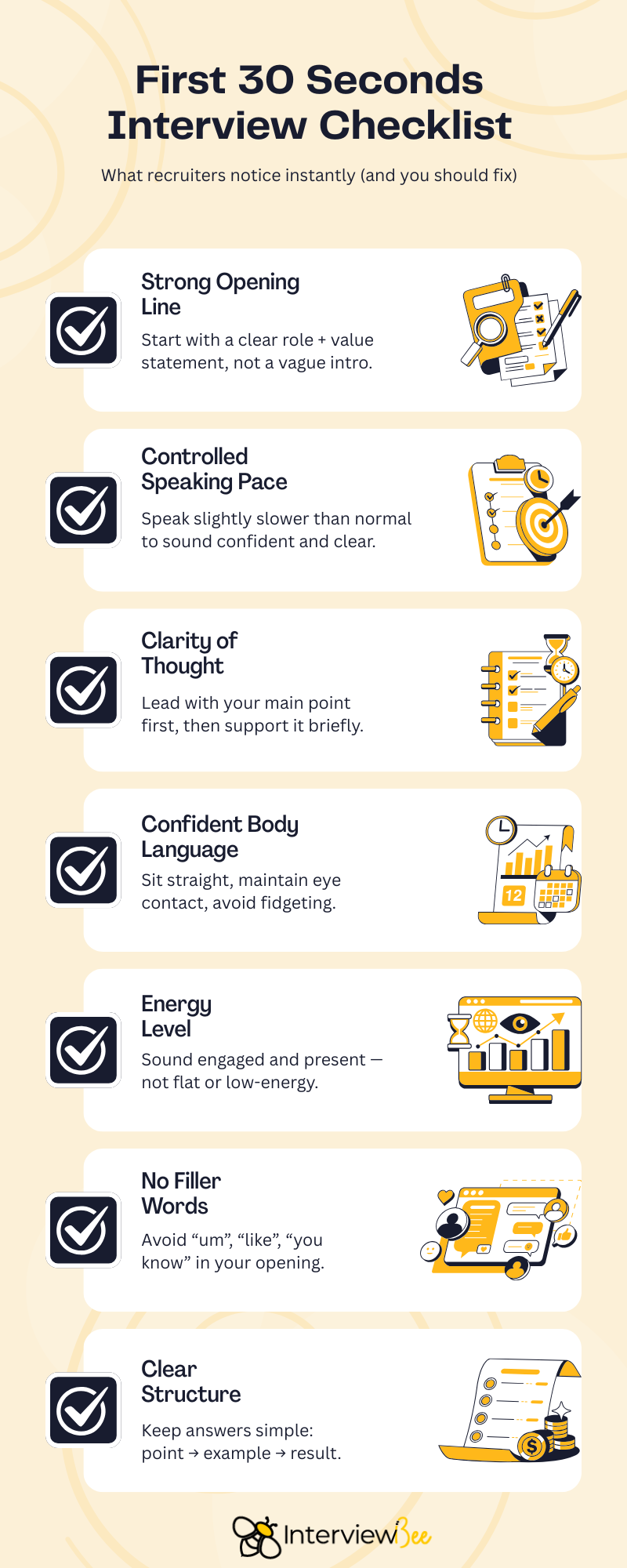
Quick Checklist: Before Every Interview
• Strong, role-specific first line ready and rehearsed
• Pace deliberately slower than feels comfortable
• Eye contact — consistent, not intense
• Clear structure: point first, then support
• No filler words in the opening 30 seconds
• Energy level: engaged, not flat
• Recording reviewed at least once
Conclusion
The first 30 seconds of an interview aren't a warm-up. They're the moment the recruiter starts deciding. Most candidates treat them as the beginning. Recruiters treat them as data.
The good news is that first impressions are not fixed; they're the result of specific, trainable behaviours. Identify what's working against you. Practise until it isn't. Then walk in knowing the hardest part is already handled.