


UK vs US Interviews: Why "Tell Me About a Time" Lands Differently Across the Pond
- Author: InterviewBee Team
- Published On: Aug 07, 2026
- Category:Interview Tips
You rehearsed the story. Clean structure, confident delivery, a strong close. You've answered "tell me about a time you dealt with a difficult teammate" a dozen times in practice. Then you walk out of the real interview certain it went well — and the rejection email shows up two days later anyway.
Nobody tells you the question can be identical on paper and scored on two completely different rubrics depending on which side of the Atlantic you're sitting on. If you're applying to UK roles after prepping the American way, or interviewing with a US-headquartered company after prepping the British way, the format tricks you into thinking you're ready when you're actually answering the wrong test.
The Same Question, Two Different Tests
"Tell me about a time when..." sounds like one universal interview format. It isn't scored the same way in both markets.
- UK interviews are competency-scored against a written framework. The interviewer usually has a rubric in front of them — specific competencies like "problem solving" or "stakeholder management" — and your answer gets marked against defined evidence criteria, often on a numeric scale. This is why UK interview prep leans so heavily on the STAR method: Situation, Task, Action, Result isn't just a storytelling device here, it's how you supply the exact evidence the scorer needs to tick a box.
- US interviews are more conversational and relationship-led. The same behavioural question is often being used to gauge chemistry and team fit as much as competency. A slightly looser, more enthusiastic answer that wanders a bit before landing the point can still score well if it builds rapport — something that would cost you marks against a strict UK competency framework.
Same words, different job. A UK interviewer taking notes against a rubric is not impressed by charm. A US interviewer building a "would I want to work with this person" read is not impressed by a rigid, checklist-sounding answer.
What Actually Changes in the Room
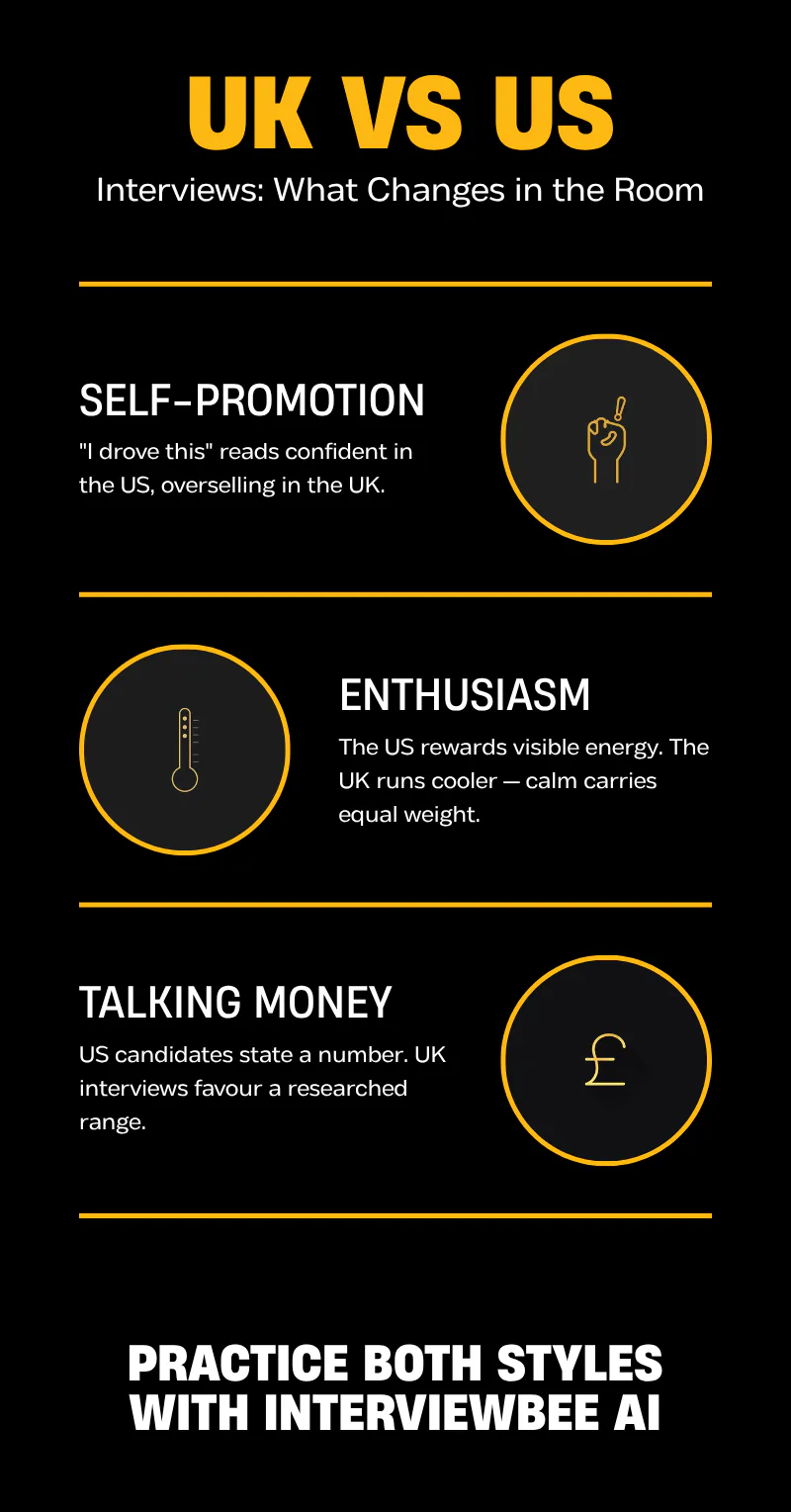
Three things shift the most, and they're the ones candidates get caught out by:
- Self-promotion. Leading with individual achievement — "I drove this," "I delivered that" — reads as confident and expected in a US interview. In a UK interview, especially with a more reserved interviewer, the same framing can land as overselling. UK candidates are often coached toward acknowledging the team even when describing their own contribution, without losing the specific "what I did" detail a competency rubric needs.
- Enthusiasm and tone. American interview culture rewards visible energy — "great," "excited," animated delivery. UK interview culture runs cooler by default; a calm, measured "that went well, and here's the evidence" can carry just as much weight as an enthusiastic pitch, and over-the-top energy can occasionally read as insincere.
- How you talk about money. If a salary question comes up, US candidates are generally more comfortable stating a number directly. UK interviews tend to favour a research-backed range framed as evidence — "based on roles at this level in London, I'd expect somewhere between X and Y" — rather than a flat demand.
None of these are about being less qualified. They're about which signals the person across the table has been trained to score.
Why This Trips Up Recent Grads Specifically
If you're early in your career, you've probably only ever practiced one version of the "tell me about a time" question — whatever your university careers service, a US-based YouTube channel, or a generic interview guide taught you. That's fine if every interview you sit is in the same market. It stops being fine the moment you apply to a UK-headquartered company while every practice rep you've done was tuned for an American panel, or the reverse.
It gets messier still with hybrid panels, which are increasingly common as more companies hire across both markets. You might face a UK-based hiring manager running a strict competency scorecard alongside a US-based team lead who's really just trying to get a read on whether they'd enjoy working with you day to day. Answer purely to one style and you risk under-scoring with the other person in the room — which is part of why generic "just be yourself" advice doesn't hold up once you're actually being evaluated against two different sets of expectations at once.
The fix isn't learning two completely different personalities. It's knowing which evidence to lead with and which tone to dial up or down depending on who's asking — and being able to switch that framing on the fly when a panel is mixed.
Practising for the Market You're Actually Interviewing In
This is exactly the kind of shift that's hard to catch by reading advice — you don't notice your framing is off until someone (or something) actually questions you on it. InterviewBee's Mock AI Interviewer runs adaptive, role-specific practice sessions with follow-up questions that probe your answer the way a real interviewer would, so you get instant feedback on whether your evidence, structure, and tone are actually landing — not just whether you covered the topic.
Practice the UK competency format until STAR structure is automatic. Practice the US conversational format until you're not over-tightening a story that's supposed to breathe a little. Either way, you find out before the real interview, not after the rejection email.
Practice this with InterviewBee's AI mock interviewer — free to start. Start practicing
Frequently Asked Questions
Are UK and US behavioural interviews scored the same way?
No. UK interviews are more likely to score evidence against a written competency framework, while US interviews often assess rapport, communication style, and team fit alongside the candidate's evidence.
How should I use the STAR method in UK and US interviews?
In a UK interview, make each STAR element explicit so the interviewer can map your evidence to the competency rubric. In a US interview, keep the same evidence but deliver it more conversationally so the answer does not sound like a checklist.
How should candidates discuss individual achievements in UK versus US interviews?
US interviewers generally expect direct ownership statements such as "I drove this." In UK interviews, state your individual contribution clearly while also acknowledging the team's role so confidence does not become overselling.
How can I prepare for an interview panel with both UK and US interviewers?
Lead with structured, specific evidence that satisfies a competency scorecard, then adapt your tone and level of enthusiasm to the conversation. Practising both styles makes it easier to switch without changing the substance of your answer.