


Microsoft Interview Process 2026: How Azure and Consumer Teams Score STAR Answers Differently
- Author: InterviewBee Team
- Published On: Jul 07, 2026
- Category:Company Interviews
You prepped the same way everyone tells you to: memorize a few STAR stories, rehearse "growth mindset" language, walk in ready to talk about a time you learned from failure. Then the interviewer - an Azure infrastructure lead - asks you to walk through how a decision you made would hold up at 10x scale. Your story about "learning from feedback on a team project" doesn't land. Not because it was a bad story. Because it was answering the wrong question.
Microsoft treats "growth mindset" as a company-wide value, but it does not get evaluated the same way in every room. A hiring manager on an Azure or cloud infrastructure team and a hiring manager on a consumer product team (Office, Xbox, Windows Experience) are listening for different signals inside the same behavioral framework. Most prep guides treat "Microsoft interview questions" as one undifferentiated list. That's the gap.
Why the Same Value Gets Scored Two Different Ways
Microsoft's cultural pitch - famously reshaped under Satya Nadella around "growth mindset" - asks candidates to show curiosity, resilience, and collaboration. That part is consistent everywhere in the company. What differs is which part of the story a given interviewer is trained to weight.
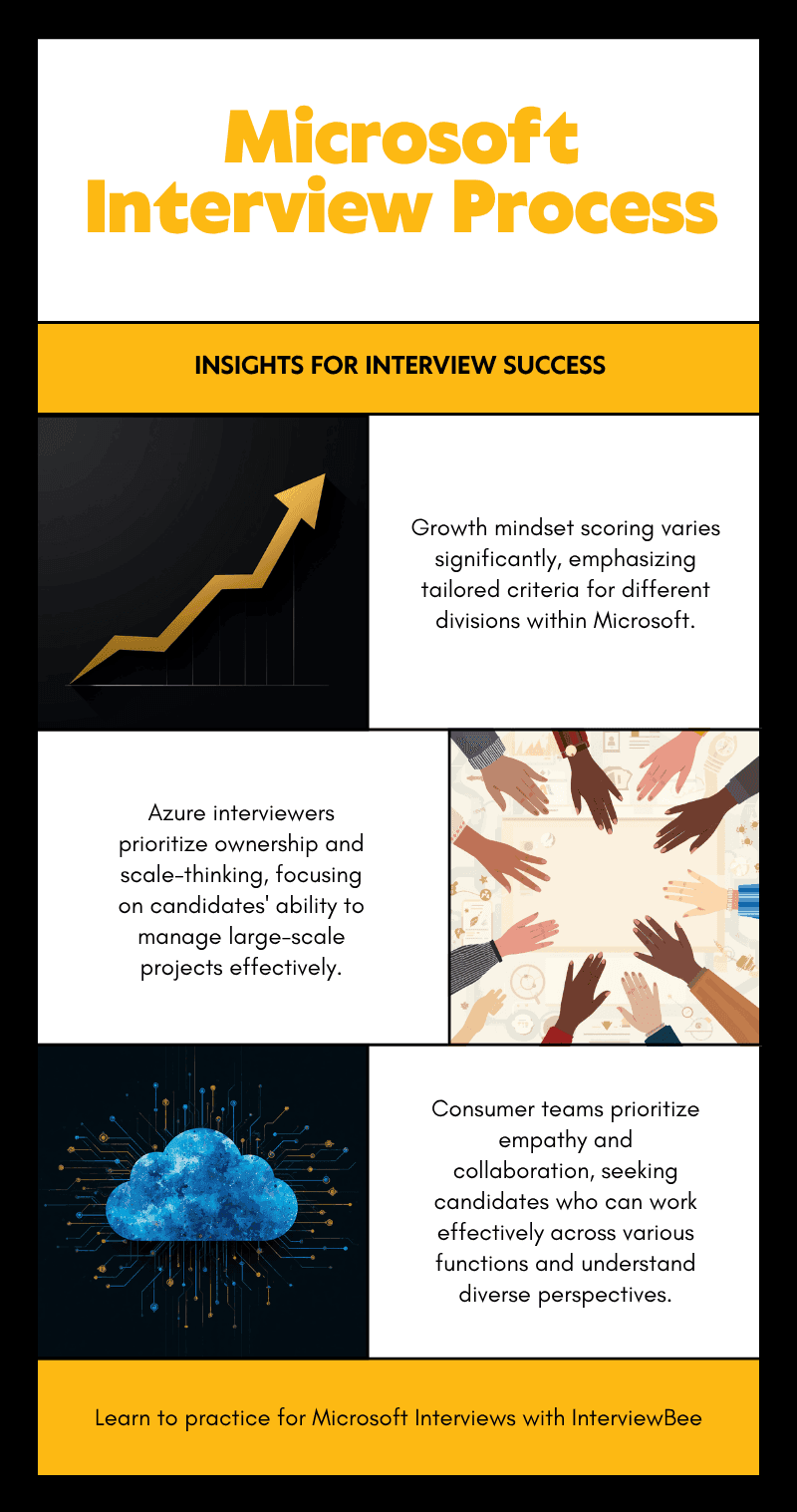
Teams building and operating cloud infrastructure at scale are graded, day to day, on decisions that are hard to reverse once traffic hits them: capacity planning, reliability tradeoffs, technical ownership when something breaks at 2 a.m. Interviewers from these teams tend to probe your STAR answers for ownership and scale-thinking - did you understand the blast radius of your decision, did you own the outcome even when it wasn't fully your call, would your approach survive being used by a team ten times your size.
Consumer-facing product teams operate under a different set of daily pressures: shipping features real people will react to immediately, reconciling design, engineering, and marketing input, and translating ambiguous user feedback into next steps. Interviewers here listen for empathy and cross-functional collaboration - how you incorporated a perspective you initially disagreed with, how you handled a stakeholder conflict, whether you can explain a technical tradeoff to someone non-technical.
Same competency. Same "tell me about a time." Different scoring lens.
Reading the Room Before the Interview
You don't have to guess blind. The clues are usually available before you ever get a calendar invite:
Check the job description's verbs. "Own," "scale," "reliability," "operate" point toward the ownership/scale-thinking lens. "Partner," "collaborate," "user-facing," "cross-functional" point toward the empathy/collaboration lens.
Look at who's in the room. If your interview loop includes a principal engineer from an infra or platform team, expect scale-thinking probes even in a "culture fit" round. If it includes a PM or someone from design, expect the story to get pulled toward stakeholder handling.
Match your story's ending, not just its plot. The same project - say, fixing a broken deployment pipeline - can end two ways depending on what you emphasize: "I made the call to roll back and rebuilt with rollback safeguards" (ownership/scale) versus "I looped in the on-call PM immediately and we agreed on a customer-communication plan together" (collaboration). Same event. Different close.
Prepare a Story Bank, Not a Script
The candidates who struggle most in Microsoft loops aren't underprepared - they're prepared for one version of the story and get asked a follow-up that assumes the other. The fix isn't more stories. It's flexible endings on the stories you already have.
For each of your 4-5 core behavioral stories, write two possible closing beats before the interview: one that foregrounds ownership and technical judgment, one that foregrounds partnership and communication. Decide in the room, based on who's asking and what they've emphasized, which ending to use.
This is exactly the kind of adjustment that's hard to practice alone, because you don't get real-time feedback on which version of your story just landed. Practicing out loud, with a mock interviewer that pushes back and asks the natural follow-up, is what surfaces the gap between "technically a good story" and "the story this specific interviewer needed to hear."
InterviewBee's AI mock interviewer runs role-specific and company-specific interview simulations, including Microsoft-style behavioral loops, so you can practice the same story two ways and hear which version actually holds up under a follow-up question before it's the real interview asking it.
Frequently Asked Questions
Is the Microsoft interview process the same for every team?
No. Microsoft uses company-wide values such as growth mindset, but Azure and cloud infrastructure teams may probe ownership and scale-thinking more heavily, while consumer product teams may listen more closely for empathy and cross-functional collaboration.
How should I adapt STAR answers for Azure or infrastructure interviews?
Emphasize ownership, reliability tradeoffs, blast radius, technical judgment, and how your decision would hold up at larger scale. The same story can work, but the ending should foreground operational accountability and durable outcomes.
How should I adapt STAR answers for Microsoft consumer product teams?
Emphasize empathy, stakeholder handling, collaboration, user-facing tradeoffs, and how you incorporated perspectives from product, design, engineering, or customers into your decision.
How can I tell which scoring lens an interviewer may use?
Read the job description verbs and the interview loop. Words like own, scale, reliability, and operate point toward an ownership lens, while partner, collaborate, user-facing, and cross-functional point toward a collaboration lens.
Should I memorize separate stories for each Microsoft team?
No. Build a small story bank with flexible closing beats. For each core story, prepare one ending that highlights ownership and technical judgment and another that highlights partnership and communication.