



Startup vs MNC Interview Differences: What to Expect
- Author: Anshika
- Published On: Mar 14, 2026
- Category:Career Advice
Startup vs MNC Interview Differences: What Candidates Should Expect
If you're actively job hunting, you've probably noticed that interviews don't follow a universal script. Applying to a 30-person fintech startup feels nothing like going through rounds at a global consulting firm — and that gap goes well beyond company size.
Understanding startup vs MNC interview differences before you walk into either process can be the thing that separates a confident performance from a surprised one.
Whether you're a fresh graduate weighing your first role or a professional switching sectors, this guide breaks down what each type of company is actually evaluating, how their processes work, and how to prepare smartly for both.
Startup vs MNC Interview Differences: A Side-by-Side Comparison
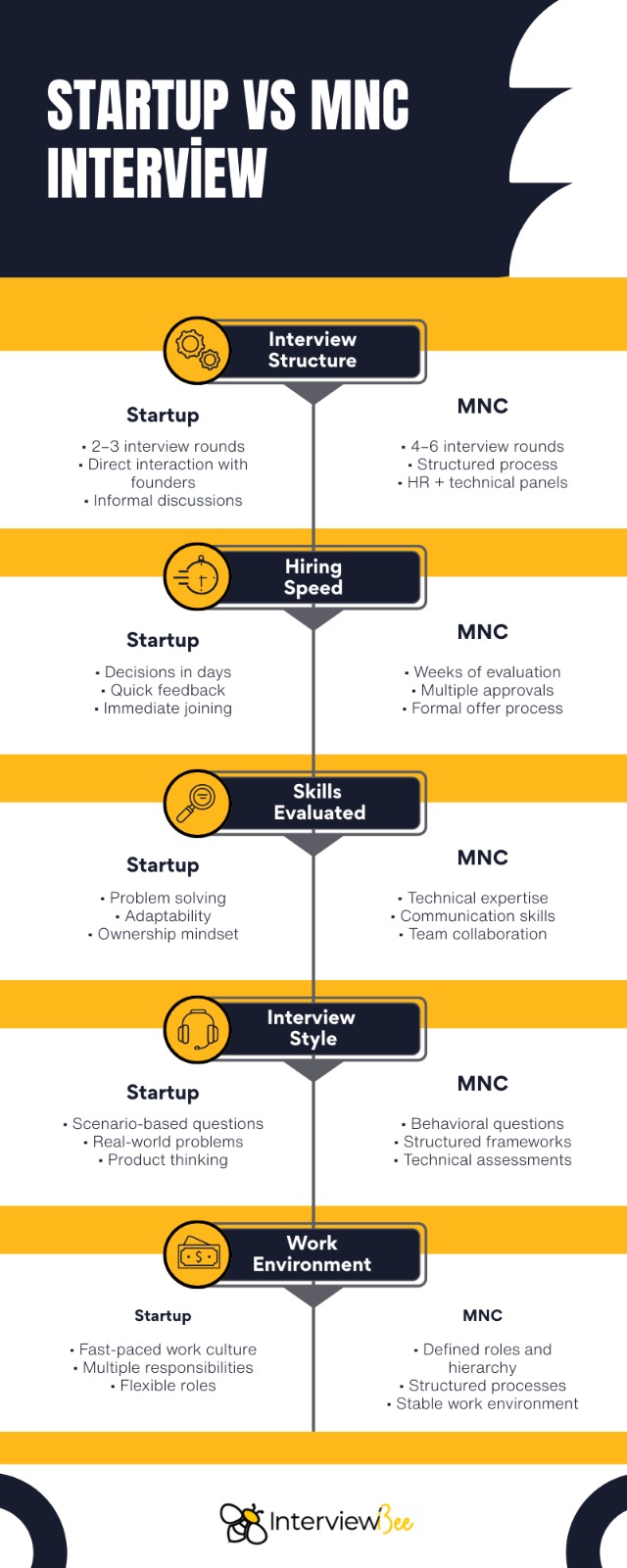
Before diving into the details, here's a quick overview of how the two interview environments typically compare.
| Factor | Startup | MNC (Multinational Company) |
|---|---|---|
| Number of rounds | 2–4 (often fewer) | 4–8+ structured rounds |
| Decision speed | Days to 1–2 weeks | Weeks to months |
| Who interviews you | Founders, team leads, direct peers | HR, panel interviews, department heads |
| Primary focus | Skills, initiative, cultural fit | Process fit, competency frameworks |
| Technical depth | Broad and hands-on | Structured and role-specific |
| Assessment style | Take-home tasks, live problem solving | Psychometric tests, case studies |
| Flexibility | High — roles evolve | Low — structured job descriptions |
| Interview tone | Conversational | Formal and structured |
The Typical Startup Interview Process
Startups move quickly, and their hiring reflects that. Most startup interview processes run between two and four rounds, often completed within a single week.
What the process usually looks like:
Initial screen: A short call with a founder or hiring manager focused on whether you understand the problem the company is solving.
Practical task: A real-world assignment such as a coding challenge, marketing brief, or product idea.
Culture interview: Often informal — assessing whether you thrive in ambiguity and contribute beyond your role.
Final conversation: Usually with founders or senior team members to align on expectations.
Speed is intentional. Startups cannot afford long hiring pipelines, so strong candidates usually receive decisions quickly.
What startups are really evaluating
Beyond technical ability, startups look for initiative, adaptability, and the ability to solve problems without a playbook.
The Typical MNC Interview Process
The MNC interview process is far more structured. Large organizations use consistent systems to evaluate candidates across departments and geographies.
Typical stages include:
HR screening call: Eligibility check, salary expectations, and basic questions.
Online assessments: Psychometric, numerical, or situational judgement tests.
First-round interview: Competency-based questions with HR or recruiters.
Technical or panel interview: Role-specific evaluation with multiple interviewers.
Case study or presentation: Common for consulting, strategy, and finance roles.
Final leadership interview: Often focused on long-term potential and culture fit.
Hiring timelines are longer — often several weeks — because multiple teams must approve the decision.
What MNCs are really evaluating
MNCs rely heavily on competency frameworks. Candidates are expected to provide structured examples showing how they handled real work situations.
The STAR method (Situation, Task, Action, Result) is the most common response structure used in behavioral interviews.
Startup Interview Questions vs MNC Interview Questions
Typical startup interview questions
• Tell me about a time you had to figure something out from scratch.
• What would you do in your first 30 days here?
• How would you grow our user base in Southeast Asia?
• Tell me about a disagreement you had with a manager.
• What's a project you're proud of and why?
These questions are open-ended and designed to observe your thinking process.
Typical MNC interview questions
• Describe a situation where you handled conflicting priorities.
• Give an example of when you demonstrated leadership.
• How do you handle disagreements with stakeholders?
• Walk me through a complex problem you solved.
• Where do you see yourself in five years?
These questions are structured and expect clear examples backed by evidence.
How to Prepare for Both Types of Interviews
For startup interviews
• Research the product, competitors, and business model.
• Be ready to discuss real work you've done and measurable outcomes.
• Practice thinking aloud while solving problems.
• Show curiosity about the company’s stage and goals.
For MNC interviews
• Practice the STAR method for behavioral questions.
• Map your experience to the job description competencies.
• Prepare for aptitude and reasoning tests.
• Research the company’s strategy, values, and global operations.
Practice makes the real difference
Structured practice through mock interviews can significantly improve performance. Simulating real interview conditions helps candidates refine their answers and identify weaknesses before the actual interview.
Conclusion
Understanding the startup vs MNC interview differences gives candidates a real advantage. These environments test different qualities, move at different speeds, and reward different preparation styles.
The candidates who succeed are the ones who understand what each company is actually evaluating and prepare accordingly.
Whether you prefer the fast-paced environment of startups or the structured growth of multinational companies, preparation aligned with the company's expectations will always improve your chances.
Frequently Asked Questions
Q1: What is the biggest difference between a startup and MNC interview?
The biggest difference is structure. MNC interviews follow formal processes with competency-based questions, while startup interviews are more conversational and problem-focused.
Q2: How many interview rounds should I expect at an MNC?
Most multinational companies conduct four to eight interview rounds including HR screening, assessments, and leadership interviews.
Q3: Do startups care about qualifications as much as MNCs?
Startups usually prioritise skills and results over formal credentials, while MNCs often include academic requirements in their hiring criteria.
Q4: What type of questions are asked in startup interviews?
Startup interviews often include open-ended questions about problem solving, strategy, and how you handle ambiguity.
Q5: How can I prepare for both startup and MNC interviews?
Build strong structured examples using the STAR method and practice solving open-ended problems. Mock interviews tailored to different company types can also help build confidence.