




How to Answer the Revenue Forecasting Question in Sales Director Interviews
- Author: Anindita Ghosh
- Published On: Jun 22, 2025
- Modified Date: Oct 2, 2026
- Category:Sales
The brutal truth about modern sales director interview questions: Most candidates never make it past the first round when asked to build a revenue forecast. The candidates failing aren't inexperienced reps, they're proven performers with millions of track records who've spent entire careers closing deals without developing forecasting expertise.
The Question That Exposes Everything
It sounds deceptively simple: "Walk me through how you'd forecast Q3 revenue for our Northeast territory, given we're launching two new products and expanding into healthcare verticals."
Yet this single sales director interview question has derailed more $200K+ careers than any other. Why? Because it reveals whether you're a strategic revenue architect or just a high-performing individual contributor wearing a director's title.
Where Most Sales Directors Go Wrong
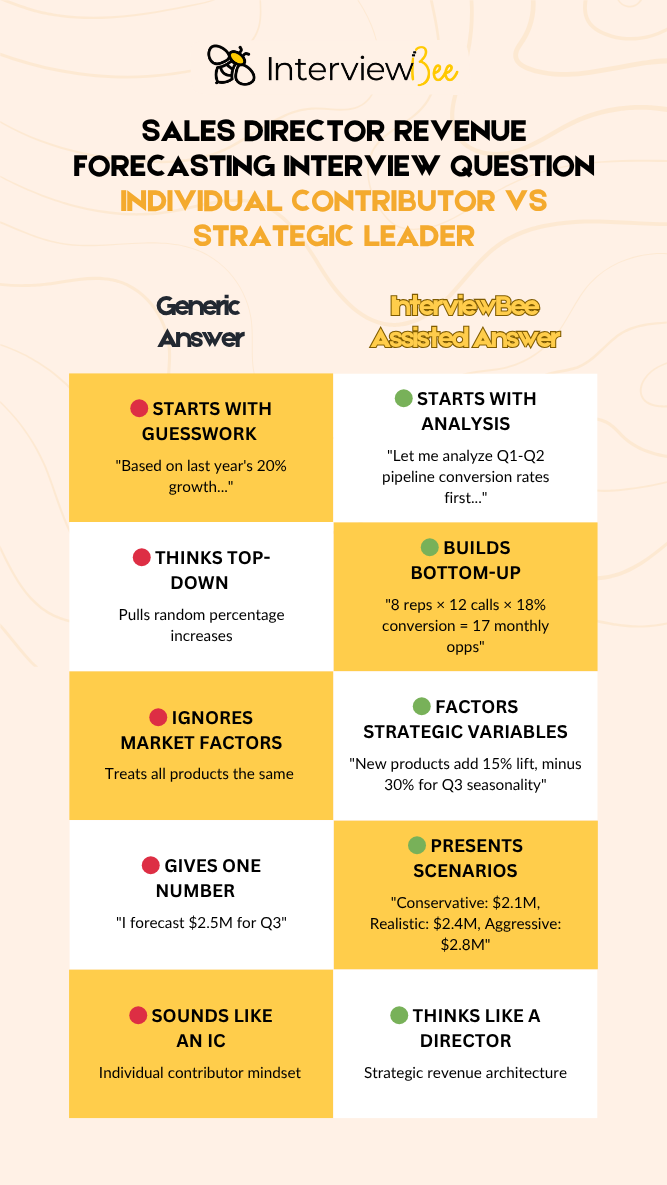
- Top-Down Guessing: Most candidates immediately jump to round numbers: "Based on last year's growth, I'd estimate 25% increase..." This approach screams individual contributor thinking, not strategic leadership.
- Missing Pipeline Reality: They fail to connect forecasting to actual sales activities. Budget and forecast interview questions require understanding conversion rates, deal velocity, and territory capacity not just historical trends.
- No Process Framework: Without a systematic approach, candidates ramble through disconnected thoughts about market conditions and team performance, missing the structured thinking sales directors need.
The Framework That Gets You to Round 2
Successful sales directors follow a methodical approach that demonstrates revenue forecasting skills:
- Territory Analysis (1 minute): Start with current pipeline health. "I'd first analyze our Q1-Q2 pipeline conversion rates by deal size and source. For healthcare expansion, I'd benchmark against similar vertical penetration we've achieved."
- Bottoms-Up Build (2 minutes): Construct forecast from sales activities up. "With 8 reps averaging 12 qualified calls weekly, at our 18% meeting-to-opportunity rate, that generates 17 new opps monthly. At $85K average deal size and 22% close rate, that's $327K monthly from new business."
- Product Launch Impact (1 minute): Factor in new offerings strategically. "The two new products historically generate 15% pipeline lift in launch quarters, but I'd discount that by 30% for Q3 given summer seasonality and ramp time."
- Risk Adjustment (1 minute): Show directorial judgment. "I'd build three scenarios: 85% confidence at $2.1M, 50% at $2.4M, and aggressive at $2.8M. Given the healthcare expansion uncertainty, I'd commit to the conservative number while preparing resources for upside capture."
This systematic approach separates strategic sales directors from tactical individual contributors, exactly what budget and forecast interview questions are designed to test.
How InterviewBee Elevates Your Revenue Forecasting
When facing complex sales director interview questions, InterviewBee provides strategic frameworks in real-time:
- Instant Structure: The moment you hear "forecast," InterviewBee prompts: "Start with pipeline analysis: current qualified opportunities, average deal size, and historical conversion rates by source."
- Territory-Specific Intelligence: For expansion questions, it suggests: "Mention comparable vertical penetration metrics and ramp time assumptions for new markets."
- Director-Level Metrics: InterviewBee ensures you address sophisticated concepts like "cohort analysis for product adoption curves" and "capacity modeling for quota achievement probability."
Conclusion
Revenue forecasting isn't going anywhere. It's the foundation of sales leadership. Companies need sales directors who can build predictable revenue engines, not just manage existing ones.
With proven frameworks and revenue forecasting skills support, you can demonstrate you're among the strategic minority who think like true sales directors.
Ready to ace your next sales interview? Try InterviewBee for free and turn complex forecasting questions into director-level offers.
Frequently Asked Questions
How should I structure a revenue forecasting answer in a sales director interview?
Start with territory and pipeline analysis, build the forecast from sales activity and conversion data, account for product launches or market changes, and finish with conservative, expected, and upside scenarios.
What inputs should a sales director use when building a revenue forecast?
Use qualified pipeline, conversion rates, deal size, sales velocity, rep capacity, territory performance, source quality, seasonality, and ramp time. The strongest forecast connects revenue expectations to measurable sales activity.
How should I handle uncertainty in a sales forecast interview question?
State your assumptions and build multiple confidence scenarios instead of presenting one unsupported number. Commit to a defensible conservative forecast while explaining which conditions could produce additional upside.
What forecasting mistakes should sales director candidates avoid?
Avoid top-down guessing, relying only on last year's growth, ignoring pipeline quality and sales capacity, or giving a single number without risk adjustments. Interviewers want a repeatable forecasting process, not intuition alone.