



Salary Negotiation Scripts That Actually Work | InterviewBee AI
- Author: Anshika
- Published On: Mar 07, 2026
- Category:Career Advice
Salary Negotiation Scripts That Actually Work
There’s a very specific kind of silence that happens in the seconds after a recruiter finishes reading an offer letter to you over the phone.
You’re running numbers in your head. Is this good? Should I ask for more? What if they take it back? And then usually, because the silence is getting uncomfortable and you can’t think of the right words fast enough, you say something like: “That sounds great, I’d love to accept.”
And just like that, it’s over. The number is locked in. The moment has passed.
Most salary negotiations don’t fail in dramatic standoffs. They fail in quiet moments where candidates don’t know what to say next. This guide gives you practical scripts for real situations so you can respond confidently when the offer arrives.
Why Most Candidates Freeze — And Why It’s Normal
Negotiating salary requires something deeply uncomfortable: assigning a number to your own worth and saying it out loud while someone decides whether they agree.
Because of that discomfort, candidates often tell themselves stories: “This is probably their best number.” “They’ll think less of me if I push.” “I don’t have enough experience to negotiate.”
In reality, most employers expect negotiation. The first offer is usually a starting point rather than the final ceiling.
When Salary Negotiation Should Actually Happen
The correct time to negotiate is after a formal offer has been made but before you accept it.
At that moment two things are true: the company has decided they want you, and you haven’t committed yet. That short window is where your leverage exists.
If recruiters ask about salary expectations early in the process, it’s acceptable to say you'd prefer to discuss compensation once you understand the full scope of the role.
Once the offer arrives, take time to review it, research market salaries, and respond thoughtfully within one or two days.
Salary Negotiation Scripts That Actually Work
These scripts are meant to guide your structure. Adjust the wording so it sounds natural in your own voice.
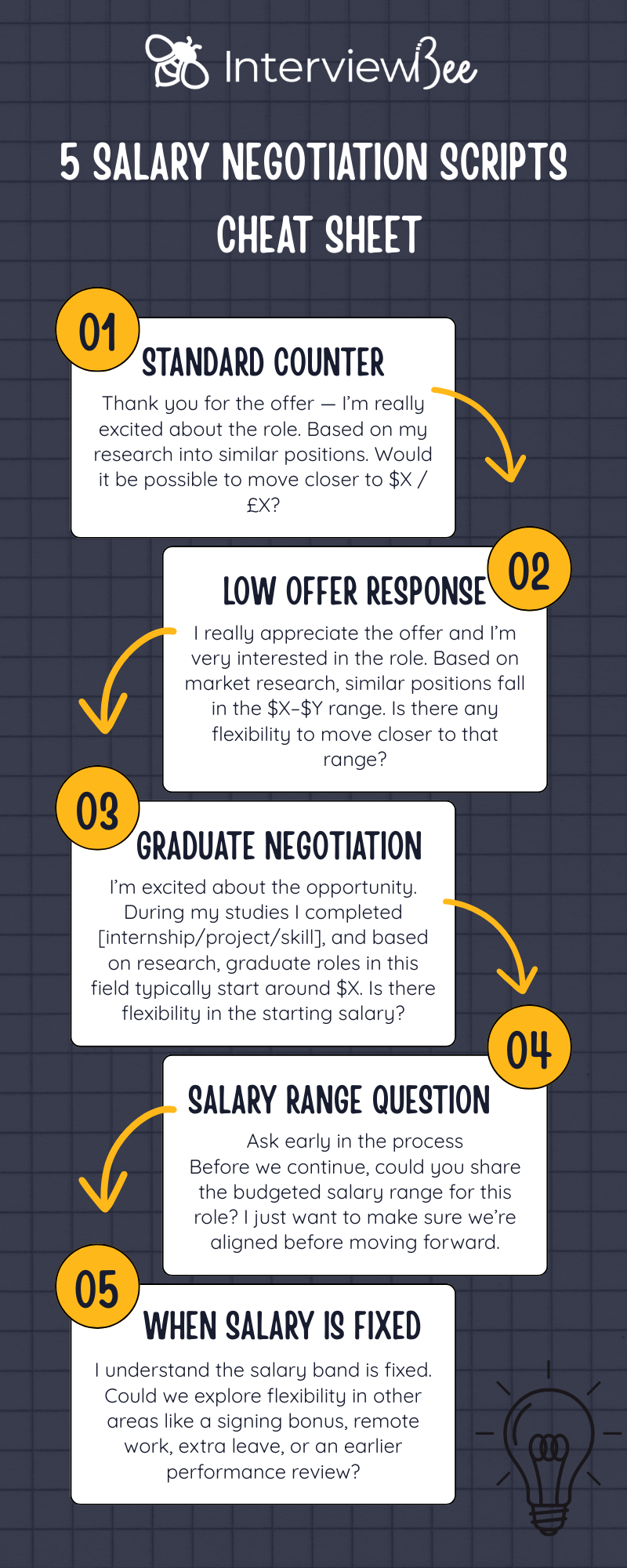
Script 1: The Standard Counter Offer
“Thank you so much — I’m really excited about the role. I’ve had time to review the offer and do some research on similar positions, and I was hoping we might be able to discuss the base salary. I’d be looking at something closer to $[X] / £[X]. Is there any flexibility on that?”
This keeps the conversation open without sounding aggressive.
Script 2: When the Offer Is Lower Than Expected
“I really appreciate the offer and I’m very interested in the role. I did want to be transparent — the salary came in a bit lower than I anticipated based on my research. I’ve been seeing ranges of $[X]–$[Y] / £[X]–£[Y] for comparable roles. Is there any room to close that gap, or possibly look at the wider package?”
Mentioning the broader package signals flexibility and solution-oriented thinking.
Script 3: Negotiating as a Graduate
“Thank you for the offer — I’m really excited about the opportunity. I did want to ask whether there’s any flexibility on the starting salary. During my degree I completed [internship/project/skill], and from what I’ve seen, graduate roles in this area typically start around $[X] / £[X]. Would there be room to meet somewhere in that range?”
Even entry-level candidates have leverage through projects, internships, and technical skills.
Script 4: Asking for Salary Range Early
“I’m really interested in the role and keen to learn more. Before we go further, could you share the budgeted salary range for the position? I just want to make sure we’re in the same territory before we both invest more time.”
This helps avoid investing hours in a process that might not match your expectations.
Script 5: When Salary Is Fixed
“I appreciate you being transparent about the pay band. In that case, I’d love to explore whether there’s flexibility elsewhere — things like additional annual leave, remote work, a signing bonus, learning budget, or an earlier salary review. Are any of those options available?”
Total compensation includes much more than the base salary.
Common Salary Negotiation Mistakes
• Responding immediately instead of taking time to review the offer.
• Using personal expenses as the justification for higher pay.
• Starting the negotiation with apologies.
• Going back and forth too many times.
• Accepting a verbal promise without written confirmation.
Why Interview Preparation Helps Salary Negotiation
Candidates who negotiate successfully usually understand the role deeply. They can clearly explain how their skills solve the company’s problems, which naturally strengthens their case when discussing salary.
Practicing interview questions, researching the company, and running mock interviews all help you articulate your value more clearly during negotiation conversations.
Salary research also increases confidence. Candidates who know market salary ranges are far more likely to negotiate successfully.
Before You Make That Call
Negotiating salary is uncomfortable for most people. But the difference between accepting immediately and asking one thoughtful question can affect your earnings for years.
Often the negotiation happens in a few seconds of silence — the moment when you decide whether to ask if there’s flexibility in the offer.
Learning to sit comfortably in that silence is one of the most valuable career skills you can develop.
About InterviewBee AI
InterviewBee AI helps candidates prepare for interviews through personalised AI mock interviews, curated question banks, and practical career resources designed around how hiring actually works.
Whether you're preparing for your first job or your fifth, InterviewBee helps you practice confidently and negotiate the salary you've earned.
Frequently Asked Questions
Q1. When is the best time to negotiate salary?
The best time is after you receive a formal job offer but before you accept it. At that stage the company has decided they want you, which gives you leverage.
Q2. Will negotiating make me look greedy?
No. Most employers expect candidates to negotiate. As long as your request is professional and supported by research, it’s viewed as normal.
Q3. Can fresh graduates negotiate salary?
Yes. Internships, projects, certifications, and technical skills can all justify negotiation even at entry level.
Q4. What if the salary cannot increase?
Negotiate other elements such as additional leave, remote work, signing bonuses, or earlier salary reviews.
Q5. How many negotiation rounds are appropriate?
Usually one or two rounds. Beyond that the conversation can start to feel drawn out, so it’s better to reach a decision.