


Meta Engineering Interviews: What the Coding Loop Actually Tests (And Why LeetCode Alone Isn't Enough)
- Author: InterviewBee Team
- Published On: Jul 01, 2026
- Category:Technical Interviews
Most engineers spend 8 weeks grinding LeetCode before a Meta interview and walk out of the coding rounds feeling good, then get rejected because the behavioral was "not a fit."
That's not bad luck. That's a preparation mismatch.
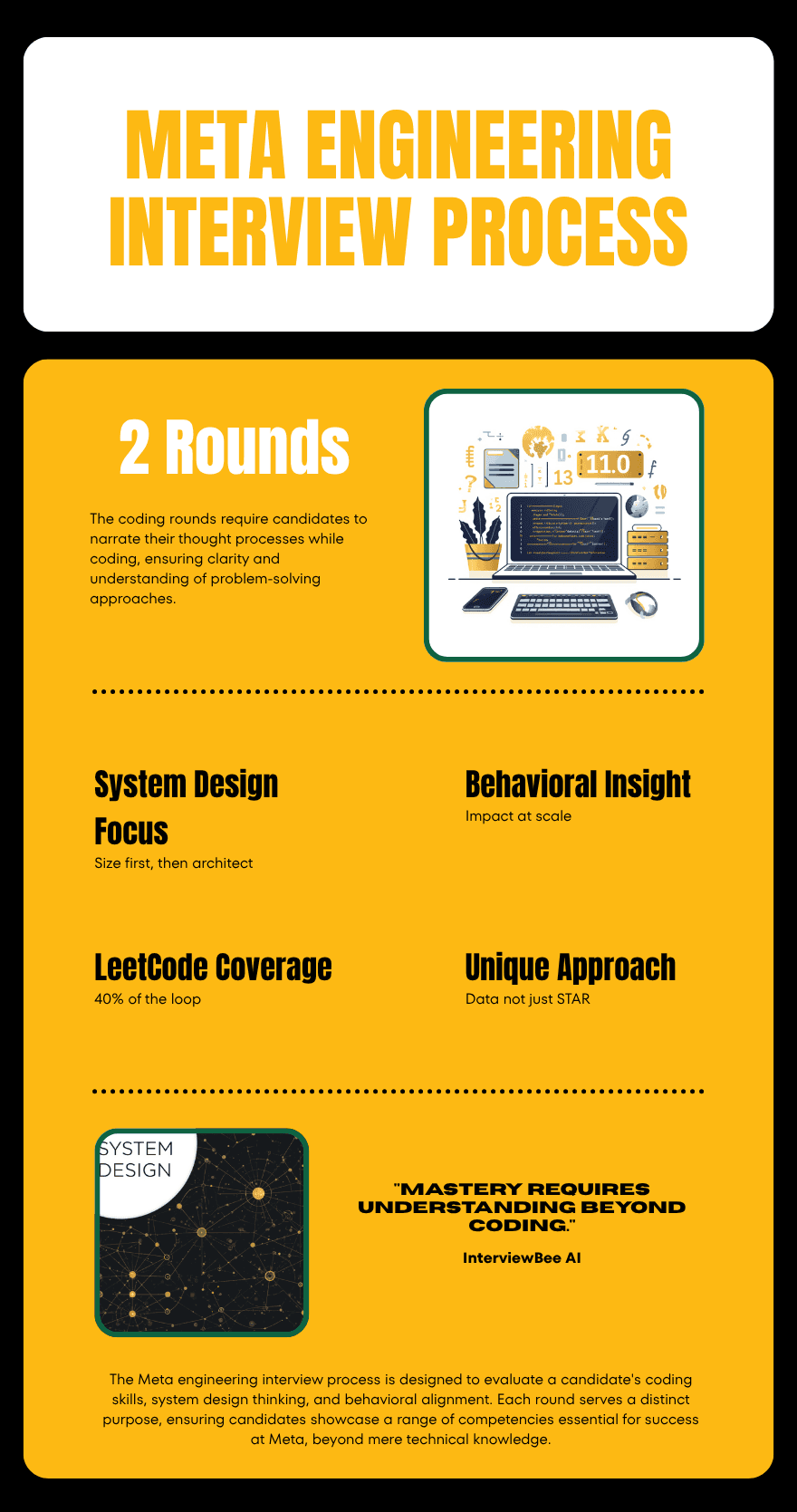
Meta's engineering interview loop has a specific structure, and each component tests something different. If you only train for the coding rounds, you're ready for roughly 40% of what actually matters.
Here's what the loop looks like, what each round evaluates, and why the rounds that eliminate most candidates aren't the coding ones.
The Meta Engineering Interview Structure
Meta's standard engineering loop has four components:
- Two coding rounds: data structures and algorithms, medium-to-hard LeetCode difficulty
- One system design round: large-scale distributed systems, with emphasis on trade-offs and justification
- One behavioral round: evaluated through Meta's specific culture and impact framework
Some candidates see a fifth round, such as a second system design or cross-functional session, but the four above are standard for L3-L5 software engineering roles.
This structure isn't a secret. What most candidates miss is that each round is evaluated on fundamentally different criteria, and preparing for all four with the same approach guarantees a gap.
What the Coding Rounds Are Actually Measuring
Meta's coding rounds use standard algorithmic problems. Medium on LeetCode is the floor; hard difficulty appears frequently for L5+ roles. But the evaluation goes well beyond getting the correct output.
Meta interviewers assess:
- Speed to a working solution: getting unstuck quickly, not grinding in silence for 20 minutes
- Communication while coding: walking through reasoning as you build, not narrating after the fact
- Code quality: readable variable names, clean structure, not just code that runs
- Edge case instinct: surfacing constraints before writing a single line
The problem is a vehicle. The interview is testing whether you think like someone who ships production software, not someone who memorized solution patterns.
This is where candidates who only practice solo on LeetCode fall apart. They've trained to solve quietly. Meta interviewers want a running dialogue, and silence reads as uncertainty, not focus.
Why System Design Rounds Break Most LeetCode Grinders
System design is where the preparation gap becomes a chasm.
LeetCode trains you to find the correct answer within fixed constraints. System design at Meta asks you to build something where no single answer is correct, and justify your decisions under pressure as requirements change.
A typical Meta system design prompt at L4-L5 might ask you to design a notification system for 500 million users with sub-second delivery across mobile, web, and third-party apps.
What the interviewer is evaluating:
- Do you identify bottlenecks before jumping to architecture?
- Can you size the system with confidence: QPS, storage, bandwidth, and peak load?
- Do you make trade-offs explicitly and explain what you would sacrifice and why?
- Can you handle a mid-session constraint change, such as multi-region failover, without losing composure?
Grinding LeetCode doesn't build this muscle. Reading system design guides helps. But only practicing under real interview conditions, with a blank whiteboard, an unfamiliar prompt, and a mock interviewer changing the constraints, builds the actual skill.
The Behavioral Round: Where Meta Differs from Everyone Else
This is the most underestimated component in the loop.
Meta's behavioral interviews are not standard STAR format. They evaluate cultural fit through a specific lens: impact at scale, data-driven decisions, and moving fast with accountability.
The questions sound familiar:
- "Tell me about a time you made a decision with incomplete information."
- "Describe a situation where you had to push back on a stakeholder."
But Meta's evaluation criteria are distinct. Interviewers want to hear:
- Did you ship something that affected a meaningful number of users or drove measurable business impact?
- Did data guide your decision, not instinct alone?
- When things broke or went wrong, did you own it, and what did you change?
Candidates who respond with polished STAR-format answers often score below expectations because the stories are too small in scope or too process-heavy. Meta is looking for outcome density: concrete numbers, scale, and honest retrospection.
If you're a developer with fewer than three years of experience, this doesn't mean you need to have shipped to a billion users. But you do need to frame your stories around measurable outcomes, and be specific about what you would do differently.
How to Actually Prepare for the Full Loop
Each round tests a different mode of thinking, so prepare for each separately.
For coding
Don't just solve problems. Practice solving them out loud. Record yourself. If your communication sounds like internal monologue, you're not ready. The goal is a natural running commentary that explains decisions as you make them.
For system design
Pick five canonical systems: URL shortener, rate limiter, notification system, distributed cache, and feed ranking. Practice designing each from scratch in 45 minutes with evolving constraints. The constraints changing mid-session is not a curveball. It's the point.
For behavioral
Build a story bank of 8-10 high-impact moments from your work history. For each, know the scale, such as users affected, time saved, or revenue impacted, the decision you made, and what you measured afterward. Meta interviewers want numbers. Vague outcomes signal fuzzy thinking.
InterviewBee's AI mock interviewer covers all three modes: coding communication practice, system design walk-throughs with adaptive questioning, and behavioral rounds with role-specific feedback calibrated to senior engineering expectations.
It is worth running a full simulated Meta loop before the real one.
Frequently Asked Questions
How many rounds are in a Meta engineering interview loop?
Most L3-L5 Meta software engineering loops include two coding rounds, one system design round, and one behavioral round. Some candidates may see a fifth round depending on level, team, or signal gaps.
Is LeetCode enough for Meta engineering interviews?
No. LeetCode helps with coding patterns, but Meta also evaluates communication while coding, system design trade-offs, behavioral impact, ownership, and data-driven decision-making.
What do Meta coding interviews actually test?
They test speed to a working solution, clear reasoning, edge-case instinct, and code quality. The interviewer is watching how you think and communicate, not only whether the final solution is correct.
How should I prepare for Meta system design?
Practice designing common large-scale systems from scratch, size the system before drawing architecture, explain trade-offs clearly, and rehearse adapting when the interviewer changes constraints mid-session.
What makes Meta behavioral interviews different?
Meta behavioral interviews look for impact at scale, data-driven decisions, accountability, and honest retrospection. Strong answers include concrete numbers, ownership, what changed after the event, and what you learned.