



LinkedIn Algorithm: How Recruiters Actually Find You in 2025
- Author: Anshika
- Published On: May 09, 2026
- Category:Interview Tips
Introduction
Most people treat LinkedIn like a digital resume they upload once and forget. They add a few connections, switch on "Open to Work," and wait. Nothing happens.
Here is the reality: LinkedIn is a search engine. The LinkedIn algorithm decides which profiles recruiters see when they search for candidates. If your profile is not optimized, you can be the perfect fit for a role and still never show up. Thousands of qualified people stay invisible simply because their profile does not speak the right language.
What the LinkedIn Algorithm Actually Looks For
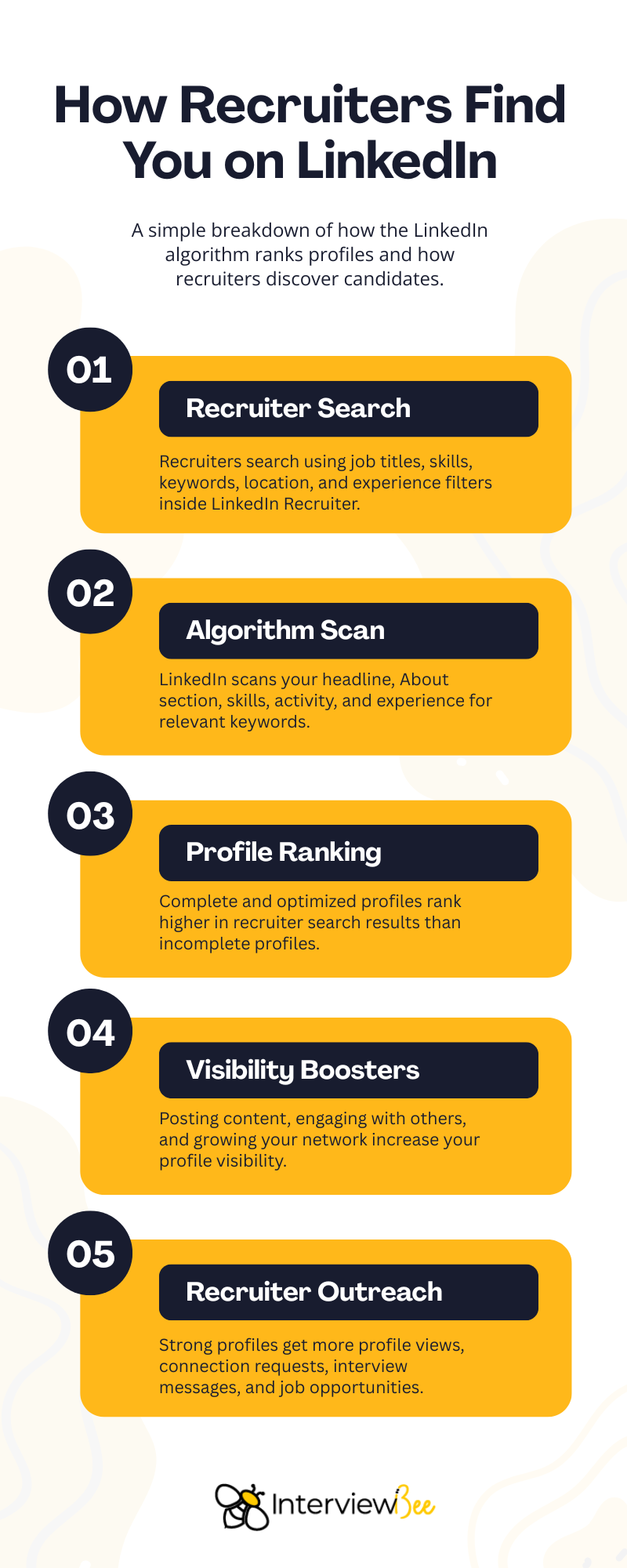
The algorithm is not random. It ranks profiles based on specific signals:
| Signal | Why It Matters |
|---|---|
| Keywords | LinkedIn scans your headline, About section, and job titles for search-relevant terms |
| Job Titles | Exact and related titles are matched against recruiter search queries |
| Skills | Recruiter filters directly filter by skill tags you have listed |
| Profile Completeness | All-Star profiles rank significantly higher than incomplete ones |
| Activity Level | Posting, commenting, and engaging signals you are an active user |
| Connection Network | First and second-degree connections appear higher in search results |
| Endorsements | Endorsed skills carry more weight than self-listed ones |
Think of your profile as a web page. The more relevant signals it sends, the higher it ranks.
How Recruiters Search on LinkedIn
Most corporate and agency recruiters use LinkedIn Recruiter, a dedicated sourcing tool that goes far beyond a regular search bar.
Here is what a typical recruiter search looks like in practice:
A fintech startup in London needs a junior UX designer. The recruiter opens LinkedIn Recruiter, types "UX Designer," then stacks filters: Location (London), Skills (Figma, User Research), Experience (0–3 years). Within seconds, they have a shortlist.
If your profile says "Design Graduate" and you have not listed Figma as a skill, you do not appear. Someone with identical experience but a better-optimized profile does.
The filters recruiters most commonly use:
Job title
Location
Skills
Years of experience
Education
Industry or company
Open to Work status
Recent activity
LinkedIn SEO is not optional. It is what gets you into that shortlist in the first place.
Biggest LinkedIn Mistakes That Make Profiles Invisible
Most job seekers make the same avoidable errors:
| Mistake | The Fix |
|---|---|
| Weak headline ("Student" or "Looking for Opportunities") | Use a keyword-rich, role-specific headline |
| Empty About section | Write 150–250 words with natural keyword placement |
| No measurable results in experience | Replace vague duties with numbers and outcomes |
| Missing skills section | Add up to 50 relevant skills — recruiters filter by these |
| No profile photo | Profiles with photos get significantly more views |
| Zero activity | Even one post or a few comments per week helps |
| Generic resume copy-pasted into LinkedIn | Rewrite for the platform — LinkedIn is not a PDF |
How to Optimize Your LinkedIn Profile for Recruiters
Headline
Your headline is the first thing the algorithm reads and the first thing a recruiter sees.
Do not use: "Marketing Graduate" or "Open to Work"
Do use: "Digital Marketing | SEO and Content Strategy | Open to Full-Time Roles"
Include your target job title and two or three core skills
Keep it under 220 characters
About Section
Open with a one-sentence summary of what you do
Mention your target role, key tools, and top skills naturally
Include one or two specific achievements
Close with what you are looking for
Aim for 150 to 250 words — concise but searchable
Experience Section
| Weak | Strong |
|---|---|
| Managed social media accounts | Grew Instagram following from 2,000 to 18,000 in 6 months |
| Assisted with market research | Analyzed data from 500+ surveys to inform product roadmap |
| Worked in customer support | Resolved 95% of tickets within 24 hours across a team of three |
Numbers make you memorable. Vague descriptions do not.
Skills
Add up to 50 skills — use all of them
Prioritize skills most commonly listed in job descriptions for your target role
Ask colleagues, managers, or professors for endorsements on your top 3 to 5 skills
Featured Section
Pin your best work here:
A portfolio link or Behance profile
A relevant certification
A project write-up or case study
A strong LinkedIn post that performed well
Networking
Connect with people working in your target industry or company
Follow recruiters at organizations you want to join
Send short, specific connection requests — not blank ones
Does Posting Content Really Help?
Yes. But you do not need to become an influencer.
Even minimal activity boosts your profile visibility. Here is what works:
Sharing a project you worked on
Writing a short take on something you learned
Commenting meaningfully on posts in your industry
Reposting industry news with a one-line opinion
Posting once or twice a week is enough to trigger the activity signal the algorithm rewards. Recruiters also browse content when sourcing. A thoughtful post is a second channel that most candidates ignore entirely.
The Future of LinkedIn SEO and AI Recruitment
Hiring is moving faster toward automation. Here is what is shifting:
| Trend | What It Means for You |
|---|---|
| AI-powered candidate matching | LinkedIn now surfaces profiles based on predicted fit, not just search terms |
| ATS integration with LinkedIn | Your profile data feeds into external hiring tools companies use |
| Skills-based hiring on the rise | Skills sections carry more weight as degrees matter less |
| Recruiter tools getting smarter | Filters are more granular — generic profiles get buried further |
Personal branding is no longer optional. The candidates who show up consistently in recruiter searches are the ones treating their LinkedIn profile like a living document, not a static file.
Conclusion
The LinkedIn algorithm rewards profiles that are complete, keyword-optimized, and active. Recruiters are running searches every single day. Whether you appear in those results comes down to how well your profile is set up.
Start with your headline. Write a proper About section. Fill your skills list. Then show up on the platform — even occasionally. Small changes create compounding visibility over time.
You do not need to be the most experienced candidate. You just need to be the most discoverable one.
Frequently Asked Questions
Q1: How does the LinkedIn algorithm decide which profiles to show recruiters?
LinkedIn ranks profiles based on keyword relevance, profile completeness, connection proximity, and user activity. The more optimized and active your profile, the higher it appears in recruiter search results.
Q2: What is the most important part of a LinkedIn profile for recruiter searches?
Your headline and skills section carry the most weight in LinkedIn Recruiter filters. These are the fields most directly matched against what recruiters type into search.
Q3: Does the "Open to Work" feature actually help you get found?
Yes. It signals your availability to recruiters using LinkedIn Recruiter's filters. You can choose to show it only to recruiters rather than your entire network if you prefer discretion.
Q4: How often should I post on LinkedIn to improve my visibility?
Once or twice a week is enough. Consistency matters more than frequency. Commenting meaningfully on posts in your industry works just as well as publishing original content.
Q5: Does LinkedIn SEO work the same way as Google SEO?
They share the same core principle — keywords, relevance, and authority — but the signals differ. LinkedIn SEO focuses on profile fields, skill endorsements, and platform activity rather than backlinks and domain authority.