


Investment Banking First Round: How to Answer the Valuation Question
- Author: InterviewBee Team
- Published On: Jun 09, 2026
- Category:Investment Banking
You have studied DCF models, learned the major valuation methodologies, and memorized the bridge between enterprise value and equity value. Then an interviewer asks you to walk through a valuation and the open-ended format makes the answer suddenly feel harder.
This is often a delivery problem rather than a knowledge problem. A strong response shows that you can clarify the objective, structure the analysis, explain assumptions, and communicate limitations under pressure.
What a First-Round Valuation Question Tests
Investment banking interviews commonly combine technical questions—such as valuation, accounting, and markets—with fit questions about your motivation, experience, and interest in the firm.
An interviewer may deliberately use an open prompt:
“Walk me through how you would value this company.”
The question tests more than recall. The interviewer wants to see how you frame an ambiguous problem, select relevant methods, and explain the reasoning behind your choices.
Start by Clarifying the Purpose
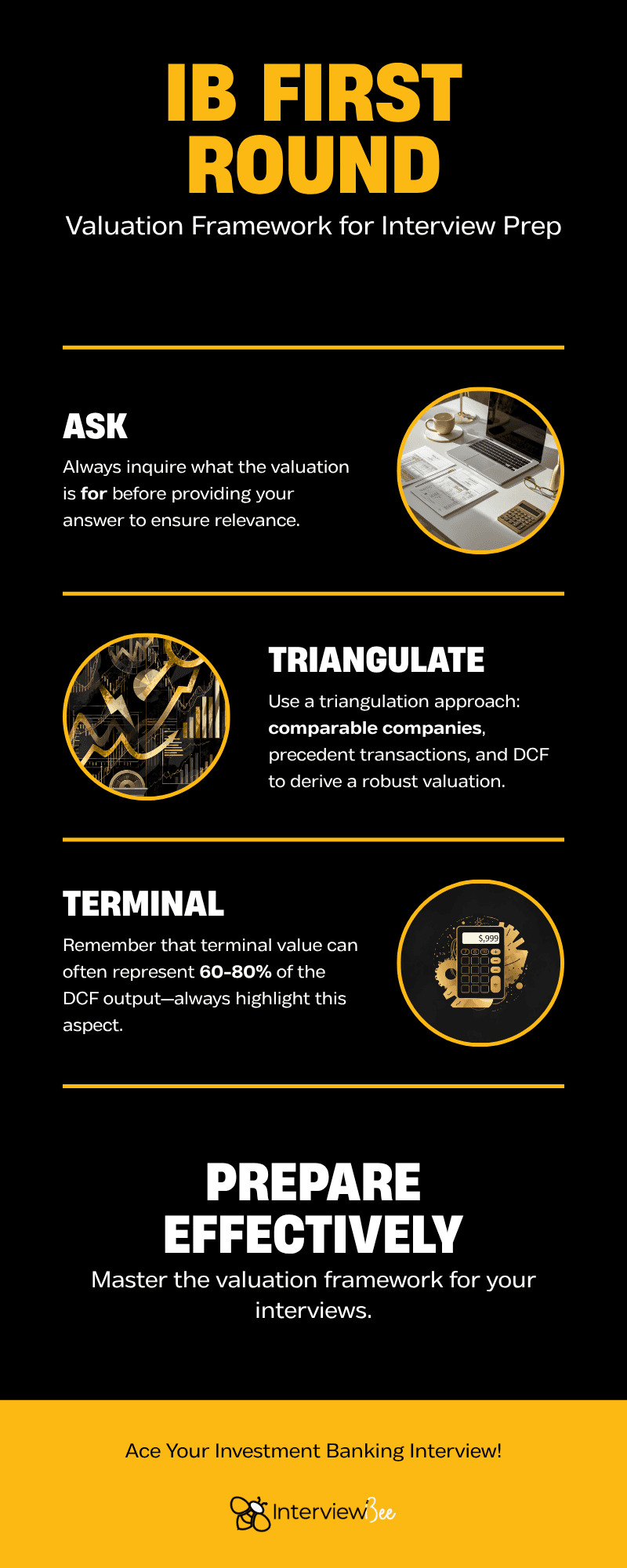
Before launching into DCF assumptions, ask what the valuation is for and what information is available. Is the client considering an acquisition, preparing for an IPO, evaluating strategic alternatives, or conducting internal planning?
The purpose affects how you use each method and which assumptions matter most. Asking a focused clarification question demonstrates commercial judgment and gives you a moment to organize the answer.
Use a Three-Method Valuation Structure
Explain that you would typically triangulate a valuation range using three approaches rather than relying on one output:
- Comparable company analysis: examines how relevant public peers trade using suitable operating and valuation metrics.
- Precedent transaction analysis: studies prices paid in comparable acquisitions, including control premiums and transaction context.
- Discounted cash flow analysis: estimates intrinsic value from projected unlevered free cash flow and terminal value, discounted at the weighted average cost of capital.
Different methods capture different perspectives. The goal is a defensible range supported by assumptions, not a falsely precise single number.
Acknowledge Each Method's Limitations
Strong candidates explain what could make an output unreliable. A DCF can be highly sensitive to forecast, discount-rate, and terminal-value assumptions. Comparable-company analysis depends on a genuinely relevant peer set. Precedent transactions may reflect different market conditions, deal structures, or strategic premiums.
This is not hedging. It demonstrates that you understand how valuation is used in practice and why sensitivity analysis matters.
Handle the Multiple Follow-Up With Evidence
If the interviewer asks which EV/EBITDA multiple you would use, do not rely on a memorized universal sector range. Start with current trading data from a carefully selected peer group.
Then explain what could move the target within that range: expected growth, margins, capital intensity, recurring revenue, cyclicality, leverage, geographic exposure, and business mix. The interviewer is evaluating the logic behind the range more than an unsupported point estimate.
Build Fluency Through Realistic Practice
Knowing the framework and delivering it clearly under time pressure are different skills. Practice speaking the answer aloud, responding to follow-up questions, and leading with the conclusion before expanding into technical detail.
InterviewBee's AI mock interviewer runs role-specific scenarios with adaptive follow-ups and structured feedback, helping you identify skipped steps, unclear explanations, and answers that bury the main point.
Practice the valuation question with InterviewBee's AI mock interviewer—free to start.
Frequently Asked Questions
How should I answer “Walk me through how you would value this company”?
Clarify the purpose, then explain how you would triangulate a range using comparable companies, precedent transactions, and a DCF where appropriate.
Why should I ask what the valuation is for?
The objective affects the methods, assumptions, and perspectives that deserve the most weight.
What valuation methods should I know?
Know comparable-company analysis, precedent-transaction analysis, and discounted cash flow analysis, including the strengths and limitations of each.
How do I choose an EV/EBITDA multiple?
Use current data from relevant peers and explain how company-specific fundamentals affect where the business belongs within the observed range.
What DCF topics should I prepare?
Prepare unlevered free cash flow, WACC, terminal value, sensitivity analysis, and the bridge from enterprise value to equity value.