


Internship to Full-Time Offer: The 12-Week Interview Happening Without You Knowing
- Author: InterviewBee Team
- Published On: Jul 15, 2026
- Category:Interview Tips
You show up on day one with a laptop, a Slack account, and a project brief. Somebody walks you through the onboarding deck. Nobody tells you the internship itself is the interview, the only one that decides whether you get a full-time offer twelve weeks from now.
Most interns treat the internship like a school assignment: finish the project, get a good grade, move on. That's the wrong frame. Your manager isn't grading a deliverable. They're deciding whether to spend a full-time headcount on you, and that decision gets made gradually, in small moments you're probably not tracking.
Your Project Is Not the Interview. Your Behavior Around It Is.
Here's the part that catches interns off guard: the polish of your final presentation matters less than how you got there. A manager watching you for twelve weeks isn't primarily judging whether the code works or whether the deck looks clean. They're watching for whether they can hand you something ambiguous next quarter and trust you not to need hand-holding.
That means the internship to full-time offer conversion decision is being shaped by things that never show up in your project scope doc: whether you asked for feedback before it was due, whether you flagged a blocker the day it happened instead of the day before the deadline, whether you said "I don't know, let me find out" instead of guessing and hoping nobody noticed.
The Signals Managers Actually Track
Talk to enough people who've sat on either side of an intern conversion decision and a pattern shows up. It's not about raw output. It's about four things, roughly in this order of weight:
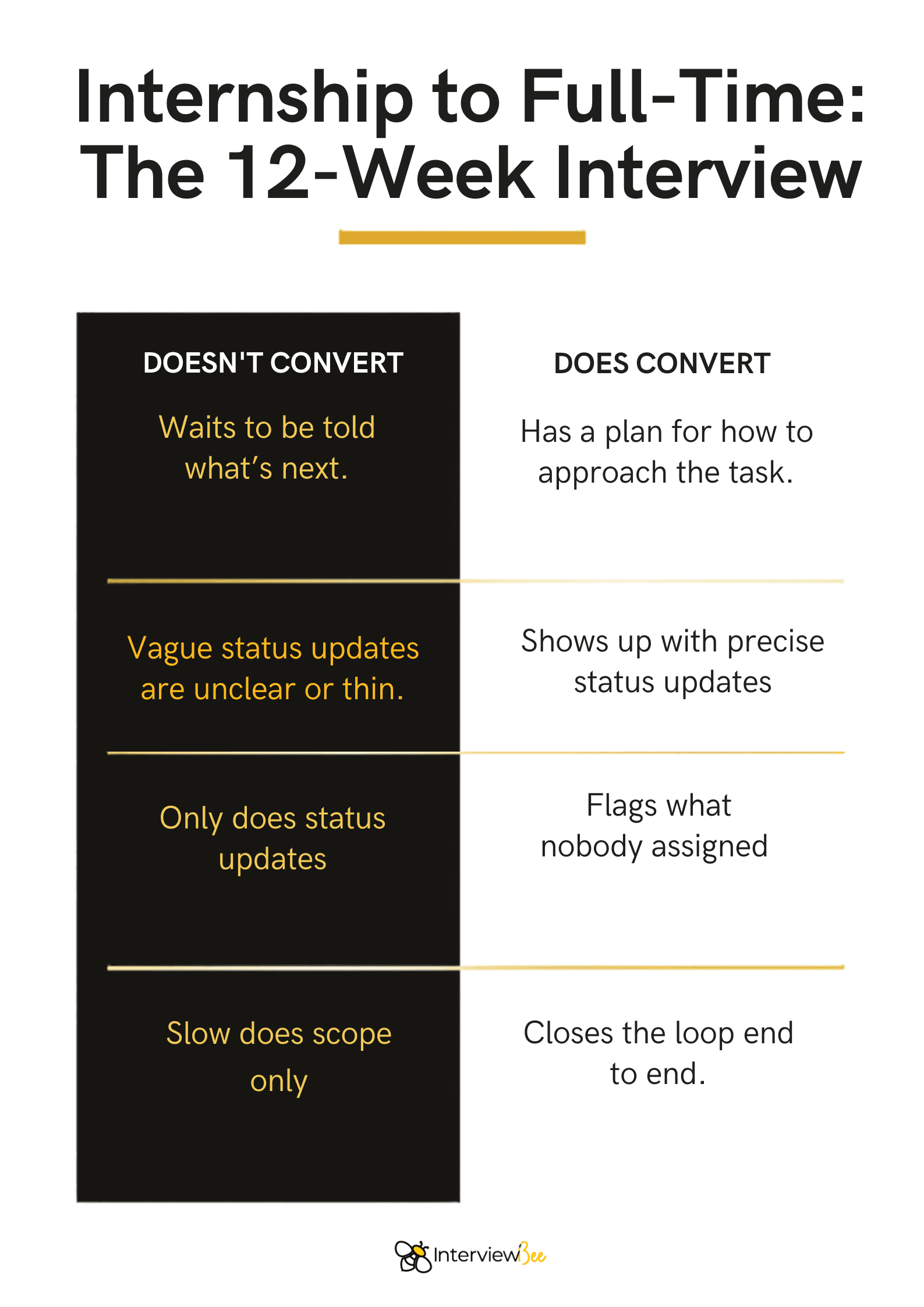
Ownership. Did you treat the project like it was yours, or like it was assigned to you? Interns who ask "what should I do next" every few days read very differently from interns who show up with a plan and ask for a gut-check. Ownership isn't working more hours. It's making decisions and being accountable for them.
Communication. Not politeness. Clarity. Can your manager understand your status in thirty seconds without asking three follow-up questions? Interns who send vague updates, like "still working on it, going well," create more anxiety than interns who send precise ones, like "blocked on API access, requested it Tuesday, following up today."
Initiative. Did you only do what was scoped, or did you notice something adjacent worth flagging? This is the difference between finishing the assigned task and finishing it while also pointing out that the underlying process has a gap nobody mentioned. You don't need to reinvent anything. Noticing and naming is often enough.
Completion. This one's obvious but still gets missed. Did you actually ship the thing, end to end, including the unglamorous parts like documentation, handoff notes, and a working demo, or did you get 90% done and call it finished? Managers remember who closes loops.
None of these show up on a resume line. They show up in daily standups, Slack threads, and the two or three moments where something goes sideways and you have to react in real time.
How to Perform Against This Without Overthinking It
You don't need a strategy deck. You need habits that make the four signals visible without making it look like you're performing for an audience.
Send a short weekly update to your manager even if they didn't ask for one: status, blockers, next steps. Three sentences is enough. This does two things: it shows communication discipline, and it gives your manager a paper trail of your judgment calls when they're deciding whether to advocate for your offer.
When something breaks or slips, say so immediately, with a plan attached. "This is behind because X, here's what I'm doing about it" reads as ownership. Silence until the deadline reads as the opposite, even if the outcome is identical.
Ask one good question in every 1:1 that isn't about your task list: how the team prioritizes, what the manager's own manager cares about, or why a past decision was made a certain way. This signals you're thinking beyond your ticket, which is exactly the initiative managers are scanning for.
And treat the final presentation like what it actually is: a compressed, high-stakes interview. The questions your manager and skip-level ask you in that room are functionally no different from a behavioral interview round. They're testing whether you can explain your reasoning, defend a tradeoff, and handle a question you didn't prep for.
Practicing for the Moment That Actually Decides It
That final round, the wrap-up presentation and closing conversation with your manager, is where most of the conversion decision gets confirmed, even if it was already forming for weeks. It's also the part interns prepare for the least, because it doesn't feel like a real interview.
Treat it like one. InterviewBee's AI mock interviewer lets you run through the kind of questions that come up in an internship wrap-up conversation: "walk me through a decision you made under uncertainty," "what would you do differently," and "how did you handle the week things fell behind," before you're standing in the room answering them for real. It's built for exactly this kind of high-stakes, once-a-quarter conversation where you don't get a second take.
The internship isn't a twelve-week assignment with an interview at the end. It's a twelve-week interview with a project attached. Once you see it that way, the offer decision stops feeling like it's out of your hands.
Practice this with InterviewBee's AI mock interviewer and rehearse the questions that decide whether your internship converts.
Frequently Asked Questions
How do interns convert an internship into a full-time offer?
Interns convert by making ownership, communication, initiative, and completion visible throughout the internship. Managers are looking for whether they can trust you with ambiguous work after the internship ends.
What do managers evaluate during an internship?
Managers evaluate how you handle blockers, communicate status, ask for feedback, make decisions, close loops, and respond when something changes. The final deliverable matters, but the behavior around the work often carries more signal.
How often should interns update their manager?
A short weekly update is a strong baseline. Include current status, blockers, and next steps so your manager never has to chase clarity or guess where the work stands.
Should interns practice for the final presentation like an interview?
Yes. The wrap-up presentation and closing conversation often confirm the conversion decision. Practice explaining tradeoffs, uncertainty, missed timelines, feedback, and what you would do differently.