

How to Interview When You Have Zero Work Experience: A Framework That Actually Works
- Author: InterviewBee Team
- Published On: Jul 24, 2026
- Category:Interview Tips
"Tell me about a time you handled conflict on a team."
You've never had a team. Not a real one, not one with a boss and a deadline and a performance review attached to it. So you freeze, or you reach for something that happened in a group project sophomore year and immediately feel like it doesn't count.
This is the moment that ends interviews for students and new grads before they've really started. Not lack of skill — lack of translation. The interviewer isn't testing whether you've had a job. They're testing whether you can recognize a pattern (conflict, ownership, failure, leadership) and describe how you handled it. Work experience is just the most common raw material for that. It isn't the only one.
You Have More Material Than You Think
Every behavioral question is really asking about a handful of underlying situations: a disagreement, a deadline you almost missed, a time you had to learn something fast, a moment you had to speak up. Those situations show up constantly outside of jobs — you just haven't been trained to notice them as interview material.
A few sources most students overlook:
Coursework and group projects carry real conflict and real deadlines, even if the stakes feel smaller than a "real job." A group project where one teammate stopped contributing and you had to redistribute the work under a hard deadline is a legitimate ownership story — the interviewer doesn't care that it was for a grade instead of a paycheck.
Hackathons and personal projects show initiative and technical judgment in a way a resume line never can. Building something in 36 hours with three strangers, hitting a wall at 2am, and shipping anyway is a better "how do you handle pressure" answer than most entry-level jobs produce in a year.
Volunteering, clubs, and part-time work outside your target field still involve people, deadlines, and mistakes. Running a student org's budget, organizing an event that almost fell apart, or training a new volunteer are all leadership and communication stories — they just don't look like it on paper.
Open-source contributions or self-directed learning demonstrate something employers genuinely struggle to assess: whether you can teach yourself. "I didn't know React, so I spent two weeks in the docs and shipped a feature" is a stronger learning-agility story than most internships.
Reframe, Don't Apologize
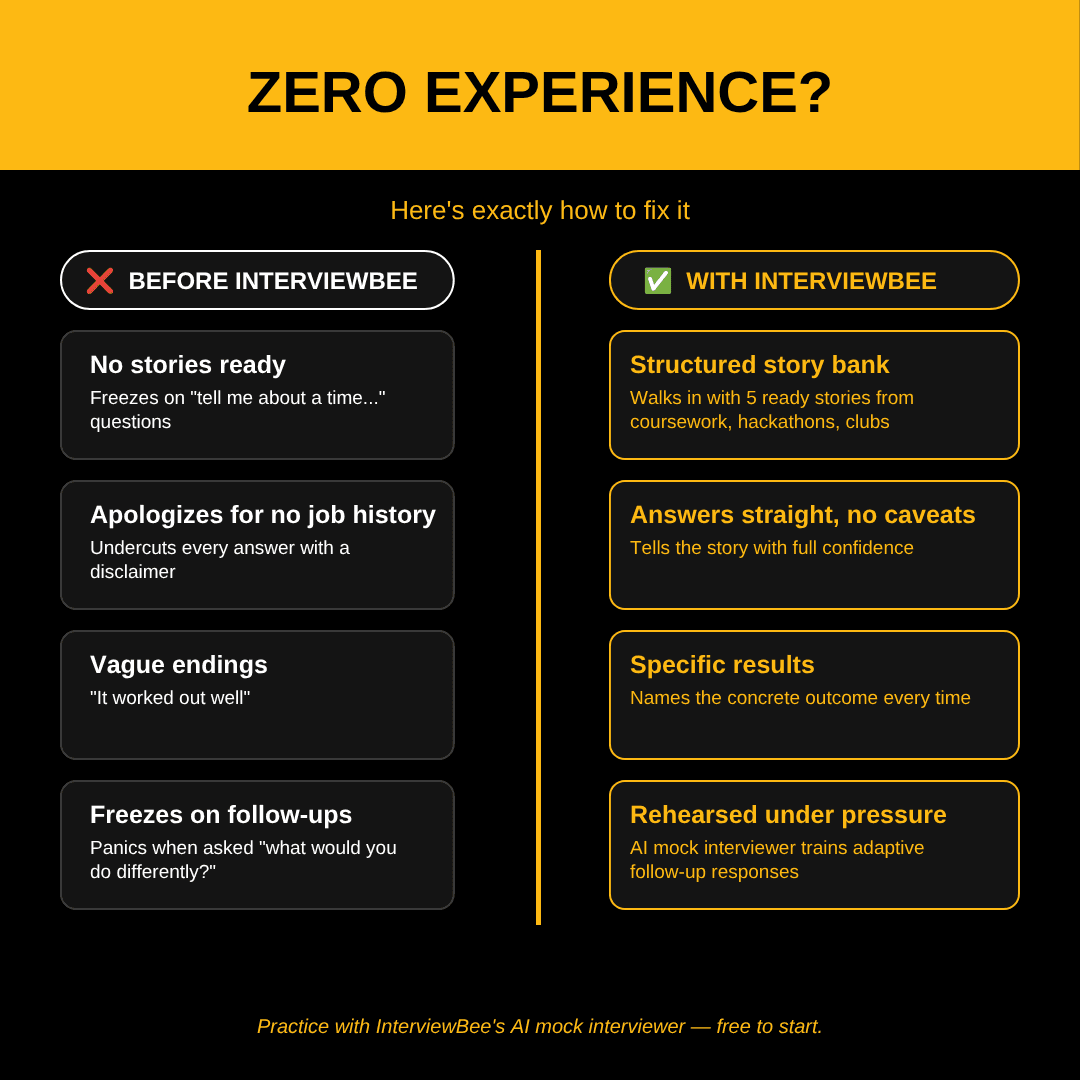
The mistake most students make isn't picking the wrong story — it's introducing it with a disclaimer. "I haven't had a real job, but..." tells the interviewer to discount everything that follows before they've even heard it. Drop the caveat. Walk into the story the same way you would if it happened at a Fortune 500 company, because the structure of a good answer doesn't change based on where it happened.
Use the same shape every strong behavioral answer uses: what was the situation, what did you specifically do, what happened as a result. The result is where student stories often go soft — "and it worked out well" isn't a result. Get specific: the project shipped on time, the club's attendance doubled, the bug got fixed before the demo. Interviewers remember specifics. They forget vague reassurance.
Match the Story to the Question, Not the Job Title
Interviewers aren't listening for "have you done this exact job before." They're pattern-matching for the skill behind the question. "Tell me about a conflict" is really asking: can you navigate disagreement without either avoiding it or blowing it up. "Tell me about a failure" is asking: do you own mistakes or deflect them. Once you see the question that way, a coursework story and a job story are equally valid evidence — the interviewer just needs to see the pattern clearly.
Build a small bank of five or six stories before you walk in: one about conflict, one about failure, one about leading without formal authority, one about learning something fast, one about a deadline under pressure. Pull from projects, clubs, hackathons, and part-time work freely. Most behavioral questions in an interview are variations on those five themes — you're not memorizing answers, you're organizing the material you already have.
Where Practice Actually Helps
Knowing the framework and delivering it live under pressure are two different skills. The gap usually isn't the content of the story — it's the delivery: rambling toward the result, burying the specific outcome, or freezing when a follow-up question ("what would you do differently?") lands.
This is where InterviewBee's AI mock interviewer earns its keep. It asks the same behavioral questions a real interviewer would, listens to how you structure your answer, and flags exactly where it goes soft — the missing result, the vague conflict description, the disclaimer you didn't mean to add. You walk in having said the answer out loud under adaptive follow-up questions, not just rehearsed it in your head.
Practice this with InterviewBee's AI mock interviewer — free to start.