


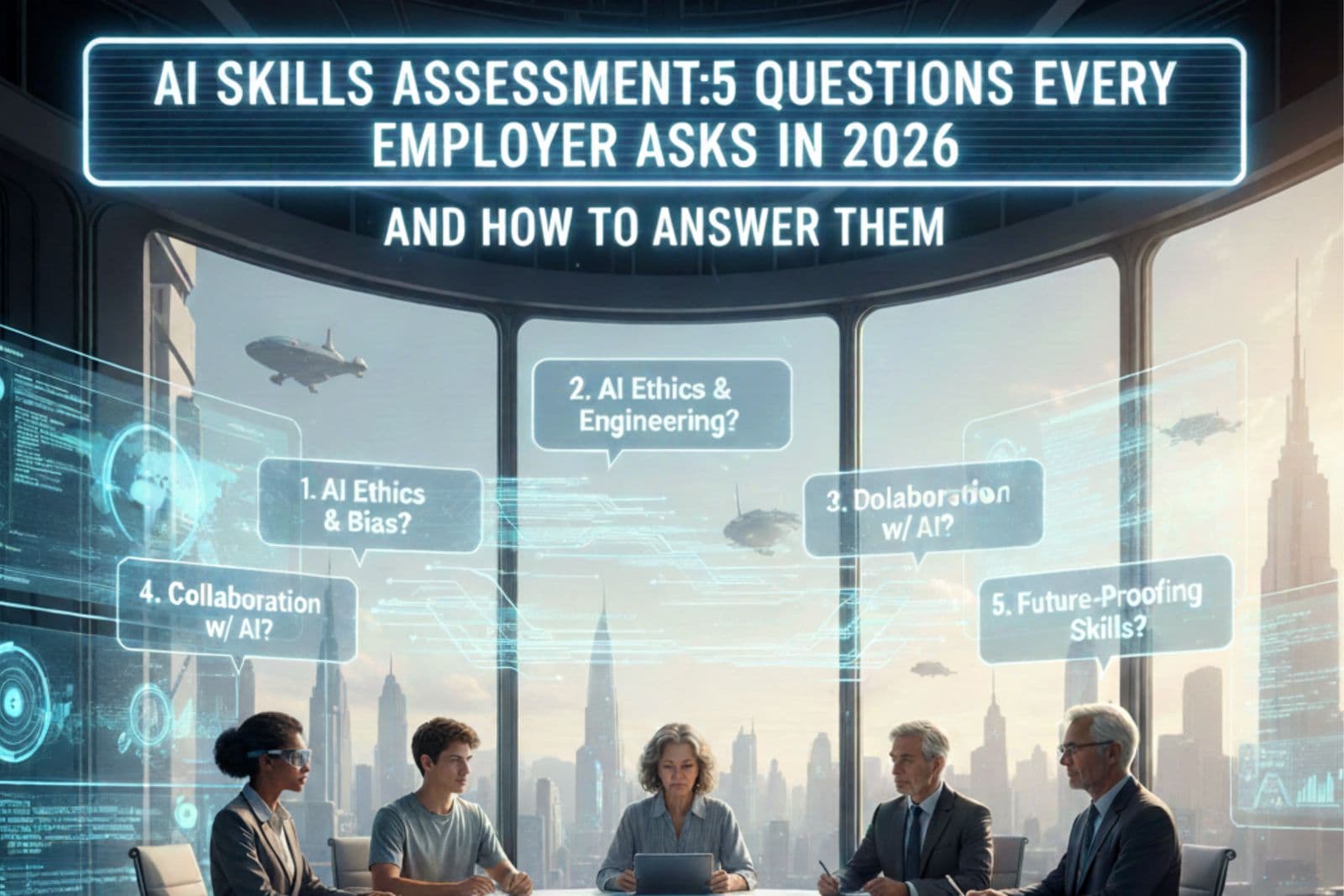
AI Skills Assessment: 5 Questions Every Employer Asks in 2026 (And How to Answer Them)
- Author: Bismayy
- Published On: Dec 27, 2025
- Category:Interview Tips
The bar for AI proficiency has shifted. According to Dice's 2025 report, 50% of tech roles now require demonstrable AI skills. Employers aren't asking whether you've heard of ChatGPT. They want to know if you can apply AI to business problems, recognize when it fails, and measure its impact.
We've heard from candidates that the AI skills assessment portion of interviews can feel intimidating, especially when the questions probe deeper than surface-level definitions. Based on hiring patterns across tech, consulting, and product roles, these five questions show up consistently.
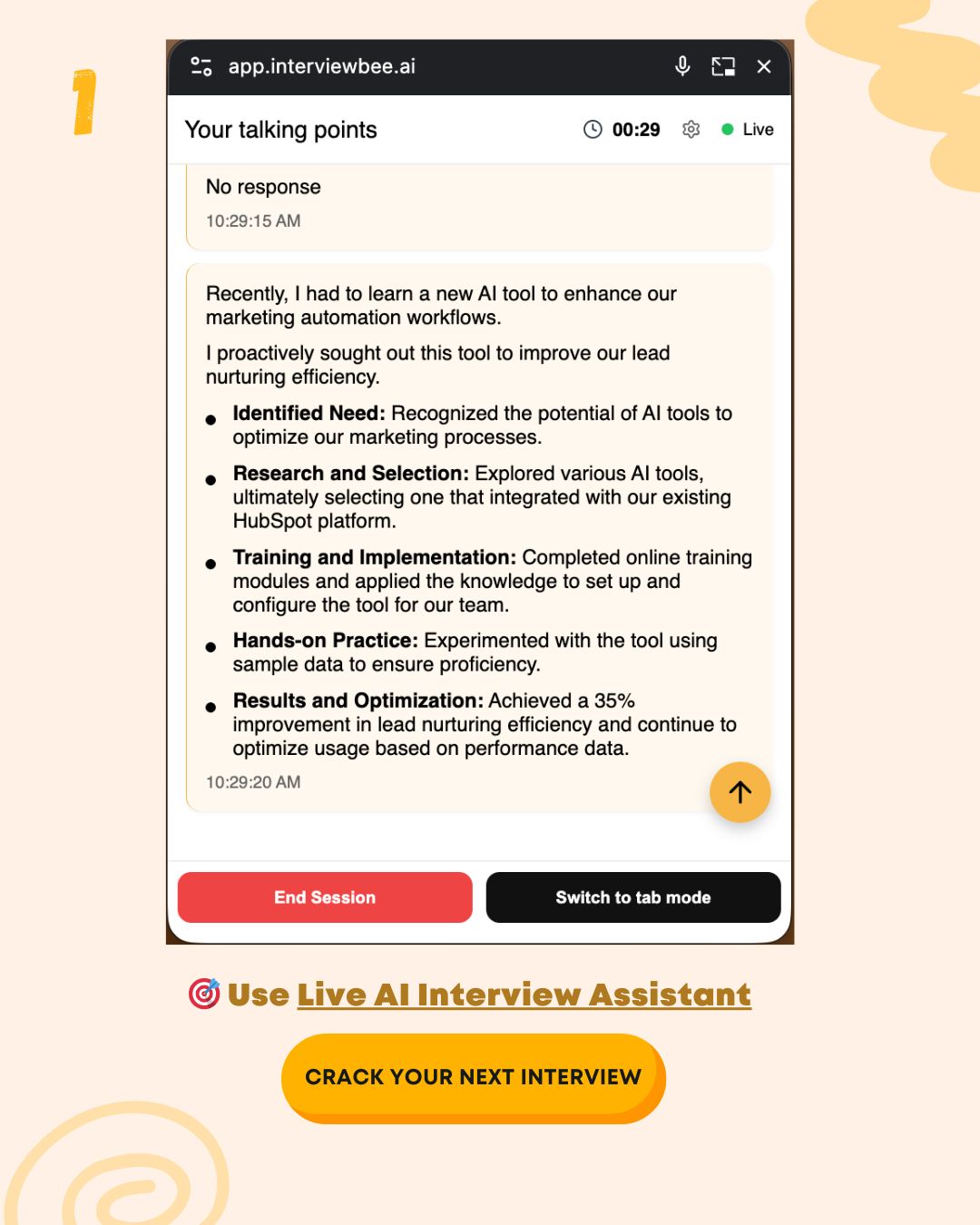
1. "Walk me through how you learned a new AI tool recently."
This tests your learning methodology, not your memorization. Companies like Unilever and IBM have reported that candidates who describe a structured approach to learning are 2.5x more likely to succeed post-hire.
How to answer: Break it into four steps: define your goal, research multiple sources (docs, forums, case studies), build a quick prototype, then iterate based on results. Mention specific tools and what you measured, not vague statements about "experimenting."
InterviewBee Live AI Interview Assistant
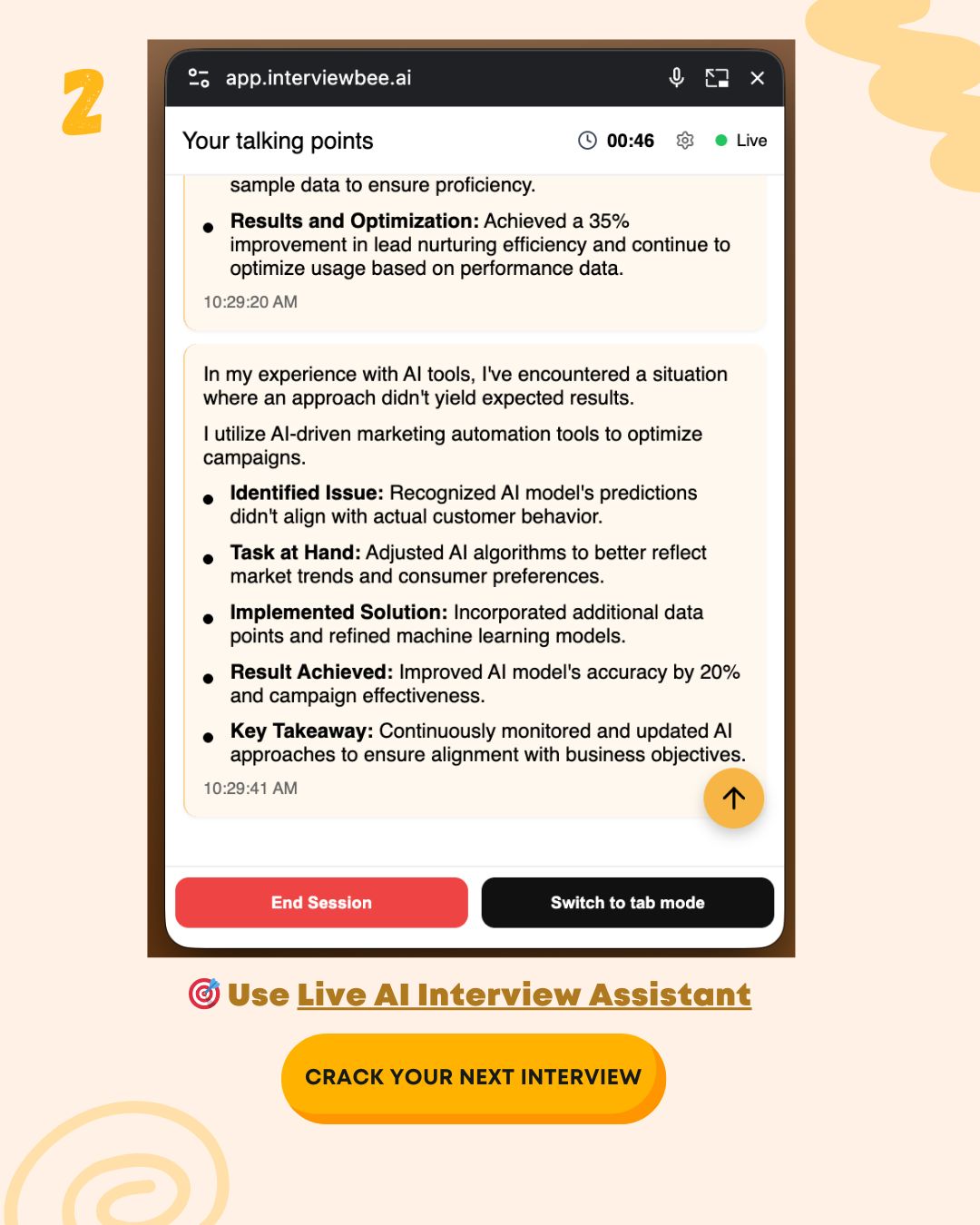
2. "Describe a time an AI approach failed or disappointed you."
Hiring managers use this as a responsibility filter. With only 26% of job applicants trusting AI evaluations, companies want proof you understand where systems break.
How to answer: Pick a real example. Maybe an LLM hallucinated legal citations, or a sentiment model missed sarcasm. Explain what went wrong, what you learned, and how you adapted. Admitting failures signals maturity.
InterviewBee Live AI Interview Assistant
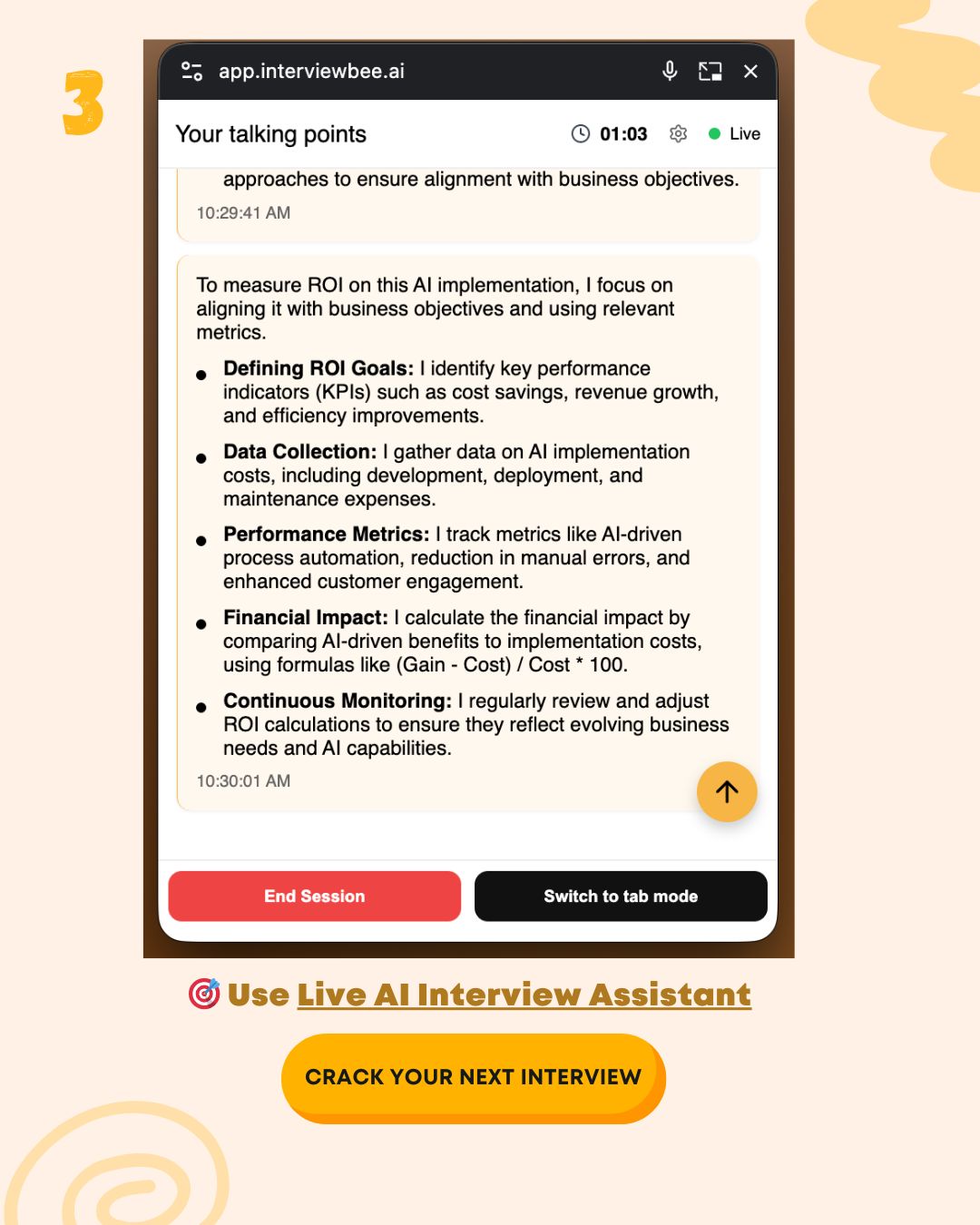
3. "How would you measure ROI on this AI implementation?"
This separates engineers from strategic thinkers. The question reveals whether you see AI as an end goal or a means to business outcomes.
How to answer: Connect metrics to business objectives. If you're discussing customer service automation, don't stop at "model accuracy." Trace it to resolution time, customer satisfaction scores, and cost per interaction. Acknowledge trade-offs, like speed vs. quality.
InterviewBee Live AI Interview Assistant
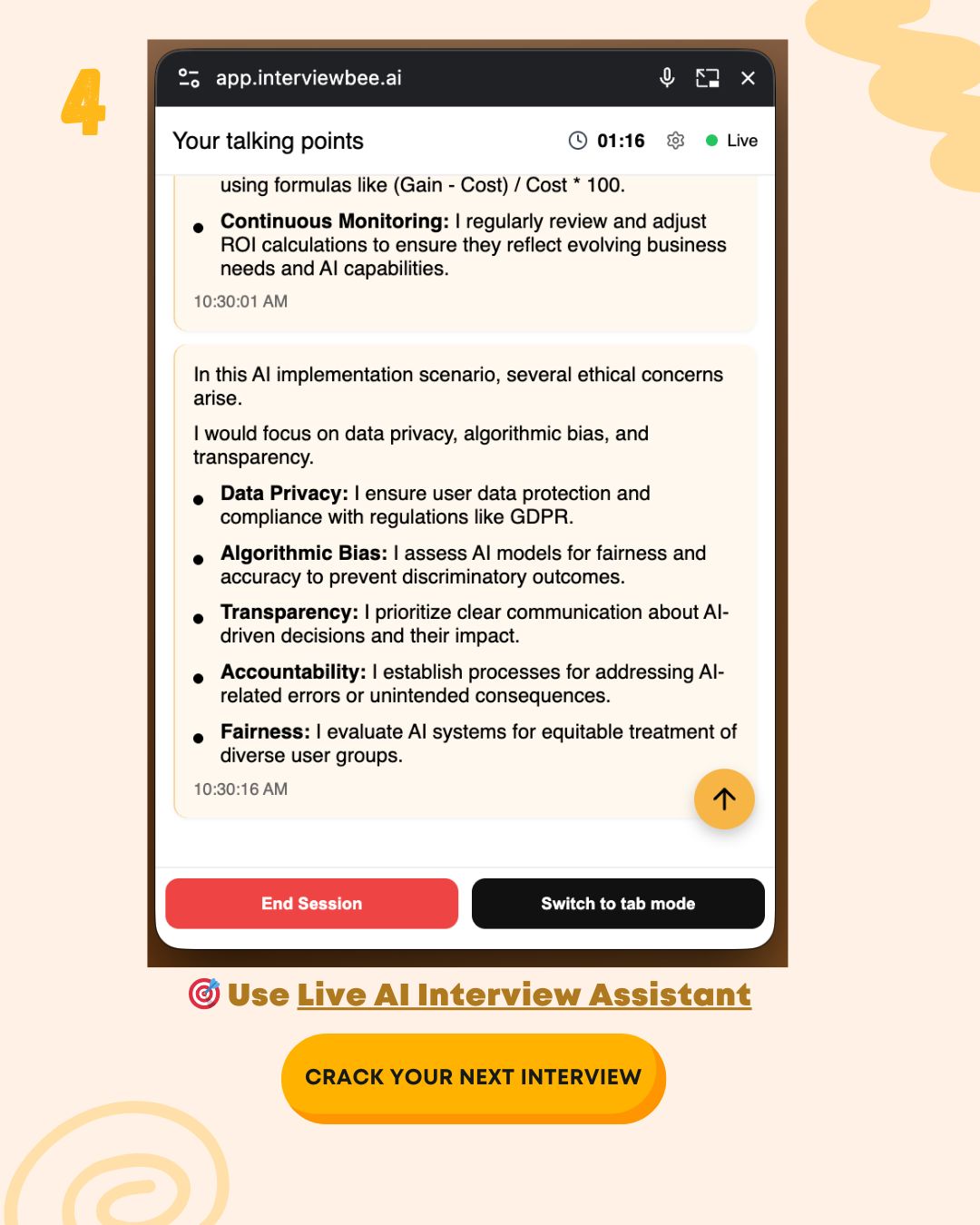
4. "What ethical concerns would you flag in this scenario?"
AI ethics has become non-negotiable. Forbes reports that only 46% of employers plan to expand skills-based hiring in 2026, partly due to concerns about bias and fairness in AI-driven screening.
How to answer: Identify stakeholders first, who could be harmed. Then name specific risks: training data bias, lack of transparency, data privacy violations. Propose mitigations like bias audits, human review for edge cases, and clear disclosure policies.
InterviewBee Live AI Interview Assistant
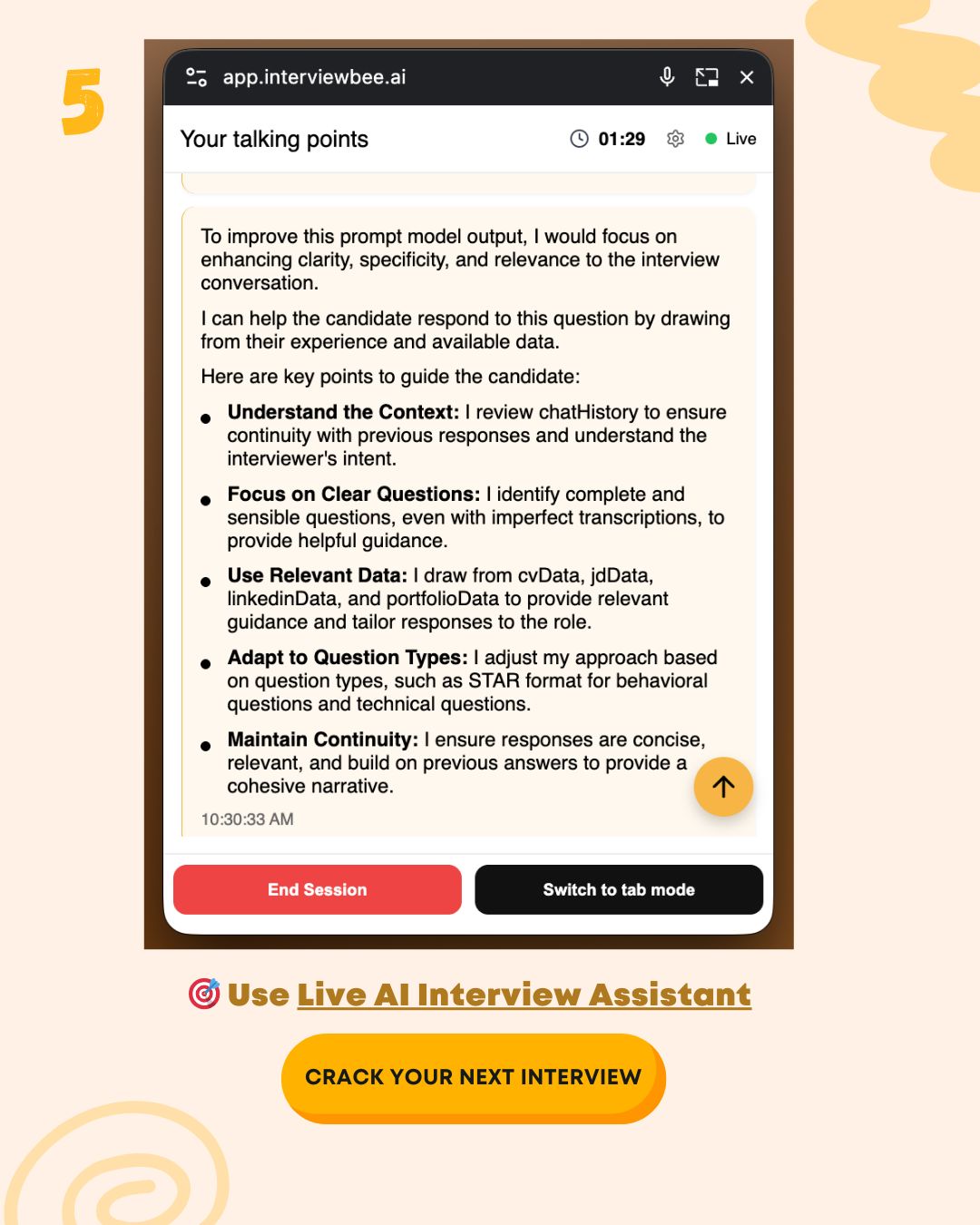
5. "Show me how you'd improve this prompt or model output."
This is a practical test of hands-on skills. Employers want to see systematic refinement, not random tweaking.
How to answer: Assess the current output first. Form a hypothesis about what needs adjustment, context, format, constraints. Change one variable, test it, measure results. Document what worked. If you're given a vague prompt producing generic summaries, show how adding specific structure ("summarize in three parts: likes, improvement areas, recommended action") sharpens the output.
InterviewBee Live AI Interview Assistant
Preparing for AI Interview Questions
Across all five questions, the pattern is the same: employers care more about your thinking process than your final answer. They want candidates who can diagnose problems, acknowledge uncertainty, and iterate.
To practice these scenarios before your interview, InterviewBee's Mock AI Interviewer simulates realistic AI-focused questions tailored to your resume and target role. If you want real-time support during live interviews, the Live AI Interview Assistant delivers talking points in under two seconds, invisible to your interviewer.
Not actively interviewing yet? The Job Hunter tool can match you with roles that fit your AI skills and experience.
The candidates who get offers in 2026 aren't those with the flashiest technical credentials. They're the ones who demonstrate clear thinking about what AI can and cannot do.
FAQs
Q: Do I need coding experience to answer AI skills assessment questions?
Not necessarily. Many AI interview questions focus on your ability to use AI tools, evaluate outputs, and think critically about applications. Product managers, marketers, and business analysts regularly pass these assessments without writing code. What matters is demonstrating that you understand how AI fits into workflows and where it has limits.
Q: How do I prepare if I've never worked with AI tools professionally?
Start with personal projects. Use ChatGPT or Claude to draft emails, summarize documents, or analyze data. Build a portfolio example where you used an AI tool to solve a specific problem. Interviewers care about your approach and what you learned, not whether it happened at a Fortune 500 company.
Q: What if I don't know the answer to a technical AI question during an interview?
Say so, then explain how you'd find out. Hiring managers prefer "I haven't worked with that specific model, but I'd start by reviewing the documentation and testing edge cases" over a fumbled guess. Honesty about knowledge gaps paired with a clear learning process scores higher than fake confidence.
Q: Are AI skills assessment questions the same across industries?
The core themes are consistent, learning methodology, failure awareness, ROI thinking, ethics, and practical refinement. But the examples differ. A healthcare company might ask about patient data privacy. A fintech firm might focus on fraud detection trade-offs. Tailor your examples to the industry you're interviewing for.
Q: How long should my answers be during an AI skills assessment?
Aim for 60 to 90 seconds per question. Use a clear structure: context (10 seconds), action (30-40 seconds), result (20-30 seconds). Rambling answers signal poor communication skills. If the interviewer wants more detail, they'll ask follow-up questions.