



15 Interview Mistakes and how to avoid them
- Author: Anindita Ghosh
- Published On: Aug 31, 2025
- Modified Date: Oct 27, 2026
- Category:Interview Guide
Walking into a job interview can feel like a high-stakes test where one wrong move ends your chances. The good news is that most rejections come from the same small set of common interview mistakes, and almost all of them are avoidable.
We reviewed advice from recruiters, HR leaders and hiring managers, including former Meta recruiter Jenn Bouchard and executives at ZipRecruiter, to identify the most common interview mistakes that lead to rejection. For each of the 15 common mistakes in job interviews below, you will see what recruiters notice and how to avoid it.
The stakes couldn't be higher. Leadership IQ research reveals that 46% of new hires fail within 18 months, with 89% of these failures attributed to attitude and soft skills , rather than technical gaps. Recruiters have become experts at spotting red flags that predict future performance problems, and they're not taking chances.
Most Common Interview Mistakes and How to Avoid Them
Here are the most common interview mistakes and how to avoid them, in one table.
| Sr No | Mistake | How to avoid it |
|---|---|---|
| 1 | Being late or rescheduling without notice | Test your route or video link the day before, arrive about 10 minutes early, and message the recruiter if anything changes |
| 2 | Not preparing | Research the company, role and interviewers, and rehearse "Tell me about yourself" and "Why us?" |
| 3 | Unprofessional behavior | Silence your phone, skip gum and food, and be courteous to everyone you meet |
| 4 | Giving generic answers | Use the STAR method and include one number or outcome in every story |
| 5 | Having no questions | Prepare 5 to 8 specific questions about the role, team and success metrics |
| 6 | Speaking negatively about past employers | Describe what you learned and what you are looking for next |
| 7 | Lying or exaggerating | Stick to facts and say clearly what the team achieved and what your part was |
| 8 | Contradicting your resume | Re-read your resume before the interview and keep titles, dates and numbers consistent |
| 9 | Not citing achievements | Prepare five quantified wins you can adapt to different questions |
| 10 | Getting defensive | Own the mistake, explain what you changed and move on |
| 11 | Sounding arrogant | Credit your team and show curiosity, not just confidence |
| 12 | Making it all about money | Lead with value and fit, and raise pay at the right moment |
| 13 | Ignoring culture fit | Read the company values and give honest examples that connect to them |
| 14 | Poor communication | Pause, answer in a clear structure and do not interrupt |
| 15 | Poor follow-up | Send a thank-you within 24 hours and one polite follow-up if you do not hear back by the stated date |
The Foundation Breakers: Common Interview Mistakes That Signal Unprofessionalism
1. The Punctuality Problem
"They're late or reschedule without a good reason. Life happens, but consistently rescheduling interviews or showing up late without communication shows a lack of respect for your time," explains a hiring manager from a Toronto recruiting firm.
The Reality Check: 84% of employers consider punctuality a critical factor in hiring decisions. Being late signals that you may not prioritize important commitments or respect others' time. Emily Levine, Executive Vice President at Career Group Companies, notes that even "showing up very early looks 'too eager'" and can backfire.
What This Really Means: Punctuality is viewed as a fundamental indicator of how you'll handle workplace responsibilities, client meetings, and project deadlines.
2. The Preparation Disaster
Ana Colak-Fustin, HR Consultant at ByRecruiters, explains the devastating impact of poor preparation: "The lack of preparation is obvious from the start. They stumble over the standard opener ('Tell me about yourself') and struggle when asked basic questions about the company or why they're a fit for the role. That absence of preparation is a dealbreaker because it signals low interest and questionable motivation."
This early misstep shows why the critical first 4 minutes of an interview can set the psychological anchor for the rest of the conversation.
The Test Questions: If you can't answer "What does our company do?" or explain why you want this specific role, you've already failed. Amy Garefis, Chief People Officer at ZipRecruiter, is blunt: "You should never walk into an interview without doing your research."
Behind the Scenes: Recruiters interpret a lack of preparation as a preview of how you'll approach the actual job with minimal effort and engagement. This is one of the most preventable interview mistakes with proper job interview tips.
3. The Behavior Breakdown
Some unprofessional behaviors are so shocking that they become instant conversation stoppers. A hiring manager in Ireland's tech sector reported candidates "taking a phone call during an interview, vaping during an interview, getting up and leaving the room, telling us 'I'll be back in a few minutes.'"
The Smaller Sins: Even seemingly minor infractions matter. Emily Levine warns against "chewing gum" or "having your sunglasses on your head" during interviews. Business Insider research shows that swearing, especially "angrily swearing at someone," can immediately disqualify candidates.
The Communication Catastrophes: How You Present Yourself
4. The Generic Response Trap
"When a candidate answers questions like, 'Tell me about a time you handled a difficult situation,' with broad, non-specific statements (e.g., 'I always try to stay calm and solve the problem'), it signals a lack of real experience or preparation," explains HR Consultant Ashish Gaur.
Understanding the psychology behind interview questions helps you decode what the interviewer is genuinely testing rather than giving surface-level replies.
What Recruiters Really Think: Vague responses often indicate you're "fabricating or embellishing," "haven't taken time to reflect on your actual experiences," or "don't know how to communicate impact." This communication failure frequently leads to interview rejection.
The STAR Method Reality: Recruiters expect Situation, Task, Action, Result. Anything less suggests you either lack experience or can't articulate your value.
5. The Question-Less Candidate
Former Meta recruiter Jenn Bouchard identifies this as her biggest red flag: "If candidates don't have follow-up questions or if they just say 'I've had all of my questions answered,' that's a red flag. Having worked in talent acquisition for more than 15 years, I learned that the absence of questions from candidates generally signals 'disinterest' in the job."
The Strategic Importance: Asking thoughtful questions demonstrates engagement, preparation, and genuine interest. It also shows you're evaluating the opportunity, not just desperate for any job.
6. The Negativity Spiral
"If you have had multiple jobs, and you left because everything was everyone else's fault at every place you've been," notes one hiring manager from Reddit's recruiting community. Thomas Jennings, an Executive Recruiter, explains: "You start catching these trends of 'Well, I had an issue with my manager, and I had another issue with a manager…maybe that candidate is actually the issue."
Professional Assessment: Robbin Schuchmann, Global Employment Expert, states: "There are many candidates who slip up by speaking negatively about past roles or colleagues. This is a red flag because it implies a lack of professionalism and raises doubts about how they will handle challenges on my team."
The Credibility Crushers: Mistakes That Destroy Trust
7. The Honesty Catastrophe
Tessa White, former head of HR and CEO of The Job Doctor, is emphatic: "Don't ever lie in an interview. You'd be surprised how much goodwill you get from your interviewer when you give authentic insight into your career growth, and you can talk honestly about what you've learned along the way."
Detection Reality: Alex Martinez, Lead Recruiter at Nova Industries, shares: "I caught a candidate exaggerating their role on a past project. If they're not honest in the interview, it's a huge risk to hire them."
The Trust Factor: Once credibility is damaged, there's no recovery. Recruiters recognize that dishonesty in interviews is a predictor of workplace integrity issues.
8. The Inconsistency Problem
Corporate recruiters report that "contradiction between what is being said and what is on the CV" and providing "one-liners for answers to questions" are immediate red flags. When your interview responses don't align with your resume, it raises questions about both preparation and honesty.
9. The Achievement Vacuum
Executive recruiting experts note: "One significant red flag is when a candidate cannot provide specific examples of their achievements or contributions in previous roles. Executives are typically responsible for driving significant results, so they should be able to articulate clear, measurable accomplishments."
The Standard: Strong candidates provide examples like "I increased sales by 20% over two years by implementing a new marketing strategy" rather than vague statements about "contributing to team success."
10. The Defensive Response
Megan Hill, HR Director at Brightside Ventures, warns: "Candidates who always have excuses and blame others for their failures worry me. Accountability is key, and if they don't have it, they won't last."
Executive Wisdom: Charlene Li and John Chambers from Cisco Systems consider the inability to acknowledge failures critical: "Everyone makes mistakes. Everyone fails. Why would you want to hire someone unwilling to admit they failed?"
Tell Me About a Time You Made a Mistake
The interview question "tell me about a time when you made a mistake" is a trap only if you treat it like one. Recruiters use it to test accountability, self-awareness and learning, which are exactly the traits behind mistakes 7 and 10 above. For more examples, see our guide to behavioral interview questions about failure.
A simple formula:
- Pick a real, work-related mistake with limited impact.
- Say what happened in one or two sentences.
- Own your part with no excuses.
- Explain what you did to fix it.
- Share what you do differently now.
Sample answer:
Early in my career I scheduled a client presentation on the wrong date because I trusted a calendar invite without confirming it. I realised two days before and called the client right away, apologised and moved the meeting by a day. The client was fine, but I was not. I now confirm every external meeting in writing and put a reminder on the day before. I have not missed a date since.
Avoid blaming others, picking a fake weakness ("I'm a perfectionist"), or saying you have never made a mistake.
The Cultural Mismatches: Showing Poor Fit
11. The Arrogance Problem
Sean Clancy, Managing Director at SEO Gold Coast, recalls: "I interviewed a candidate for a senior SEO role who spent the entire time dismissing other strategies as 'basic' or 'outdated,' even when those methods were proven to work."
Professional Assessment: Sandra Lopez, Talent Acquisition Manager at Horizon Global, observes: "Arrogance is usually a mask for insecurity. I look for candidates who are confident yet humble because those are the team players we need."
12. The Money-First Mentality
Rajesh Nair, Head of HR at Jindal Steel & Power, identifies this as a critical red flag: "Negotiating salary is not bad at all, but when it becomes the only point in the conversation, it becomes a concern."
Market Reality: According to IQ Partners' research, having "salary expectations that are too high" is among the top reasons employers reject candidates.
13. The Culture Clash
GA Rogers recruiting notes: "A red flag during the interview process is when a candidate's values, attitudes, or communication style don't appear to mesh with the company's culture."
Assessment Criteria: Lydia Grant, Chief People Officer at Urban Nest, explains: "Values alignment is crucial. I look for clues in how candidates talk about their past work and what they value in a workplace."
14. The Communication Breakdown
Sara Patel, HR Coordinator at TrueNorth Digital, explains: "Good communication is non-negotiable. If a candidate can't clearly articulate their thoughts, it's a struggle to envision them in a client-facing role."
Team Dynamics: James Roberts, Senior Recruiter at Delta Systems, notes: "Candidates who interrupt often don't listen well, which is a big problem in team environments where collaboration is key."
15. The Follow-Through Failure
While not following up doesn't always result in immediate disqualification, inappropriate follow-up behavior (such as excessive contact or unprofessional communication) can damage candidacy. Candidates who fail to maintain appropriate communication throughout the process may be eliminated, particularly when other equally qualified candidates demonstrate better engagement.
Common Mistakes in Job Interviews on Video Calls
Virtual interviews add their own list of common interview mistakes. Avoid these:
- Tech problems: Test your camera, microphone, internet and the meeting link at least a day ahead.
- Poor framing and lighting: Keep the camera at eye level with light in front of you, not behind.
- Cluttered or distracting background: Use a tidy, neutral space or a subtle blur.
- Reading from a script: Use short notes and look at the camera to maintain connection.
- Multitasking: Close other tabs and silence notifications.
- Skipping the small talk: A friendly opening helps in the first minutes when impressions form.
Interview Mistakes to Avoid: Before, During and After Checklist
Pre-Interview Preparation Checklist
Research Deep Dive:
- Company mission, values, and recent news
- Role requirements and team structure
- Interviewer backgrounds (LinkedIn research)
Story Bank Development:
- 5-7 STAR method stories covering different competencies
- Specific metrics and outcomes for each story
- Failure stories with lessons learned
- Examples of teamwork, leadership, and problem-solving
Question Preparation:
- 8-10 thoughtful questions about the role, team, and company
- Focus on growth opportunities and team dynamics
During the Interview: Success Strategies
Professional Presence:
- Arrive 10-15 minutes early (not too early)
- Maintain eye contact and engaged body language
- Take notes during the conversation
Communication Excellence:
- Use the STAR method for behavioral questions
- Provide specific examples with measurable outcomes
- Ask clarifying questions when needed
- Speak positively about all past experiences
Engagement Demonstration:
- Reference your research in responses
- Ask thoughtful follow-up questions
- Show genuine curiosity about the role
Post-Interview Follow-Through
- Send thank-you email within 24 hours
- Reference specific conversation points
- Reiterate your interest and qualifications
The Bottom Line: Zero Tolerance for Fundamental Mistakes
The pattern across recruiters is consistent: technical skills may get you the interview, but behavior, communication and honesty decide who moves forward. Most of the common interview mistakes above come down to preparation and self-awareness, which you can practise. Prepare your stories, research the company, ask good questions and follow up professionally. Every interview is a chance to show the opposite of these mistakes.
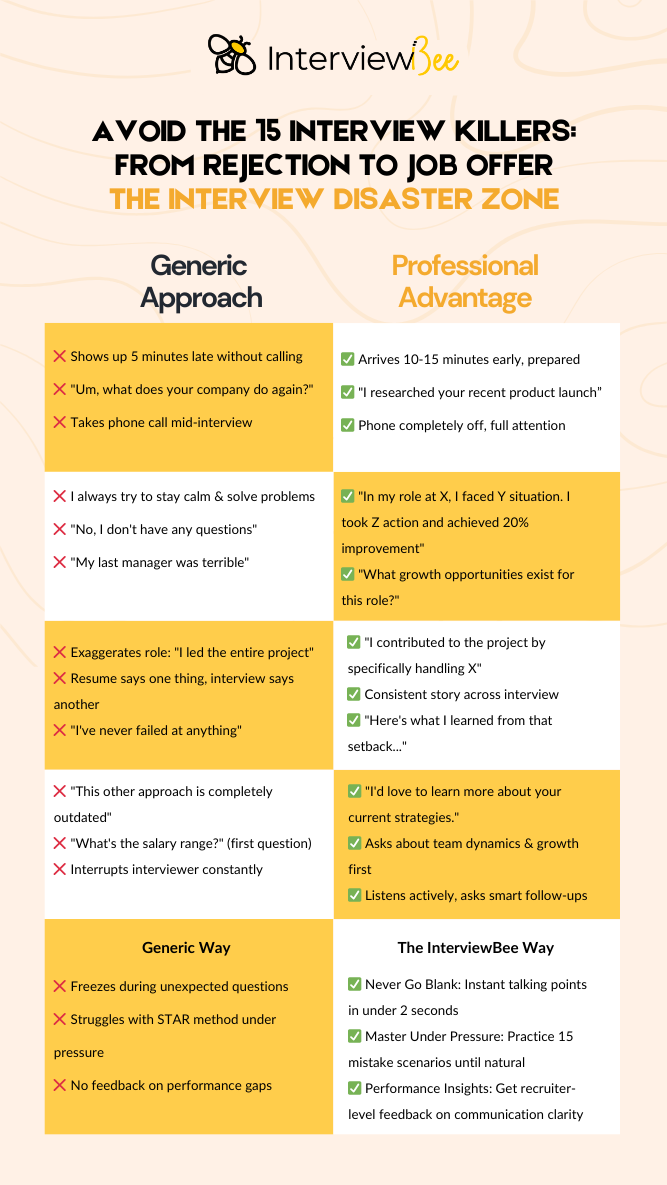
Overcome These Interview Mistakes with Smart Preparation
The difference between candidates who freeze during "Tell me about yourself" and those who deliver compelling STAR-method responses? Targeted practice and real-time support.
- Master Your STAR Stories: Practice behavioral scenarios until your responses become natural and impactful, eliminating the generic response trap that kills candidacies.Consistent mock interview practice helps build the muscle memory needed for tougher questions.
- Never Go Blank Again: Get instant talking points tailored to your resume during live interviews. Structured responses ready in under 2 seconds for unexpected questions about conflicts or failures.
- Practice Under Pressure: Experience realistic simulations that mirror recruiter challenges, from difficult questions about past employers to demonstrating cultural fit. These job interview tips help avoid common pitfalls.
- Get Performance Insights: Receive detailed feedback on communication clarity and answer structure, the same criteria recruiters use to evaluate candidates.
- Stay Invisible and Confident: The live AI assistant works undetected during video interviews, ensuring natural conversation flow while providing intelligent support when needed.
Ready to ace your next interview? Start with InterviewBee's free mock interview simulation and experience the confidence that comes from being truly prepared. Avoid interview rejection with expert guidance and practice.
Frequently Asked Question
How can I recover if I've already made one of these interview mistakes?
If you catch yourself making a mistake during the interview, acknowledge it briefly and redirect positively. For example, if you realize you gave a vague response, say "Let me be more specific about that" and provide concrete details. If you spoke negatively about a previous employer, pivot to lessons learned and positive outcomes. The key is not to dwell on the mistake but demonstrate self-awareness and adaptability.
What should I do if I've made these mistakes in past interviews and want to improve?
Start by identifying which specific mistakes you've made, then practice structured responses using the STAR method for behavioral questions. Focus on developing 5-7 specific stories that demonstrate your skills with measurable outcomes. Use InterviewBee's mock interviews to practice handling difficult questions like conflicts with managers or project failures, ensuring you can respond professionally under pressure.
How do I avoid freezing when asked "Tell me about yourself" or other common questions?
Prepare a 60-90 second elevator pitch that covers your background, key achievements, and interest in the role. Practice this response until it feels natural, not memorized. For unexpected questions, use the STAR framework as your safety net - it provides structure when you need time to think. Having real-time support from InterviewBee during live interviews can also provide instant talking points when you feel stuck.
Which of these 15 mistakes is most likely to end my chances immediately?
Being late without communication, lying about experience, or displaying unprofessional behavior (like taking calls during the interview) are typically automatic disqualifiers. However, showing complete lack of preparation - not knowing basic company information or being unable to explain why you want the role - is equally damaging because it signals disinterest. Focus on thorough preparation and authentic professional behavior to avoid the most critical mistakes.
What are the most common mistakes in job interviews on video calls?
Technical problems, poor lighting or framing, distracting backgrounds, reading from a script and multitasking.
What interview mistakes should I avoid first?
Start with punctuality, preparation and specific, structured answers. These three fix a large share of the avoidable errors.