
Amazon Business Analyst Interview Guide
Overview
The interview of the Amazon Business Analyst is characterized by a strict evaluation of technical expertise and cultural suitability. Business Analysts at Amazon operate between data and business efforts, utilizing SQL, Python, specialized analytics tools (Tableau, QuickSight, Power BI), and programming languages like R or Go to create reports, metrics tracking, and strategic support to teams such as Operations, AWS, Retail, and Logistics.
This guide applies to Level L5 (Business Analyst II) and L6 (Business Analyst III) interviews, but the general framework applies to any other level.
Interview Structure
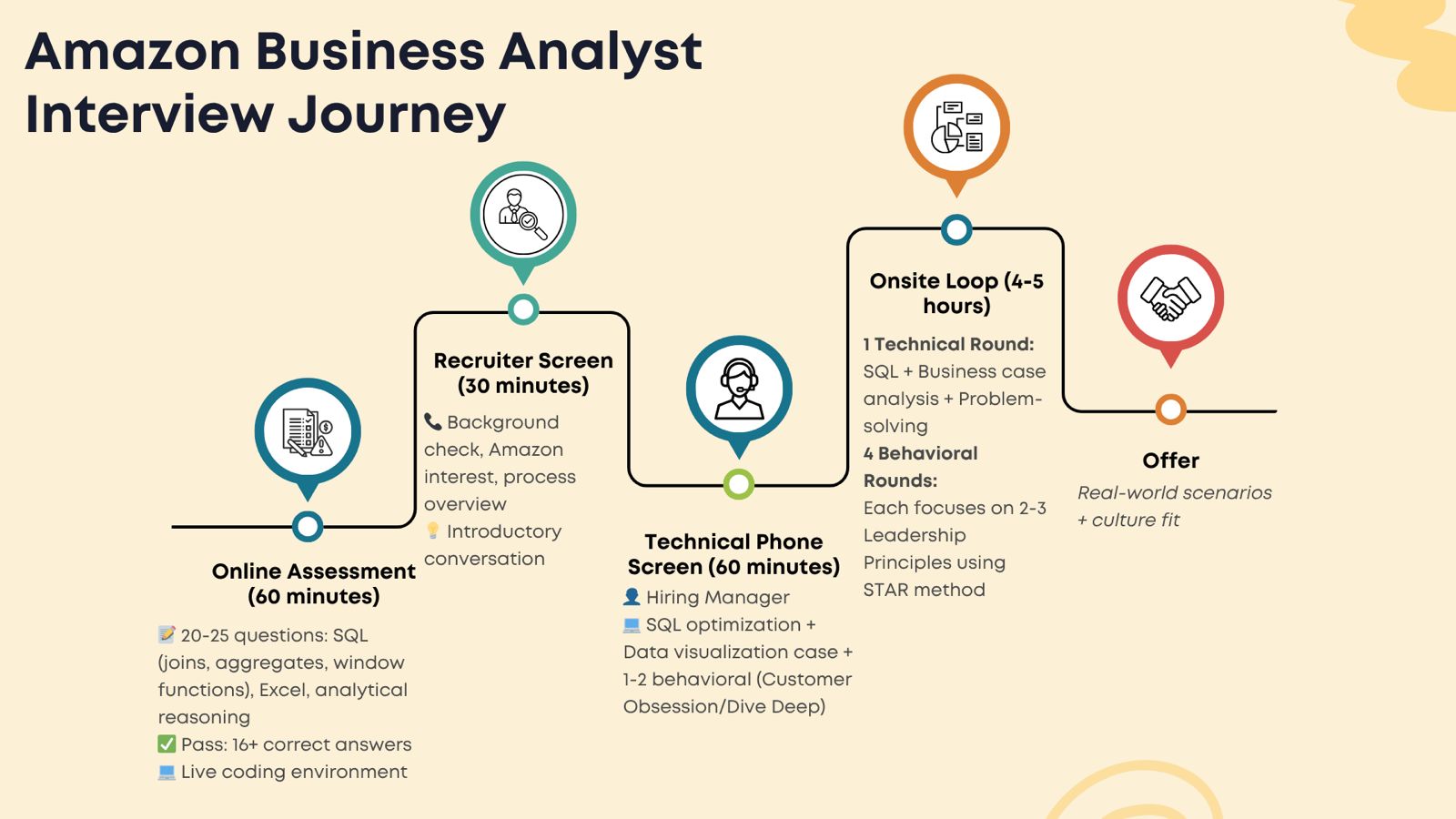
The Amazon Business Analyst (BA) interview is normally administered in 6–8 rounds:
1. Online Assessment (60 minutes)
Anticipate 20–25 questions on SQL and Excel, and analytical reasoning. You will be writing queries in a live code environment and resolving business logic problems. SQL queries are centered on joins, aggregates, and window functions. The threshold is normally 16+ correct answers.
Sample Question: Given two tables - orders and customers - write a SQL query to find the top 10 customers by total purchase amount in the last 90 days, excluding cancelled orders.
2. Recruiter Screen (30 minutes)
General introductory call and background information, interest in Amazon, and summary of the recruitment process.
Sample Question: Why are you interested in the Business Analyst role at Amazon, and how does it align with your career goals?
3. Technical Phone Screen (60 minutes)
Administered by the hiring manager. Covers SQL code (and query optimization in particular), case study of a data visualization project, and 1–2 behavioral questions based on Leadership Principles such as Customer Obsession or Dive Deep.
Sample Question: A product's conversion rate dropped 15% last week. Walk me through how you would investigate this issue using data analysis.
4. Onsite Loop (4–5 hours)
It is a combination of 5 individual interviews:
- A single technical round consisting of SQL, business case analysis, and problem-solving.
- Four behavioral interviews, each emphasizing 2–3 Leadership Principles.
Sample Technical Question: Design a dashboard to track delivery performance for Amazon Prime. What metrics would you include and why?
Sample Behavioral Question: Tell me about a time when you had to make a decision with incomplete data. What was your approach? (Bias for Action)
Technical Skills Required
SQL
You will need to exhibit skill in writing effective queries on big data. Be ready to work with CTEs, window functions, and subqueries, as well as explain optimization methods such as indexing or partitioning.
Data Visualization
You do not need to have been using any particular tools (Tableau, Power BI, QuickSight), but you must be able to explain why you would use specific visualizations—scatter plots to find correlations, box plots to find distributions, line charts to find trends—and how dashboards help make decisions.
Business Acumen
In L5, demonstrate that you can resolve issues within your area. In the case of L6, it will require showing strategic thinking and cross-team initiatives that have quantifiable business results.
Leadership Principles
Amazon conducts cultural fit assessments using behavioral questions based on its Leadership Principles. Before your interview, review Amazon's official Leadership Principles. In BA roles, it is likely to pay much attention to:
- Dive Deep: How have you used data to identify root causes or disprove assumptions?
- Customer Obsession: The number of times you have put the needs of the customers at the centre stage of your analysis.
- Bias for Action: Decision-making in the absence of full information.
- Ownership: Doing what is not in your job description.
- Deliver Results: Achieving projects regardless of the challenges.
Preparation Tips
- Practice SQL on platforms like LeetCode or HackerRank, focusing on medium-to-hard-level problems involving multiple joins and aggregations.
- Create a "story bank" with 8–10 examples mapped to various Leadership Principles.
- Review business case frameworks; you may be requested to review downward-moving metrics or recommend means of growth.
- Practice speaking out what you are thinking because interviewers appreciate clarity and logical thinking.
Timeline
An online assessment to offer normally takes 1–4 months.
Compensation (2025)
- L5 (BA II): $130K total compensation
- L6 (BA III): $186K total compensation
- L7 (Principal BA): $318K total compensation (total).
Amazon Business Analyst interviews are intensive and yet formal. Dwell upon the technical basics, have ready-to-go examples, and show how you are using data to move the business.
Your InterviewBee AI Mock Interviewer
To crack the demanding BA interview procedures of Amazon, one should do more than memorizing SQL queries and Leadership Principles. You must do some real practice that replicates the real interview. InterviewBee AI Mock Interviewer can help you prepare with:
- SQL and technical scenario practice based on the style of assessment used by Amazon.
- Behavioral training of Leadership Principles with STAR method feedback.
- Simulation-based interviewing that replicates onsite interviewing at Amazon.
- Individual feedback on your technical explanation and clarity of communication.
Regardless of whether you are practicing the technical phone interview or the behavioral rounds, InterviewBee provides you with the practice setting, including access to Amazon Business Analyst interview questions, so you can develop confidence and perfect your answers before the actual interview.