


SRE Interview Questions: The Incident Postmortem Question That Eliminates 65% of DevOps Candidates
- Author: InterviewBee Team
- Published On: Jun 25, 2026
- Category:Technical Interviews
You've studied Kubernetes scheduling internals. You can explain the difference between a pod disruption budget and a priority class. You've got three years of on-call experience and scars to show for it.
Then the interviewer asks: "Walk me through how you handled a significant incident at your last company. What was your role, and how did you approach the postmortem?"
And you talk about the incident. The timeline, the tooling, the technical root cause. You explain how you tracked down the misconfigured HPA, rolled back the deployment, added a circuit breaker.
You don't get the callback.
The problem isn't what happened in the incident. It's how you talked about it.
What SRE Interviewers Are Actually Evaluating
Site reliability engineers get tested on two tracks: the technical depth track, which covers distributed systems, alerting, SLOs, and capacity planning, and the operational culture track. Most candidates prepare obsessively for the first and almost not at all for the second.
The postmortem question lives squarely on the operational culture track. What the interviewer is evaluating is not whether you fixed the problem. They assume you did, or you would not be interviewing. They are evaluating whether you think about incidents the way mature engineering organizations do.
Specifically, they are looking for four things:
- Structured thinking under pressure. Did you have a clear role and a clear process, or was the response chaotic? Interviewers want to see that you understand incident management as a system: severity classification, incident commander, communication cadence, and mitigation before root cause.
- Blameless framing. This is the one that eliminates most candidates. Blameless postmortems, the Google SRE model and the approach adopted by every serious engineering organization, operate on a foundational assumption: people do not cause outages, systems do. Candidates who narrate incidents by identifying who misconfigured what reveal that their organization's, or their own, mental model has not made this shift.
- Impact quantification. Strong candidates measure what happened in user-facing terms: error rate, p99 latency impact, affected requests per minute, revenue, or SLA implications. Weak candidates describe incidents in internal terms without connecting to what it meant at the product level.
- What changed after. The postmortem output is the proof that the organization learns. Candidates who explain what specific, measurable action items were created, tracked, and closed demonstrate that they have worked in cultures that treat reliability as a continuous improvement discipline.
The Framework Interviewers Want to Hear
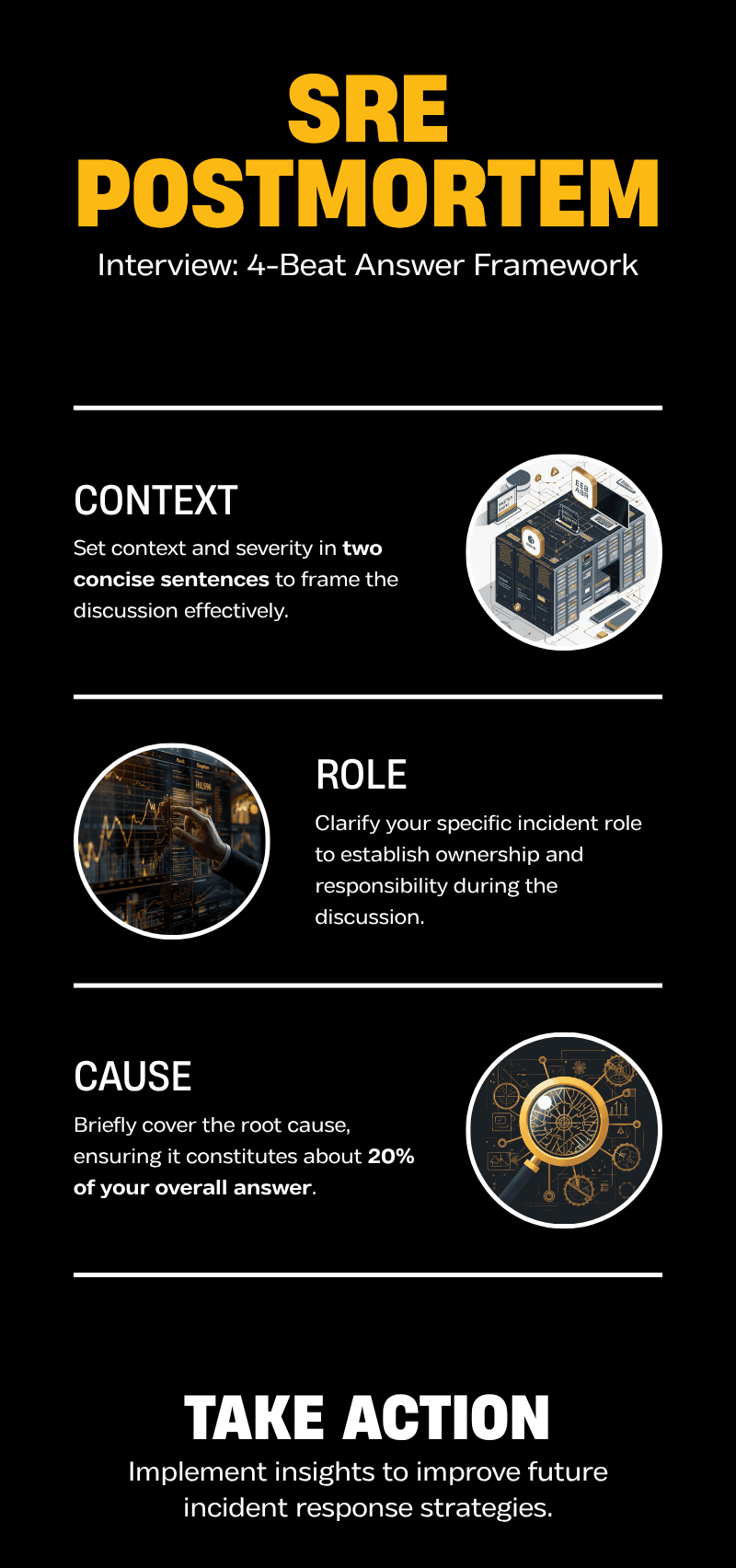
When you are asked a postmortem question, structure your answer in four beats. You do not have to announce the structure. Just follow it.
Beat 1: Context and severity
Set the stage in two sentences. What was the service, what was the user impact, and what was the severity classification? For example: "This was a Sev2. Our payments service was returning 503s for approximately 18% of checkout attempts over a 40-minute window."
Beat 2: Your role in the response
Be precise about what you personally did. "I was on-call and took the incident commander role. My job was coordinating the response, not solving the technical problem. I pulled in two engineers from the backend team while I managed stakeholder comms and status page updates." This matters because it shows you understand that incident management is a role, not a function of who is most senior or most technical in the room.
Beat 3: The root cause and resolution, briefly
This is where most candidates spend 80% of their answer. You should spend about 20%. The technical detail matters, but it is not the interview's center of gravity. "We traced the root cause to a misconfigured rate limit on an upstream dependency that had been introduced in a config change six hours earlier. We mitigated by rolling back the config change; the full fix was deployed 36 hours later after testing."
Beat 4: Postmortem output and follow-through
This is where the real signal lives. Walk through what the postmortem produced: the specific action items, who owned them, and what actually got done. "We ran a blameless postmortem two days later. Three items came out: adding automated config validation to the CI pipeline, improving our canary rollout threshold for config changes, and adding dependency SLO visibility to our reliability roadmap. I tracked all three to closure."
The Postmortem Questions That Trip Candidates in Follow-Up
Expect the interviewer to probe. Common follow-ups include:
How did you communicate with stakeholders during the incident?
They are checking whether you maintained a clear communication cadence, used a defined status update format, and separated the stakeholder channel from the technical war room.
What would you have done differently?
This is not a trap. It is an invitation to demonstrate intellectual honesty. Give a real answer, not "nothing, we handled it well," and not a minor tactical detail designed to look reflective. The best answers identify a systemic gap, such as a missing escalation path for a dependency tier.
How do you prevent recurrence versus mitigating immediately?
They are checking whether you understand the distinction between mitigation, remediation, and root cause elimination. Stopping the bleeding is not the same as changing the system so the same failure mode cannot recur.
How to Build Fluency Before the Interview
Knowing the postmortem framework is step one. Delivering it fluently under the pressure of a live technical interview, with an SRE lead probing your follow-up answers, is a different skill entirely.
The gap between knowing this and performing it is closed by practice reps in realistic conditions. InterviewBee's AI mock interviewer runs role-specific behavioral and technical sessions that simulate this kind of structured probing, including follow-up questions that push on the things interviewers actually test.
Most SRE candidates who fail postmortem questions are not bad at SRE. They are narrating incidents the way they lived them, as technical problems to be solved, rather than as systemic events to be analyzed. That is a framing shift, and it is one you can practice before the interview.
Frequently Asked Questions
What is the SRE incident postmortem interview question testing?
It tests whether you understand incident response as an operational system, not just as a technical debugging exercise. Interviewers look for structure, ownership, blameless reasoning, impact measurement, and clear follow-through after the incident.
How should I structure an SRE postmortem answer?
Use four beats: context and severity, your role in the response, the root cause and resolution briefly, and the postmortem output with action items. The strongest answers spend less time on the technical timeline and more time on learning and prevention.
Should I name who caused the incident?
No. Strong SRE answers use blameless framing. Focus on system conditions, missing safeguards, weak processes, unclear ownership, and prevention work rather than blaming an individual engineer.
What metrics should I include in an incident story?
Use user-facing and reliability metrics where possible, such as error rate, p99 latency, affected requests, downtime window, SLA or SLO impact, revenue exposure, customer impact, and time to mitigation.
How can I practice SRE incident interview questions?
Practice aloud with realistic follow-ups. A good session should push you on communication cadence, escalation, mitigation versus remediation, blameless postmortem output, and whether the action items were actually tracked to closure.