

Real Interviewers Don't Stop at Your First Answer — Here's Why Static Practice Questions Don't Prepare You for the Follow-Up
- Author: InterviewBee Team
- Published On: Aug 05, 2026
- Category:Interview Tips
You rehearsed the story a dozen times. The team hit a deadline, everyone pulled together, the project shipped two days early. You deliver it smoothly, hit every beat, and then the interviewer asks one line that undoes all of it: "Okay — but what did you specifically do?"
Suddenly the story you know cold doesn't have an answer ready. You default back to "we," because "we" is what you practiced. The interviewer just found the gap between an answer you memorized and an answer you actually own.
This happens more than people expect, especially to recent grads who spent weeks building a bank of STAR answers and assumed reciting them well was the finish line. It isn't. It's the opening line.
Why the First Answer Was Never the Real Test
Interviewers aren't grading your prepared story. They're grading how you hold up under a question you didn't see coming. That's the actual signal they're after — not whether you can deliver a polished narrative, but whether the narrative is real enough to survive being pulled apart.
A first answer tells an interviewer what you were willing to prepare. A follow-up tells them what you actually did. The questions that separate a rehearsed candidate from a strong one are almost always some version of:
- "What did you specifically do?" — isolating your role from the team's
- "What would you have done differently?" — testing self-awareness, not just outcome
- "Walk me through the moment that went wrong." — testing whether the polished version is the whole story
None of these show up if you're practicing from a static list of questions and answers. They only show up in the follow-up — the part of the conversation static practice questions never simulate.
The Practice Gap Nobody Talks About
Most interview prep — flashcards, question banks, a friend reading questions off a list — stops the moment you finish your answer. Broken down, that's actually four separate gaps:
- No probe. Nothing asks "but what did YOU do" after your first answer, so you never find out where the "we" is hiding an "I."
- No pressure-test. You never learn whether the polished version of your story survives someone pushing back on it.
- No adaptation. A fixed question list can't react to what you actually said — it just moves to the next card either way.
- No repetition under scrutiny. You never get asked the follow-up enough times for answering it to stop feeling like an ambush.
That gap stays invisible until you're sitting across from a real interviewer who does exactly what a script never does: listens, then digs. And the digging isn't random. Interviewers develop an instinct for spotting the collective "we" and the vague middle of a story — the parts most candidates haven't rehearsed, because most practice tools never ask.
The candidates who handle this well aren't smarter or more experienced. They've just been asked the follow-up before, enough times that answering under a second layer of scrutiny stops being a surprise and starts being a reflex.
This is especially rough for recent grads, and it's not really about experience level. It's about exposure count. A candidate who's been through five real interview loops has probably had the "what did you specifically do" question asked at least once, and that single repetition changes how the next answer comes out — slower, more specific, less rehearsed-sounding. Someone interviewing for the first time hasn't had that repetition yet, and a stack of flashcards can't manufacture it. You can't practice your way into recognizing a follow-up if nothing you've practiced with has ever asked you one.
Building the Reflex, Not Just the Answer
You can't build that reflex by writing better answers. You build it by practicing in a format that actually pushes back. Specifically, that means:
- Something is listening to what you actually say — not running down a fixed script regardless of your answer.
- It follows up on the specific gap in your answer. If you stay at the team level, it asks what your individual part was. If you gloss over a mistake, it asks what you'd change.
- You find out where the answer needed one more layer of detail — the same layer a real interviewer would have asked for anyway, but before it costs you the round.
This is the specific gap InterviewBee's Mock AI Interviewer is built to close. It doesn't run through a fixed script and move on the moment you've said something reasonable — the adaptive follow-up is the whole point, mock interview practice built around the exact moment static prep leaves you exposed.
What to Actually Do Before Your Next Interview
Skip the flashcards, or at least stop treating them as the finish line. When you practice a behavioral answer, don't stop after your first pass — ask yourself the follow-up before anyone else does:
- What did I specifically do — not the team? Isolate your individual role in the story, out loud, before someone makes you do it live.
- What's the one thing I'd change if I ran it back? If you can't answer this in a sentence, the story is missing the self-awareness interviewers are actually listening for.
- Where's the vaguest sentence in my story? Find it, then get specific about exactly what happens there if someone asks you to elaborate.
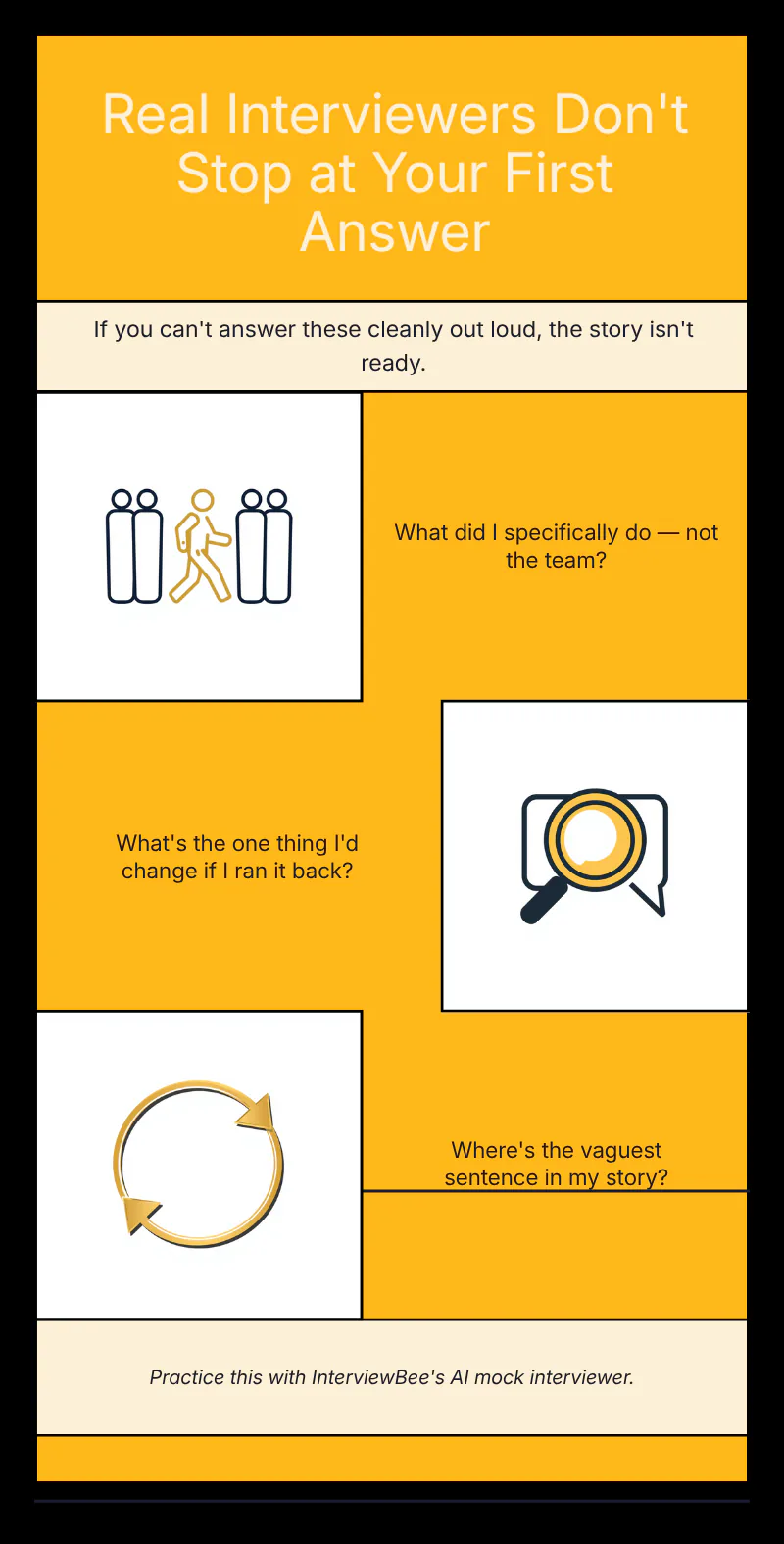
If you can't answer those three cleanly out loud, the story isn't ready — no matter how many times you've said it. That's the difference between an answer you memorized and one you actually own, and it's the only difference a real interviewer is checking for.
It's worth saying plainly: none of this means your prep so far was wasted. Having ten polished stories ready is still the right foundation — it's just not the whole building. The follow-up is where the foundation gets tested, and that's the part worth practicing on purpose instead of hoping it goes fine on the day.
Practice this with InterviewBee's AI mock interviewer — free to start. It's built to ask what real interviewers ask, including the question after your first answer.
Start practicing with InterviewBee →
Frequently Asked Questions
Why do interviewers ask follow-up questions?
Interviewers use follow-up questions to verify your individual contribution, test the depth and accuracy of your story, and see how you respond when the conversation moves beyond a rehearsed answer.
Which interview follow-up questions should I practice?
Practice explaining what you specifically did, what you would change if you repeated the situation, and the details behind the vaguest part of your story. These probes reveal ownership, self-awareness, and depth.
Why are static interview question lists not enough?
Static lists move to the next prompt regardless of what you say. They cannot detect vague language, challenge a team-level answer, or adapt their next question to a gap in your response.
How can recent graduates prepare for interview follow-ups?
Recent graduates can answer behavioral stories aloud, identify where they rely on "we" instead of "I," and practice with an adaptive mock interviewer that listens and asks specific follow-up questions.