



McKinsey First Round Interview: The 3 Case Archetypes That Separate Passes From Dings
- Author: InterviewBee Team
- Published On: Jun 16, 2026
- Category:Management Consulting
You prepared for months. You polished your resume, landed the referral, and somehow got the McKinsey first-round invite. Now you are searching for what the process actually involves and wondering whether your preparation maps to how McKinsey interviews work.
Most candidates treat McKinsey like a harder version of a corporate job interview. It is not. The format and scoring are different, and applying a short STAR answer to a Personal Experience Interview (PEI) can undermine an otherwise strong performance.
This guide explains what happens in a McKinsey first round, the three case archetypes to prioritize, and why the PEI requires a different kind of preparation.
What Actually Happens in a McKinsey First Round
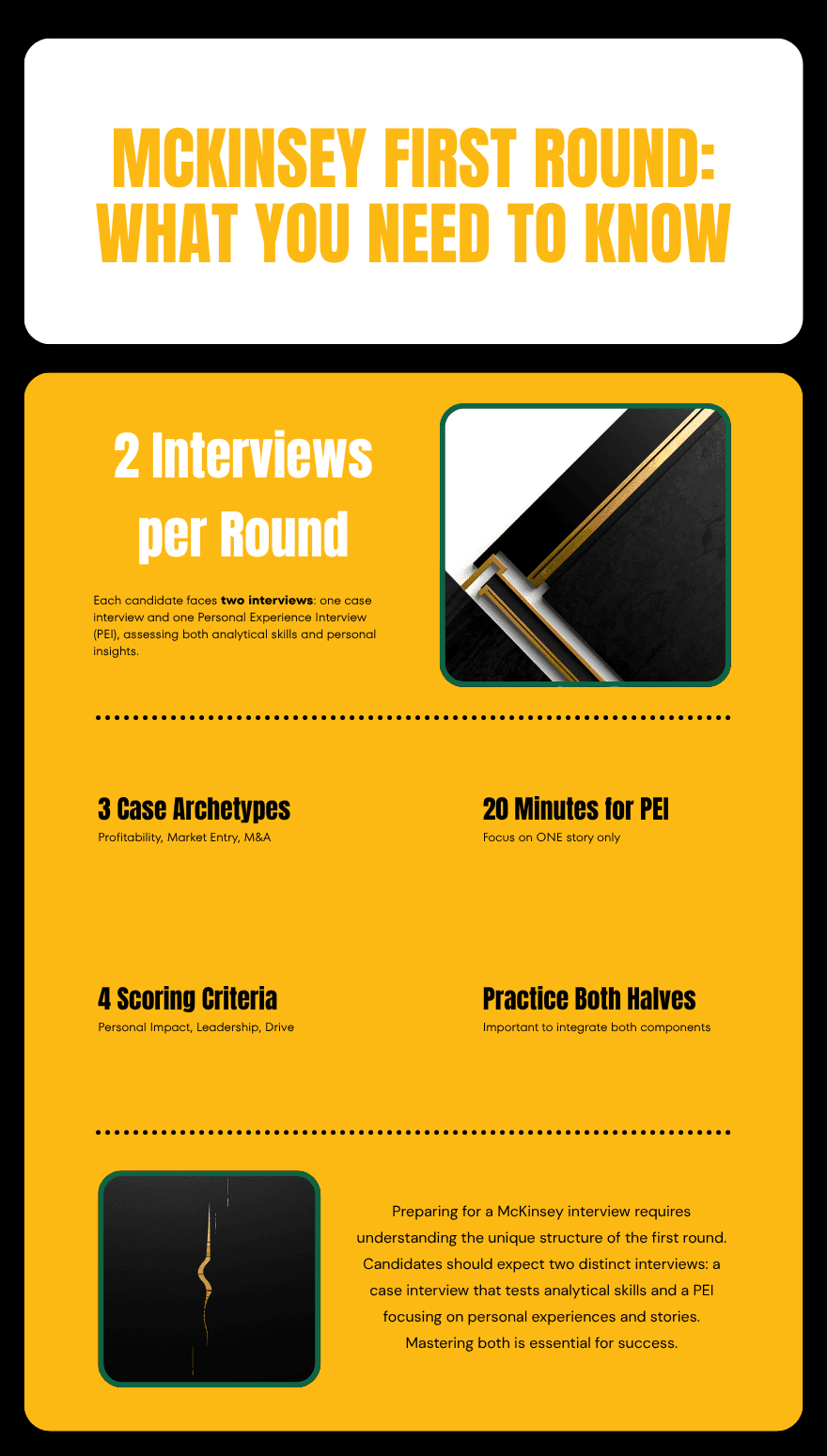
A standard first round consists of two interviews, each running approximately 45–60 minutes. Each interview has two components:
- A case interview—a business problem you solve aloud in real time.
- A Personal Experience Interview—a deep dive into one experience from your past.
Interviewers assess both dimensions. A strong case does not automatically compensate for a shallow PEI, so your preparation needs to cover both.
The 3 Case Archetypes to Prioritize
Case prompts vary, but three recurring business-problem patterns are especially useful for building first-round fluency. Recognizing the underlying problem early helps you create a tailored structure instead of forcing a memorized framework onto the prompt.
1. Profitability Diagnosis
A company's profits are declining or not growing as expected, and you need to identify why.
The trap is jumping straight to “revenue versus cost” without first defining the key question. Strong candidates form an initial hypothesis, use the revenue-and-cost split as a diagnostic tool, request relevant data, and synthesize what the numbers mean.
2. Market Entry or Opportunity Assessment
A client wants to enter a new geography, product line, or customer segment. Your task is to decide whether the opportunity is attractive and how the client should pursue it.
A useful starting structure covers market attractiveness, company fit, and entry strategy. The differentiator is the “so what”: for example, an attractive market may still be a poor choice if the client's unit economics cannot support the required scale.
3. M&A or Investment Decision
A client is considering acquiring a company or making a significant investment. You need to evaluate whether the deal makes strategic and financial sense.
This archetype tests your intuition about synergies, integration risk, and the assumptions behind an investment thesis. A strong answer identifies the two or three risks the client may be underweighting instead of reciting a generic due-diligence checklist.
Why the PEI Is Not a Standard STAR Answer
The PEI is not a typical behavioral round. Interviewers can spend a substantial part of the interview exploring one experience and probing the details behind your decisions.
Prepare to demonstrate three dimensions:
- Personal impact: how you influenced an outcome.
- Leadership: how you moved people or a situation forward, including without formal authority.
- Entrepreneurial drive: how you showed initiative and went beyond the minimum expected.
Rotating through several short STAR stories does not build the depth this format rewards. Expect questions about why you made a decision, what you said in a difficult conversation, and where the situation changed.
How to Build Your PEI Story
Choose an experience involving ambiguity, meaningful stakes, and a moment when you could have done less but chose to act. Organize it around the context, challenge, your specific actions, the result, and what you learned.
Do not memorize a script. Rehearse the experience as a sequence of decisions you can explain and defend when the interviewer asks detailed follow-up questions.
Practice the Case and PEI Together
The challenge is not only performing each component separately. You need to switch between structured case thinking and detailed personal storytelling in the same session.
Replicate that pressure during practice. InterviewBee's AI mock interviewer runs voice-based interview sessions with adaptive follow-up questions, helping you rehearse structured answers under realistic time constraints.
Practice your McKinsey interview with InterviewBee's AI mock interviewer—free to start.
The McKinsey first round is difficult because it tests two distinct skills in one interview. Candidates who prepare both halves are less likely to be caught off guard by the switch.
Frequently Asked Questions
What happens in a McKinsey first-round interview?
A typical first round includes two interviews. Each combines a case interview with a Personal Experience Interview, or PEI.
What case types should I prepare for?
Prioritize profitability diagnosis, market entry or opportunity assessment, and M&A or investment decisions. Practice adapting your structure to the specific prompt.
How is the PEI different from a standard behavioral interview?
The PEI goes deeper into one experience and uses detailed follow-up questions to understand your decisions, actions, and impact.
What does McKinsey assess in the PEI?
Prepare examples that demonstrate personal impact, leadership, and entrepreneurial drive.
How should I practice for the first round?
Practice the case and PEI in sequence under realistic time pressure, and rehearse explaining your thinking aloud throughout both components.