


LeetCode Is Not Enough: What Senior Engineers Actually Evaluate in Your Coding Round
- Author: InterviewBee Team
- Published On: Jul 04, 2026
- Category:Technical Interviews
You solved the problem. Working code, right output, no crashes. And you still got rejected.
If that's happened to you, you're not imagining it. What interviewers look for in coding rounds beyond LeetCode has almost nothing to do with whether your code runs. Two candidates can submit the same correct solution to the same problem, and only one of them gets the offer. The difference isn't the code. It's everything that happened around it.
The Two-Candidate Problem
Picture a mid-level backend role, and the question is a classic: find the longest substring without repeating characters. Both candidates land on the same sliding-window approach. Both get a working solution in about 20 minutes.
Candidate A writes the code, runs it against the given example, and says "looks right." When asked about time complexity, they pause and guess "O(n), I think?" When the interviewer asks what happens with an empty string, they patch it live without explaining why the original version broke.
Candidate B narrates while coding: "I'll use two pointers here because re-scanning the substring on every character would push this to O(n squared). The window lets us stay at O(n)." When the interviewer asks about edge cases, Candidate B has already flagged them: empty string, single character, all-duplicate string. When given a hint on a follow-up, Candidate B adjusts the approach out loud instead of going silent and typing.
Same output. Different signal. Candidate B gets the offer.
What's Actually Being Scored
Senior engineers running these interviews aren't grading a code judge. They're evaluating four things that never show up in a LeetCode acceptance rate:
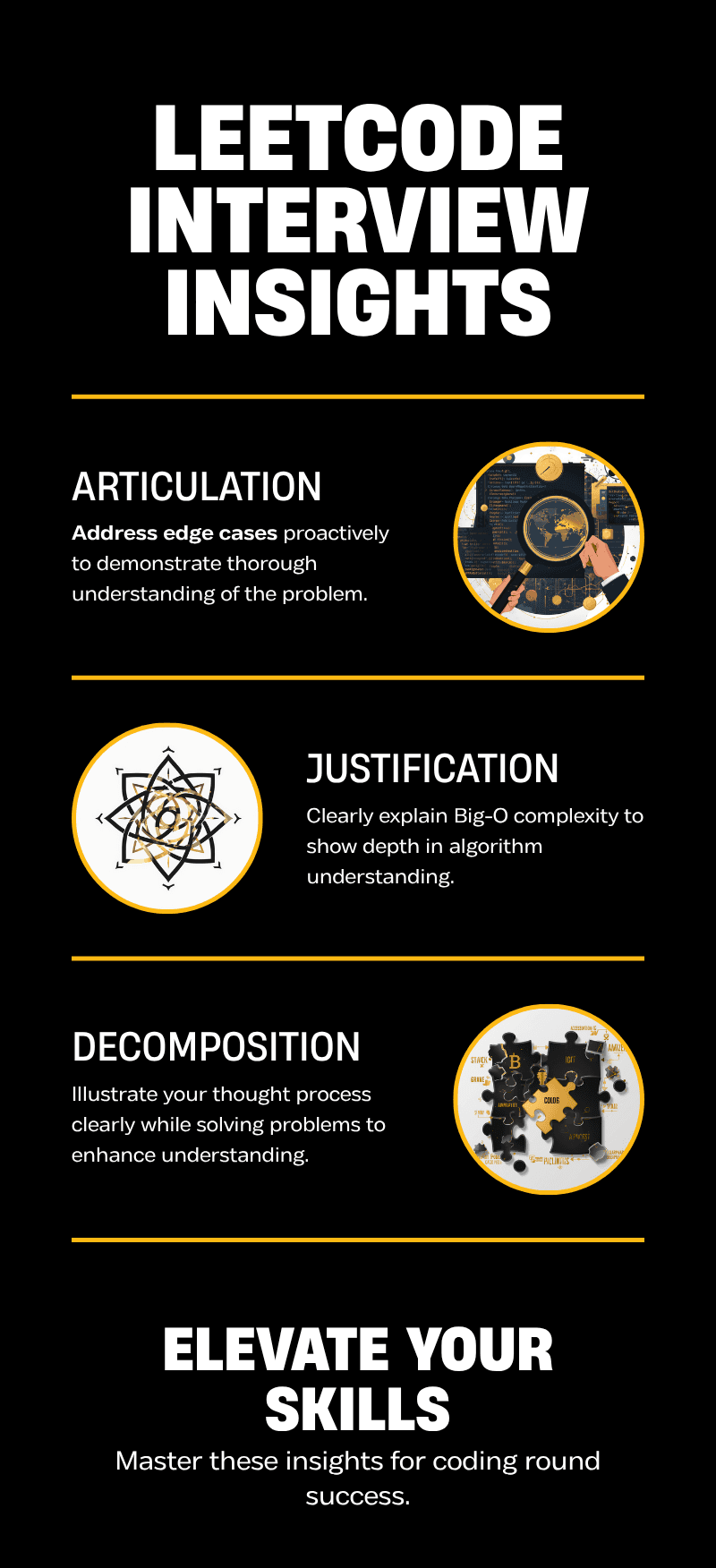
- Edge case articulation. Do you find the boundary conditions yourself, or do you need to be walked into them? Interviewers read unprompted edge-case callouts as a proxy for how you'll handle production bugs nobody flagged for you.
- Complexity communication. Stating Big-O without being asked, and being able to justify it, signals you understand why your solution works, not just that it happened to pass the test case.
- Problem decomposition narrative. Interviewers are listening for how you break the problem down before you start typing. Silence followed by a correct answer is often a weaker signal than talking through a wrong turn and correcting it.
- How you handle hints. Nobody expects you to need zero help. What gets scored is whether a hint updates your approach smoothly or derails you completely.
Why This Gap Exists
Most interview prep optimizes for the wrong metric: getting to a correct submission fast. That's the metric LeetCode grades you on, so it's the one people practice. But nobody sits across from you during a real coding round grading pass or fail on a hidden test suite. A person is watching how you think, and "I got the right answer" doesn't tell them anything about how you'll behave when the requirements change mid-sprint or the edge case shows up in production at 2am.
Practicing 300 problems solo trains you to solve problems. It doesn't train you to narrate your thinking, catch your own edge cases out loud, or adjust gracefully when someone interrupts your plan with new information, because there's no one there to interrupt you.
The Prep Gap This Creates
If you've been grinding a problem set and still coming up short in real coding rounds, this is usually why. The 300th problem doesn't teach you anything the 50th didn't. Once you recognize the pattern, you can execute it without thinking hard, which is exactly the trap. Executing without thinking is what produces Candidate A: correct code, no visible reasoning, and a shaky answer when the "why" gets questioned.
The skills that actually get scored, including narrating decisions, catching your own edge cases, justifying complexity, and absorbing a hint without losing your thread, don't show up on a solo problem set at all. There's no one there to ask you why, no one to interrupt you with a follow-up, and no one reacting to whether your explanation actually makes sense out loud versus just making sense in your head.
You can be excellent at solving problems and still underprepared for being watched solving them. That's a specific, practicable skill gap, not a talent gap. It closes with repetition in realistic interview conditions.
InterviewBee's AI mock interviewer helps you practice the parts of coding interviews that solo problem sets skip: explaining trade-offs, responding to follow-ups, surfacing edge cases, and keeping your reasoning clear while you code.
Frequently Asked Questions
Is LeetCode enough to pass coding interviews?
No. LeetCode helps you recognize patterns and write correct solutions, but live coding interviews also evaluate communication, edge-case awareness, complexity reasoning, and how you respond to hints.
Why can a correct coding solution still fail an interview?
A correct solution can still fail if the interviewer cannot see your reasoning, if you miss important edge cases, if you cannot justify complexity, or if you struggle when the problem changes.
What do senior engineers look for in coding rounds?
Senior interviewers look for decomposition, clear communication, production-aware edge cases, readable code, complexity justification, and the ability to adapt calmly to follow-up constraints.
How should I practice beyond LeetCode?
Practice solving problems out loud, explain why each approach works, name edge cases before coding, analyze Big-O clearly, and rehearse with a mock interviewer who interrupts you with realistic follow-ups.
How many LeetCode problems should I solve before interviews?
Quality matters more than raw count. Once common patterns are familiar, spend more time practicing live explanation, edge-case handling, and follow-up adaptation instead of only increasing your solved-problem number.