


Switching Careers at 30+: How to Answer 'Why Are You Making This Change?' Without Sounding Lost
- Author: InterviewBee Team
- Published On: Jul 28, 2026
- Category:Interview Tips
Every career changer gets asked this question, and most walk in without a real plan for answering it. Not because they lack a reason — because they have three or four true reasons and no idea which one to lead with, or in what order.
This question isn't really about your reasons. It's about what your reasons signal. Interviewers use your answer to figure out one thing: is this a considered move, or are you running from something and hoping this job fixes it. Everything else in the interview gets colored by how they answer that for themselves.
Here's what actually matters when you're building your answer, and what to do before you're in the room.
What to Keep in Mind
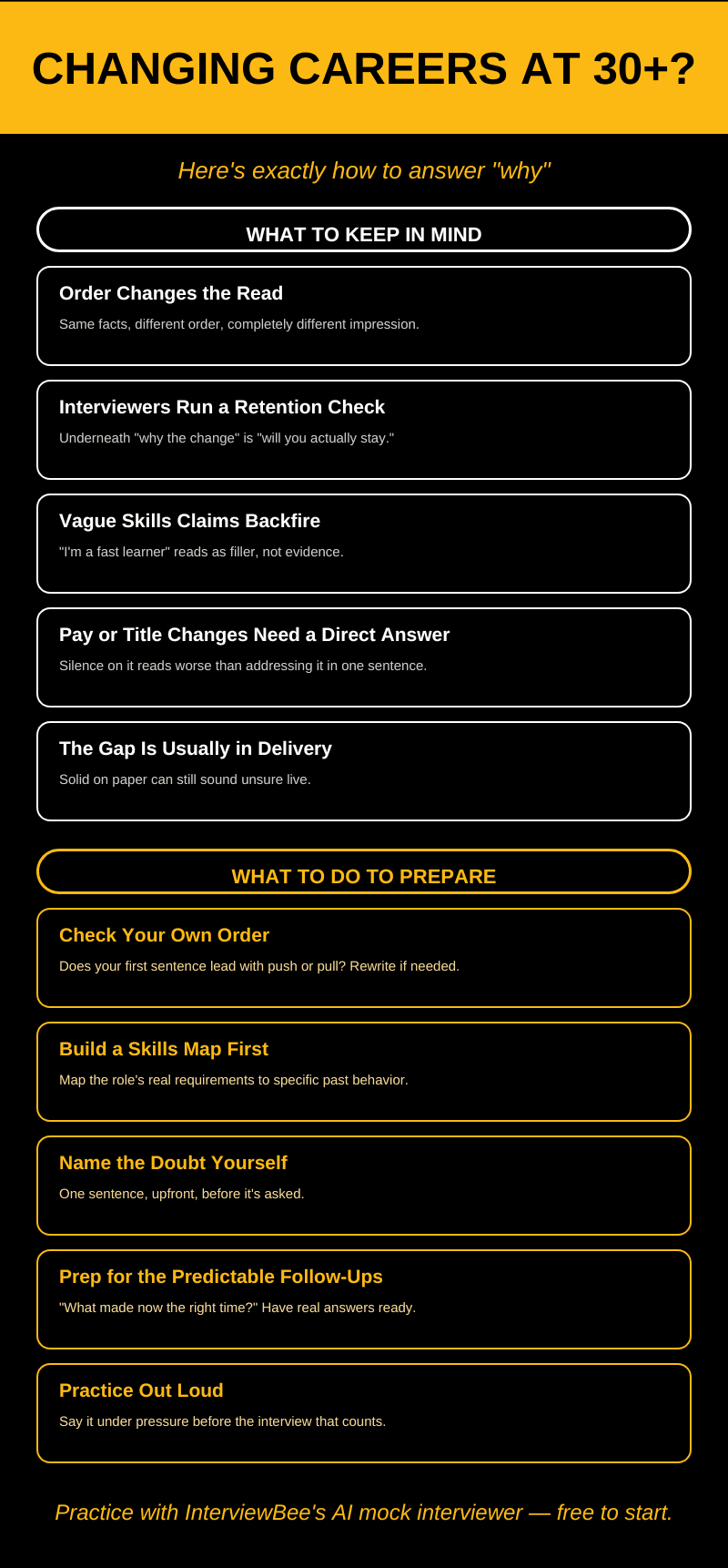
- Order changes the read, even when the facts don't. Lead with what was wrong about your last job — burnout, no growth, a bad manager — and you sound like someone escaping a problem. Lead with what you're moving toward, and the same facts read as a decision you made on purpose. The interviewer isn't grading your reasons. They're grading the order you tell them in.
- Every interviewer is quietly running a retention check. Underneath "why the change" is a second, unspoken question: will you actually stay, or are we a stepping stone while you figure out what you really want? You don't need them to ask this directly — it's already shaping how they interpret everything else you say.
- Vague transferable-skills claims hurt more than they help. "I'm a fast learner" or "I work well with people" could be said by literally anyone about literally any job. It doesn't read as evidence. It reads as filler covering for a gap you haven't actually closed.
- A pay cut, title step-down, or level change needs a direct answer. If your move involves any of these, the interviewer is going to wonder about it whether or not they ask. Silence on it reads worse than addressing it in one sentence and moving on.
- The gap is usually in delivery, not content. You can have a solid answer on paper and still botch it live. Most people hit a half-second hesitation right at the pivot — deciding in real time whether to lead with the old job or the new direction — and that hesitation is what an interviewer hears as "still not sure," even when the substance is fine.
What to Do to Prepare
- Write your answer out, then check the order. Does your first sentence lead with the old job (push) or the new direction (pull)? If it leads with push, rewrite it. Same facts, different sequence, completely different impression.
- Build a skills map before the interview, not during it. List the 3–4 things the new role actually requires day to day. Next to each one, write the specific behavior — not the job title — from your current or past role that proves you've already done something close to it. "I ran fixed-deadline sessions with competing priorities" beats "teaching is kind of like managing."
- Draft one sentence that names the commitment concern yourself. Something like: "I know a shift like this raises the question of whether it's a real commitment — for me this has been building for two years, not a reaction to a bad quarter." Say it once, briefly, and move on. Don't over-explain it.
- Prepare for the predictable follow-ups. "What made now the right time?" "What's kept you from doing this sooner?" "How is this different from your last role?" These come up in almost every career-change interview. Have real answers ready instead of improvising them live.
- Practice the answer out loud, not just in your head. A written answer and a spoken answer are not the same thing. The only way to catch your own hesitation at the pivot point is to say the answer out loud, under a bit of pressure, before it's the interview that actually counts.
Where InterviewBee Fits
None of this is complicated in theory. It's hard because you only get a few real shots at it, and the cost of getting it wrong is an offer you don't get. InterviewBee's Mock AI Interviewer asks the follow-ups a real interviewer would ask — "so what made now the right time?" — and lets you hear where your own framing wobbles before it's the version that counts.
Practice this with InterviewBee's AI mock interviewer — free to start.