


Data Science Interview vs Data Analyst Interview: Why the Same Prep Gets You Rejected from Both
- Author: InterviewBee Team
- Published On: Jun 23, 2026
- Category:Data Interviews
Here's a mistake that costs candidates callbacks every week: they apply to a Data Scientist role and a Data Analyst role at the same company, spend three weeks preparing once, and get rejected from both.
Not because they weren't qualified. Because they prepared for a role that didn't exist—a blended, imaginary hybrid of both titles that neither hiring team was looking for.
Data Science and Data Analyst are not interchangeable. The interview formats are different, the skills they probe are different, and the signals interviewers are looking for are fundamentally different. Treating them as the same role—and preparing once for both—is one of the most common and least-discussed reasons candidates stall in the data hiring market.
What a Data Analyst Interview Actually Tests
Data Analyst interviews are built around one core question: can you turn ambiguous business data into a clear decision?
The technical baseline is SQL—specifically, your ability to write clean queries under pressure against messy, multi-table schemas. Interviewers at most companies will give you a case scenario, such as sales dropping 12% in Q3, hand you a schema, and watch how you approach the problem before you write a single line. The approach is the test, not just the output.
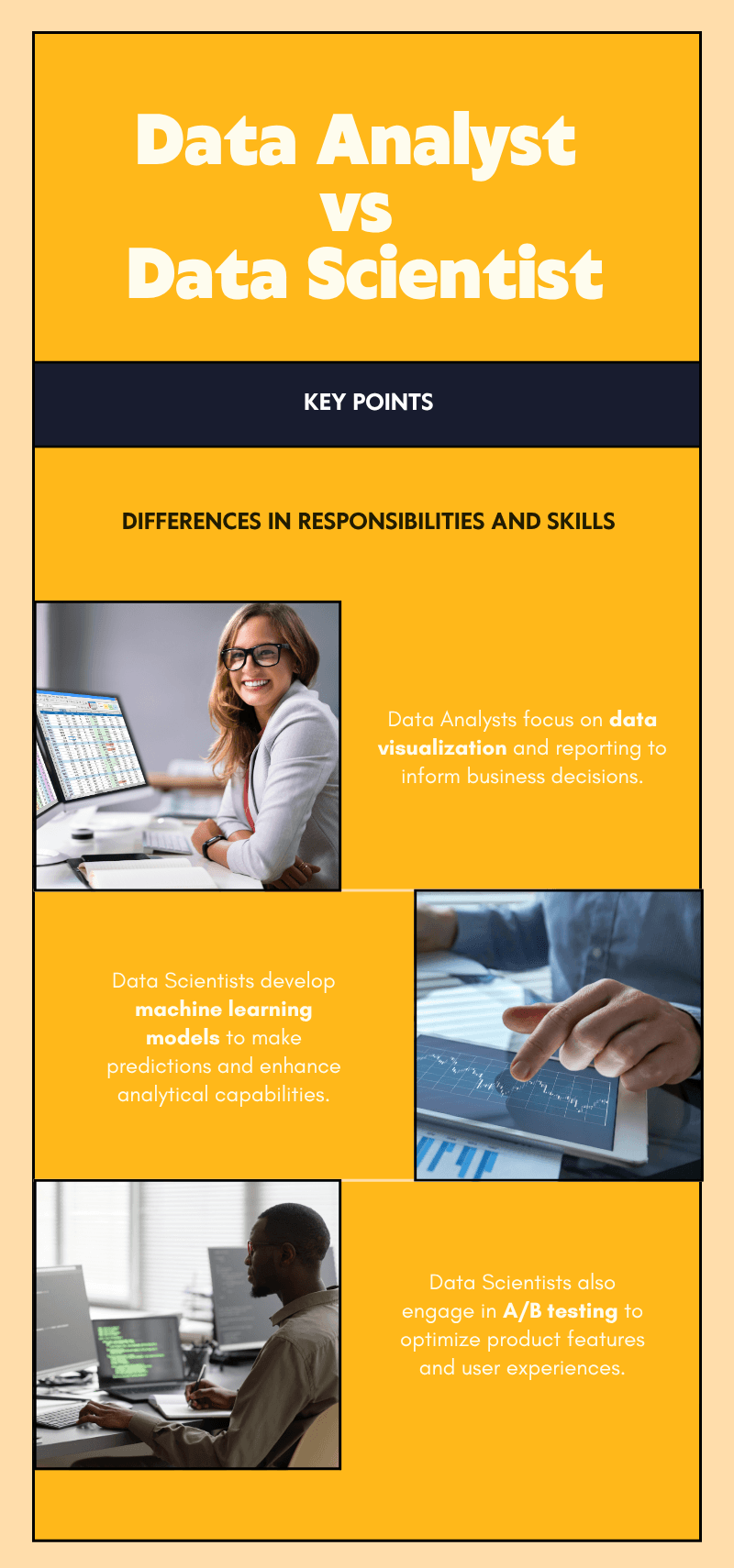
Beyond SQL, Data Analyst interviews lean heavily into data visualization, stakeholder communication, and metric definition. Expect questions like, “How would you build a dashboard to track customer retention?” or “Which metric would you use to evaluate this campaign and why?” They are testing whether you can explain data to a decision-maker who does not code—because that is the job.
What these interviews rarely test at depth: machine learning, model selection, statistics beyond basic probability, or Python beyond light scripting. If you are studying gradient boosting or writing NumPy arrays for a Data Analyst role, you are optimizing for the wrong thing.
For role-specific examples, browse InterviewBee's company interview question banks and Data Scientist interview questions.
What a Data Science Interview Actually Tests
Data Science interviews start from a different baseline assumption: you can handle the data. What they are probing is whether you can build things that work in production.
Expect machine-learning theory questions—bias-variance tradeoff, regularization, model selection criteria, and when to use which algorithm. Expect statistics at depth: hypothesis testing, confidence intervals, A/B test design, and the assumptions behind them. At senior levels, expect system-design questions about how you would build and deploy a model at scale—not just train one in a notebook.
Python fluency is assumed. The question is whether you can write clean, production-quality code, not whether you know the syntax. Pandas and scikit-learn are baseline. The interview will push you past them.
Data Science interviews at product companies often skew heavily toward statistics and A/B testing design. Knowing how to explain the difference between statistical significance and practical significance—and when one matters more than the other—is often what separates offers from rejections.
The Overlap That Fools Everyone
Here is where candidates go wrong: both roles touch SQL, Python, and “working with data.” The job descriptions look similar, the skills sections blur together, and candidates assume the interviews will too.
The overlap is real at the edges. But the center of each role is completely different. A Data Analyst interview will almost never ask you to choose between XGBoost and Random Forest. A Data Science interview will almost never ask you to design a business dashboard for a non-technical stakeholder.
When you prepare generically—doing SQL practice, brushing up on Python, and reviewing some statistics—you end up mediocre at both. You can answer the easy questions but not the deep ones. You know enough to get to the second round, not enough to get the offer.
The candidates who get both offers prepare separately. They treat a Data Analyst application and a Data Scientist application as two different interview campaigns, with different study material, different practice questions, and different answers to “walk me through a recent project.”
How to Know Which One You're Actually Interviewing For
Before you start preparing, find the actual job description and look for three things.
- Technical emphasis: SQL and visualization tools such as Tableau, Power BI, or Looker point toward Data Analyst. Python, machine-learning libraries, and deeper statistics point toward Data Science.
- Responsibilities: reporting to stakeholders, building dashboards, and supporting business decisions indicate Data Analyst work. Building models, running experiments, and shipping ML features indicate Data Science work.
- Reporting structure: Data Analyst roles often sit under Business Intelligence or Analytics. Data Science roles often sit under Engineering, Product, or a dedicated ML or Research team.
The organizational structure tells you what success looks like—and what the interview is actually measuring.
Practicing the Right Format Matters as Much as Knowing the Content
Knowing what each role tests is the first step. The second—the one most candidates skip—is practicing the actual format of the interview, not just reviewing the material.
Data Analyst and Data Science interviews feel different in real time. Data Analyst interviews expect you to narrate your thinking about business problems aloud, often with an interviewer actively testing whether you would communicate well with non-technical teams. Data Science interviews expect you to work through technical problems precisely and defend your assumptions under follow-up.
You can know everything and still fail the format. The only way to close that gap is through practice in conditions that match the real interview.
InterviewBee's AI mock interviewer runs role-specific sessions, including data-focused tracks, that simulate the question types, pacing, and follow-up structure of Data Analyst and Data Science interviews.
Frequently Asked Questions
Are Data Scientist and Data Analyst interviews the same?
No. Both may include SQL and Python, but Data Analyst interviews emphasize business reasoning, dashboards, metrics, and stakeholder communication. Data Science interviews probe machine learning, statistics, experimentation, coding, and production model decisions more deeply.
What should I study for a Data Analyst interview?
Prioritize SQL, metric definition, funnel and cohort analysis, data visualization, dashboard design, business cases, and explaining recommendations clearly to non-technical stakeholders.
What should I study for a Data Science interview?
Prepare machine-learning fundamentals, statistics, hypothesis testing, A/B experiments, Python, model evaluation, feature engineering, and—especially for senior roles—production ML system design.
How can I tell whether a role is Data Analyst or Data Scientist?
Read the technical requirements, responsibilities, and reporting structure. Visualization and business reporting usually indicate Data Analyst work, while model building, experimentation, and ML deployment indicate Data Science work.
Can I use the same interview preparation plan for both roles?
Use shared fundamentals where appropriate, but create separate preparation plans. Each role requires different depth, examples, question formats, and ways of explaining your past work.