



Prompt Engineering Interview Questions: The $150K Skill Employers Can't Find (2026)
- Author: Bismayy
- Published On: Jan 03, 2026
- Category:Interview Tips
Prompt Engineering Interview Questions: The $150K Skill Employers Can't Find (2026)
Prompt engineering salaries at OpenAI, Anthropic, and Google DeepMind now hit $200,000 to $350,000 for senior roles. Mid-level specialists pull $120,000 to $180,000. Yet, companies continue to say they cannot find qualified candidates.
The disconnect is simple: most applicants know basic prompting. Few understand what interviews test for.
We've heard from candidates who aced technical prompts but bombed behavioral rounds. Others passed conceptual questions but froze when asked to debug a failing prompt in real-time. The pattern is consistent - employers want hybrid thinking, not isolated skills.
The Questions That Filter Out 90% of Candidates
"Walk me through how you would refine a prompt returning inconsistent results."
Interviewers use this as a baseline filter. Weak answers describe tweaking words randomly. Strong answers present systematic debugging: identify failure patterns first (vague outputs, factual errors, format violations), then analyze whether the issue stems from ambiguous instructions, missing context, or wrong technique selection.
Candidates who mention version control for prompts, A/B testing frameworks, or specific metrics like BLEU scores for translation tasks stand out. Those who treat prompt iteration like software debugging - with logs, baselines, and regression testing - access higher compensation brackets.
"Explain zero-shot, one-shot, and few-shot prompting. When would you use each?"
This separates memorizers from practitioners. The surface answer involves example counts. The deeper answer addresses tradeoffs between token cost, accuracy, and latency at production scale.
Experienced engineers explain that few-shot with chain-of-thought examples outperform zero-shot for complex reasoning, but costs 3-5x more in tokens. They discuss when accuracy gains justify that expense and when they do not. This business-aware technical thinking commands 15-25% salary premiums over baseline.
"How do you evaluate whether a prompt is working?"
Novices say, "it looks right." Professionals describe multi-dimensional frameworks: clarity and relevance (does output address the task?), factual accuracy (verified against authoritative sources), consistency (reproducible across inputs), and user satisfaction metrics.
Candidates familiar with evaluation tools like BERTScore for semantic similarity or custom business metrics tied to project goals significantly outperform vague assessors. Companies increasingly expect prompt engineers to measure as software engineers test.
The Behavioral Questions That Determine Compensation Tier
"Describe a complex prompt you created and its business outcome."
Answers without metrics fail. "It worked better" means nothing. "User satisfaction increased 22%, error rates dropped from 8% to 3%" means something.
The structure matters: articulate the business problem, explain technique selection (and why alternatives were rejected), detail the testing process, and quantify results. Interviewbee users consistently report that behavioral questions carry equal weight to technical ones in final decisions.
"How do you ensure prompts are ethical and unbiased?"
This question filters for production readiness. Employers in healthcare, finance, and legal domains, where prompt engineers command 30-40% salary premiums, need concrete answers.
Strong responses cover bias detection through diverse test cases, fairness metrics measuring equitable outputs across populations, safety constraints preventing harmful content, and audit trails documenting prompt versions with change justifications.
The Questions Candidates Forget to Prepare For
"How would this prompt behave at 1 million daily requests?"
Production thinking separates senior candidates from juniors. Address: What breaks under load? Where do costs explode? How do biases emerge with varied inputs? How would you detect degradation automatically?
"How do you stay current in a field changing this fast?"
Generic answers ("I read blogs") fail. Specific answers work: naming researchers like Yann LeCun, conferences like NeurIPS, communities on Hugging Face, or empirical testing habits that verify claims before adopting techniques.
"Where do you see prompt engineering in 3 years?"
Microsoft's 2025 hiring research ranked "Prompt Engineer" 32nd out of 35 new roles companies plan to add. The standalone title is declining, but hybrid roles, such as LLM Integration Engineer, AI Systems Architect, and Prompt Operations Manager, are growing.
Candidates who acknowledge this shift while expressing enthusiasm for broader AI system design roles demonstrate market sophistication that resonates with hiring managers.
The Skill Stack That Commands $150K+
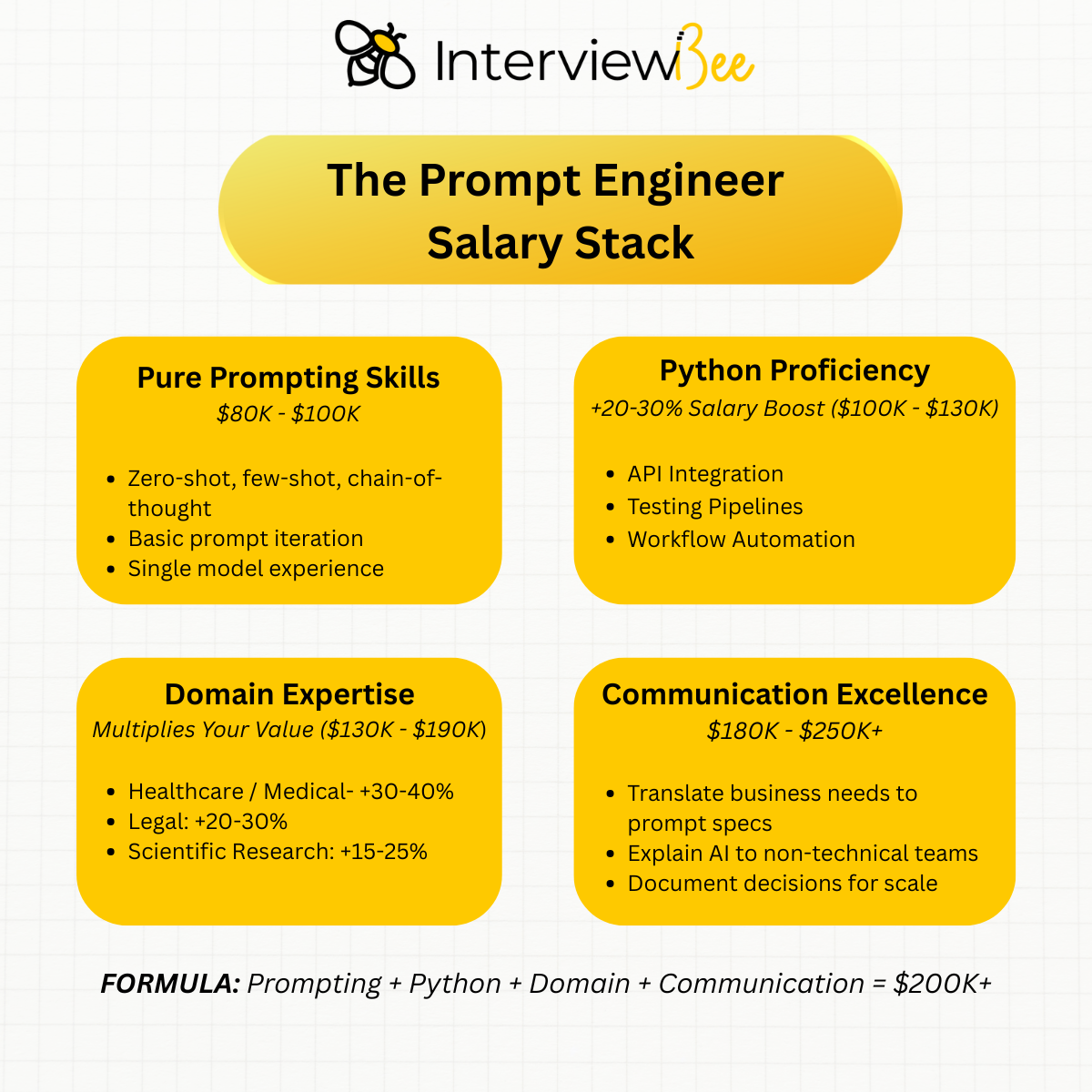
Mid-level salaries above $150,000 consistently require combinations beyond pure prompting:
Python proficiency adds 20-30% to baseline compensation. Companies expect prompt engineers to build testing pipelines, integrate with APIs, and automate evaluation workflows.
Domain expertise multiplies value. Healthcare specialists earn 30-40% above general prompt engineers. Financial services and legal domains add 20-35%.
Communication skills appear in 21.9% of prompt engineer job postings, higher than in most technical roles. Engineers who translate between business requirements and technical specifications access principal-level compensation.
Preparation That Works
The Mock AI Interviewer provides voice-based practice with dynamic follow-up questions adapted to your responses, covering technical, behavioral, and case interview formats relevant to AI roles.
For real-time support during live interviews, the Live AI Interview Assistant delivers instant talking points based on conversation context, helping candidates articulate structured answers under pressure.
Additional preparation resources include Coursera's comprehensive guide on prompt engineering interview preparation, covering common question frameworks and answer strategies, and the Prompt Engineering Wikipedia entry for foundational concepts and technique definitions.
The Bottom Line
The $150K threshold exists because companies pay for hybrid capability. Technical depth alone peaks around $100K. Adding Python pipeline skills reaches $130K. Domain expertise plus communication excellence unlocks $180K and beyond.
Interview success comes from demonstrating all three dimensions: technical mastery of prompting techniques, production engineering mindset, and strategic business thinking. Candidates who prepare across all three consistently land offers that others leave on the table.
FAQ
1. What salary can I expect as a prompt engineer in 2026?
Entry-level prompt engineers (0-2 years) earn $70,000 to $95,000. Mid-level specialists with production experience command $120,000 to $180,000, with $150,000 as the average threshold. Senior roles at companies like OpenAI, Anthropic, and Google DeepMind pay $200,000 to $350,000 including equity. Domain specialists in healthcare or finance add 30-40% on top of baseline compensation.
2. Do I need a computer science degree to become a prompt engineer?
No. Most companies waive formal degree requirements for prompt engineering roles. They prioritize demonstrated ability through portfolios, project examples, and practical assessments during interviews. Python proficiency, understanding of LLM behavior, and documented prompt projects matter more than credentials. Many successful prompt engineers transitioned from linguistics, writing, product management, or self-taught backgrounds.
3. What technical skills do prompt engineering interviews test for?
Interviews assess your knowledge of prompting techniques (zero-shot, few-shot, chain-of-thought, ReAct), your ability to debug failing prompts systematically, and your understanding of evaluation metrics like BLEU, ROUGE, or BERTScore. Senior roles also test Python scripting for API integration, prompt versioning practices, and production scaling considerations like cost-per-token tradeoffs and latency optimization.
4. Is prompt engineering still a growing field or is the role declining?
The standalone "Prompt Engineer" job title is declining. Microsoft's 2025 research ranked it 32nd out of 35 new roles companies plan to hire. However, prompt engineering skills are being absorbed into higher-paying hybrid roles: LLM Integration Engineer, AI Systems Architect, Prompt Operations Manager, and AI Trainer. Professionals who combine prompting with software engineering or domain expertise access stronger job security and compensation.
5. How should I prepare for a prompt engineering interview?
Build a portfolio with documented prompt workflows showing your iteration process and measurable outcomes. Practice behavioral questions with specific metrics (not "it worked better" but "error rates dropped 40%"). Study production scenarios: how prompts behave at scale, cost management, bias detection. Use mock interview tools to practice articulating structured answers under time pressure, especially for technical walkthroughs and case-based questions.