



How to Answer Why Were You Laid Off? Without Killing Your Chances
- Author: Bismayy
- Published On: Jan 24, 2026
- Category:Interview Tips
How to Answer "Why Were You Laid Off?" Without Killing Your Chances
Between 2023 and 2025, millions of workers across tech, finance, and retail got laid off. Meta, Amazon, Stripe, Salesforce - the list runs long. If you're reading this, chances are you're preparing to explain your own layoff to a hiring manager.
The good news: layoff stigma has faded considerably. Hiring managers have either been through it themselves or watched teammates go through it. According to the U.S. Bureau of Labor Statistics, layoffs and discharges remain a normal part of labor market dynamics. The bad news: a clumsy explanation can still tank your interview. We've talked to career coaches and HR professionals, and they all agree on one thing: preparation separates the candidates who recover from this question and the ones who spiral.
Why Interviewers Ask This Question
Hiring managers want two pieces of information:
1. Was the layoff about company circumstances or your performance?
2. Can you discuss adversity without sounding bitter or defensive?
They're not trying to catch you out. They're assessing emotional intelligence and self-awareness. The tone you bring to this question often matters more than the content itself.
The STARR Framework: Built for Layoff Conversations
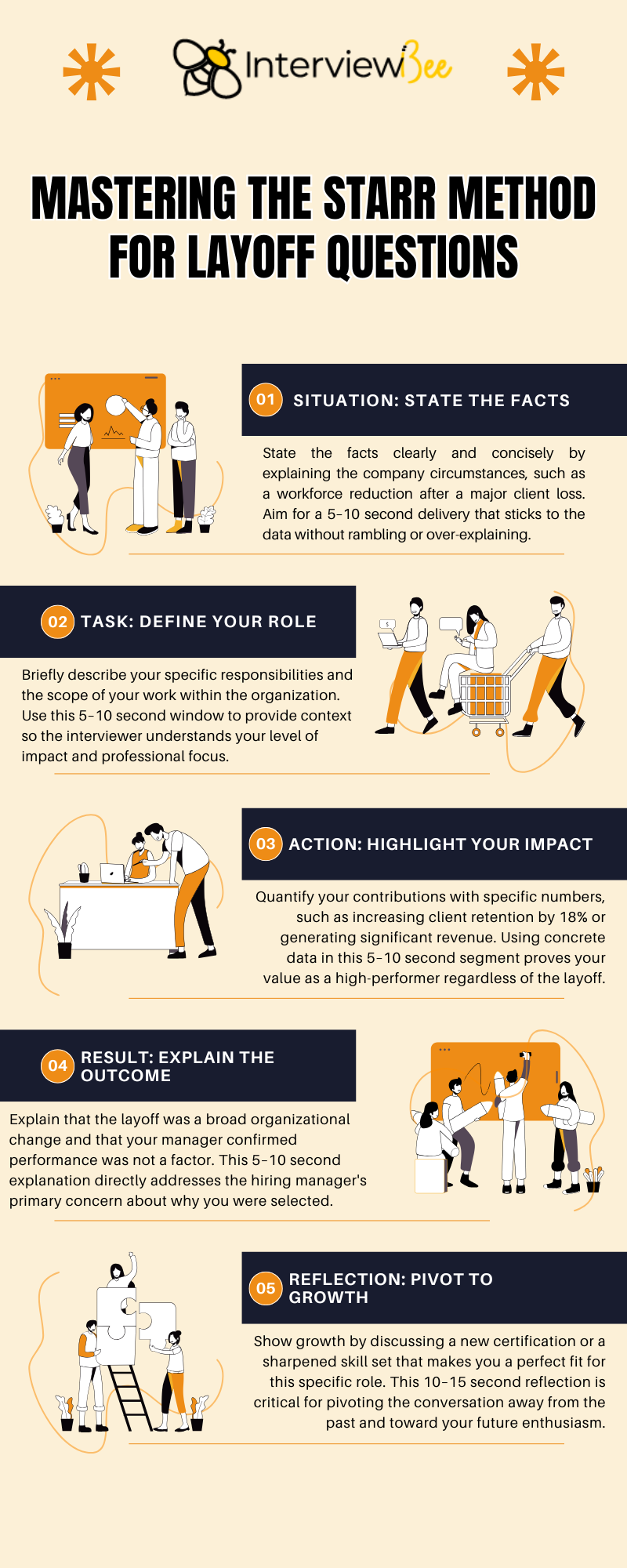
The STAR method (Situation, Task, Action, Result) works well for behavioral questions. For layoffs, we recommend adding a fifth element: Reflection. This becomes STARR.
Situation (5-10 seconds): State the facts. "My previous company went through a 25% workforce reduction after losing their largest client."
Task (5-10 seconds): Describe your role briefly. "I managed a team of five on customer retention strategy."
Action (5-10 seconds): Highlight your contributions with numbers. "During my tenure, I increased client retention by 18% and launched two product lines generating $2.3M."
Result (5-10 seconds): Explain the outcome. "I was among 200 employees affected across all departments. My manager confirmed performance wasn't a factor."
Reflection (10-15 seconds): Show growth. "Since then, I've completed a certification in data analytics and clarified what I want in my next role, which is why this position fits."
Total delivery: about 90 seconds. Confident, structured, forward-looking.
The 30-Second Version
Not every interview gives you 90 seconds. Career coach Regan Setter recommends a tighter framework:
- State it: "I was impacted by a workforce reduction in November."
- Context: "The company cut 25% of staff after losing two major contracts."
- Redirect: "I've used the time to sharpen my skills and get strategic about my next move, which led me to this role."
Done. No rambling.
Mistakes
Candidates who struggle often fall into these traps:
- Saying "I had no idea it was coming" (sounds oblivious)
- Criticizing former employers or managers
- Over-explaining with unnecessary details
- Showing visible frustration or bitterness
Interviewers can detect defensiveness within seconds. Practice your response until you can deliver it the same way you'd describe your morning commute: calm, factual, unbothered.
Preparation That Pays Off
Run mock interviews before your real ones. InterviewBee's Mock AI Interviewer lets you practice tough questions, including layoff scenarios, with voice-based AI that gives feedback on your delivery.
Also useful: InterviewBee's Live AI Interview Assistant, which provides talking points during your interview in under 2 seconds. For resume optimization before you even reach the interview stage, check out the free Resume Builder tool.
According to CNBC's career coverage, the best candidates use the layoff discussion to pivot toward enthusiasm for the new role. That pivot is everything.
Questions You Might Face
- "How did you react when you first learned about the layoff?"
- "What did you do in the weeks following the layoff?"
- "Have you identified any areas for improvement based on feedback from that role?"
- "Why do you think you were selected for the layoff over others?"
Prepare answers for each. The interviewer may never ask, but if they do, you'll be ready.
Being laid off doesn't define your career. How you explain it might shape whether you get the next opportunity. The STARR framework, honest preparation, and a calm tone go a long way. And if your resume needs to pass the ATS before you get to the interview, Forbes has solid guidance on that front too.
FAQ
1. Should I bring up the layoff myself or wait for the interviewer to ask?
Wait for them to ask. If they don't bring it up, there's no need to volunteer the information. Focus on your qualifications and fit for the role. If they do ask, be ready with your prepared response.
2. How long should my layoff explanation be?
Keep it between 30 and 90 seconds. The 30-second version works for quick screening calls. The full STARR response (90 seconds) suits longer interviews. Either way, end with a forward-looking statement about the role you're applying for.
3. What if I was laid off more than once?
Address each layoff briefly and show different lessons learned from each. For example: "The first taught me to diversify my skills. The second made me more careful about evaluating company stability before joining." Demonstrate pattern recognition and growth, not victimhood.
4. Can I mention that my former manager would give me a positive reference?
Yes, and you should. Saying "My manager confirmed the decision wasn't performance-related and offered to be a reference" adds credibility. It signals that despite the layoff, you left on good terms and your work was valued.
5. How do I explain a long gap after the layoff?
Be specific about how you spent the time. Mention certifications, freelance projects, volunteer work, or caregiving responsibilities. Vague answers raise red flags. Concrete activities show initiative and self-direction during a difficult period.