



AI Is Screening Your Salary Expectations: Smart Job Seekers Must Know This in 2026
- Author: InterviewBee Editorial Team
- Published On: Jan 31, 2026
- Category:Career Advice
Artificial intelligence is no longer just sorting résumés or scheduling interviews. Today, AI in recruitment is actively influencing how employers evaluate salary expectations, often before a human recruiter ever sees your profile. If you're entering the job market or planning your next move, understanding how this technology works can make a real difference in your earning potential.
This article breaks down how AI screens salary expectations, what that means for candidates, and how you can prepare to stay competitive in an AI-driven hiring process.
The Rise of AI in Recruitment
Over the last decade, recruitment has gone through a quiet revolution. What started as simple keyword matching has evolved into sophisticated systems capable of analyzing thousands of applications in minutes. Today, AI tools are embedded across the hiring funnel from job ads and résumé screening to interview scheduling and compensation analysis.
From an employer's point of view, the appeal is obvious. AI improves efficiency, reduces time-to-hire, and helps standardize decision-making. Many organizations also adopt AI with the goal of reducing human bias by relying on structured data rather than gut feelings. As human resources technology matures, salary-related decisions are increasingly informed by algorithms that compare candidates against market benchmarks and internal pay structures.
However, this shift also means candidates must adapt. Salary discussions no longer begin in the interview room, they often start when you fill out an online application.
How AI Screens Salary Expectations
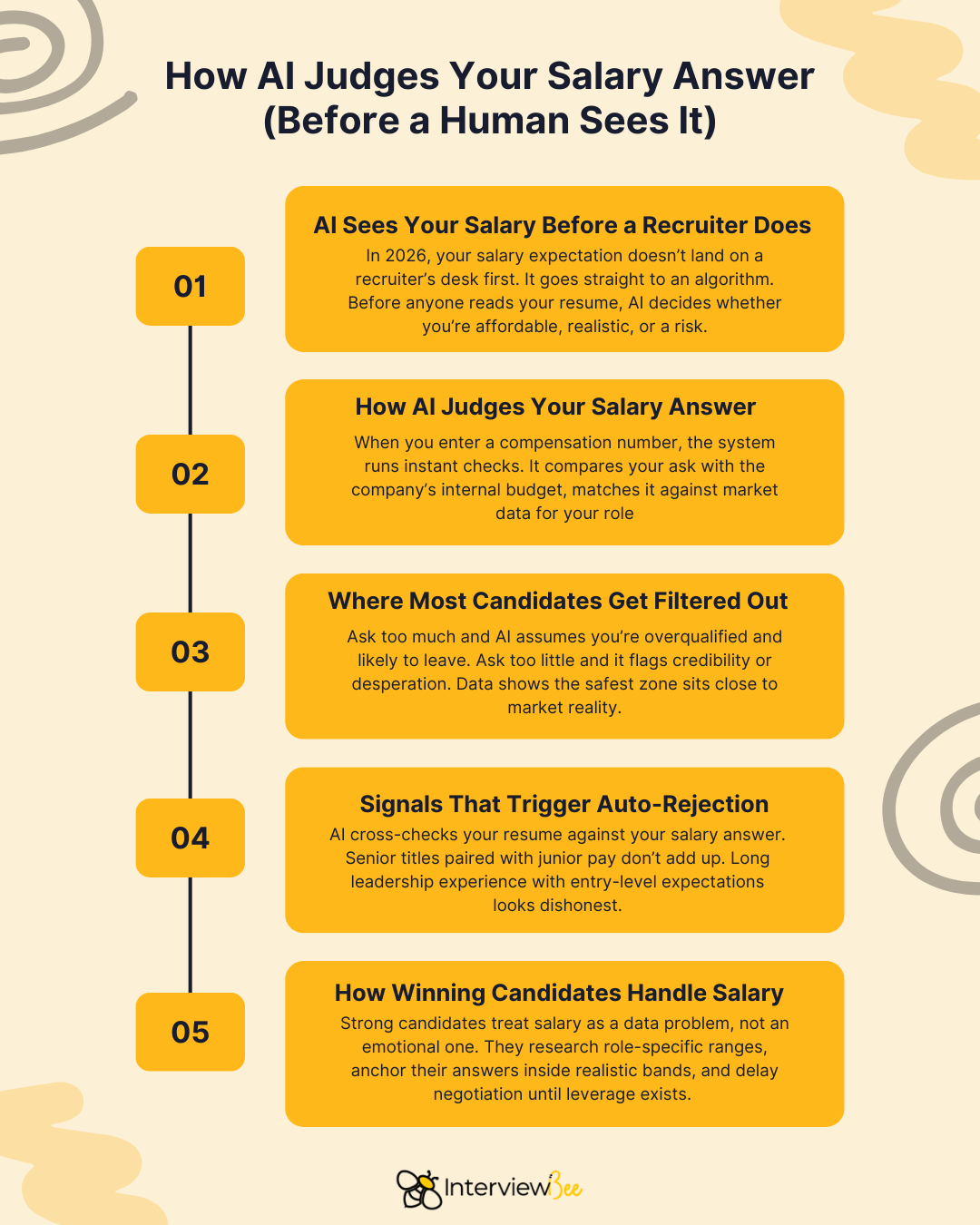
When you input your desired salary into an application, AI doesn't just record the number. It evaluates it.
Algorithms and Data Sources
AI systems pull from multiple data sources, including:
- Industry salary benchmarks
- Historical company compensation data
- Geographic cost-of-living indexes
- Role-specific demand and supply trends
- Experience level and skill alignment
Using these inputs, the system assesses whether your expectations align with the role and the company's compensation framework.
Key Metrics AI Evaluates
Some of the most common metrics include:
- Market alignment: Is your salary expectation within the typical range for this role?
- Location relevance: Does your requested pay match regional job market salary trends?
- Experience-to-cost ratio: Does your background justify your requested compensation?
- Internal equity: Would hiring you at this salary disrupt pay balance within the team?
AI Bias in Hiring
Despite good intentions, AI bias in hiring can still occur. If algorithms are trained on historical data that reflects past inequities, they may unintentionally favor certain profiles or undervalue others. This can affect how salary expectations are interpreted, especially for underrepresented groups or candidates transitioning between industries.
Preparing Your Salary Expectations
Research Is Non-Negotiable
Before entering a number, research thoroughly. Look at:
- Salary surveys from reputable platforms
- Industry and role-specific reports
- Regional pay data for your location or remote market
This ensures your expectations are grounded in reality, not guesswork.
Align With Market Data
AI systems favor candidates whose expectations align with verified data. A well-researched range signals professionalism and flexibility, which can work in your favor during automated screening.
Useful Resources
To prepare effectively, use:
- Glassdoor salary insights
- PayScale compensation data
- Bureau of Labor Statistics
- Industry association reports
- Company-specific salary disclosures
- Professional networking insights
Strong preparation supports smarter salary negotiation tips later in the process. Practice salary discussions with our Mock AI Interviewer, get real-time support with the Live AI Interview Assistant, and explore the Interview Question Bank for common questions.
Humanizing the AI Process
Even with automation, humans still make final decisions.
Communicating Your Value
Once you reach the interview stage, shift the focus from numbers to impact. Clearly explain:
- The problems you solve
- The results you deliver
- The skills that differentiate you
This context helps recruiters reassess salary expectations beyond what AI initially flagged.
Collaborative Negotiation
Approach salary discussions as a two-way conversation. Ask thoughtful questions, show openness to total compensation (benefits, bonuses, growth), and frame negotiation as collaboration, not confrontation. Robert Half offers practical guidance on answering salary questions at each stage.
Future Trends in AI and Salary Negotiations
Looking ahead, AI is expected to become more personalized. Instead of rigid benchmarks, future systems may analyze individual career paths, skill progression, and performance data to recommend customized salary ranges.
As part of the future of work and AI, candidates could eventually receive AI-generated insights showing where their salary expectations stand and how to improve them.
Conclusion
AI is already screening your salary expectations, shaping opportunities before interviews begin. Understanding how these systems work empowers you to enter the process informed, confident, and prepared. By aligning expectations with data, communicating your value clearly, and staying aware of AI's limitations, you can navigate modern hiring with greater control.
Have you encountered AI-driven salary screening in your job search? Share your experiences, insights, or questions in the comments, we'd love to hear how AI is shaping your career journey.
Key Takeaways
- 57% of companies use AI in hiring, and salary expectations are one of the earliest screening criteria - often before a human sees your resume.
- AI runs three checks on your salary answer: budget alignment, market rate comparison, and qualification signal based on your experience level.
- Candidates asking 30-50% above market rate get filtered for overqualification. Those asking far below get flagged as potentially dishonest.
- Avoid entering $0, "Negotiable," or blank entries - AI systems interpret these as evasion and may filter you out or flag you for lower-tier consideration.
- Use Glassdoor, PayScale, and Bureau of Labor Statistics to research specific ranges for your role, location, and company stage before stating any number.
FAQ
1. Can AI reject my application based only on salary expectations?
Yes. Many ATS platforms allow recruiters to set acceptable salary bands. If your stated expectation falls outside that range, the system can filter you out before any human reviews your resume. This happens more often than candidates realize, especially for roles with strict budget constraints.
2. Should I put "Negotiable" in the salary field on job applications?
Avoid it. While it seems like a safe answer, many AI systems interpret vague entries like "Negotiable," $0, or blank fields as evasion or lack of preparation. Enter a researched number within the expected range instead - you can still negotiate later once you receive an offer.
3. How do I answer salary questions when I'm switching industries?
Research the market rate for your target role, not your current one. AI systems compare your expectation against industry benchmarks for the position you're applying to. If you anchor to your previous salary from a different field, you risk being flagged as overqualified or out of touch with the new market.
4. Why do AI systems flag round salary numbers like $100K?
Some screening algorithms detect when candidates enter common benchmark figures without personalization. Numbers like $100,000 or $120,000 appear frequently in salary databases. Adding small variations, like $102,500, signals you've done specific research rather than copying a generic figure.
5. When is the best time to discuss salary during the hiring process?
Delay until you understand the full role scope if possible. During phone screens, redirect by asking about their budget first. The strongest negotiating position comes after you receive a written offer, when the company has already invested time in your candidacy and is less likely to walk away over compensation.