



Why Should We Hire You: 3-Part Answer Formula (2026)
- Author: Bismayy
- Published On: Nov 29, 2025
- Category:Interview Tips
The interview's going great. You've answered every question smoothly. Then the hiring manager asks: "So, why should we hire you?" Most people panic here. They either repeat their entire resume or mumble something generic about being "hardworking." But there's a simpler way to nail this.
A senior Tesla recruiter broke down the exact 3-part structure that consistently impresses hiring panels. Here's how it works.
Why this question trips people up
This isn't asking for your background; they already read your resume. They want to see if you actually understand what makes you valuable and can explain it without sounding desperate or arrogant. That's harder than it sounds.
The three parts you need
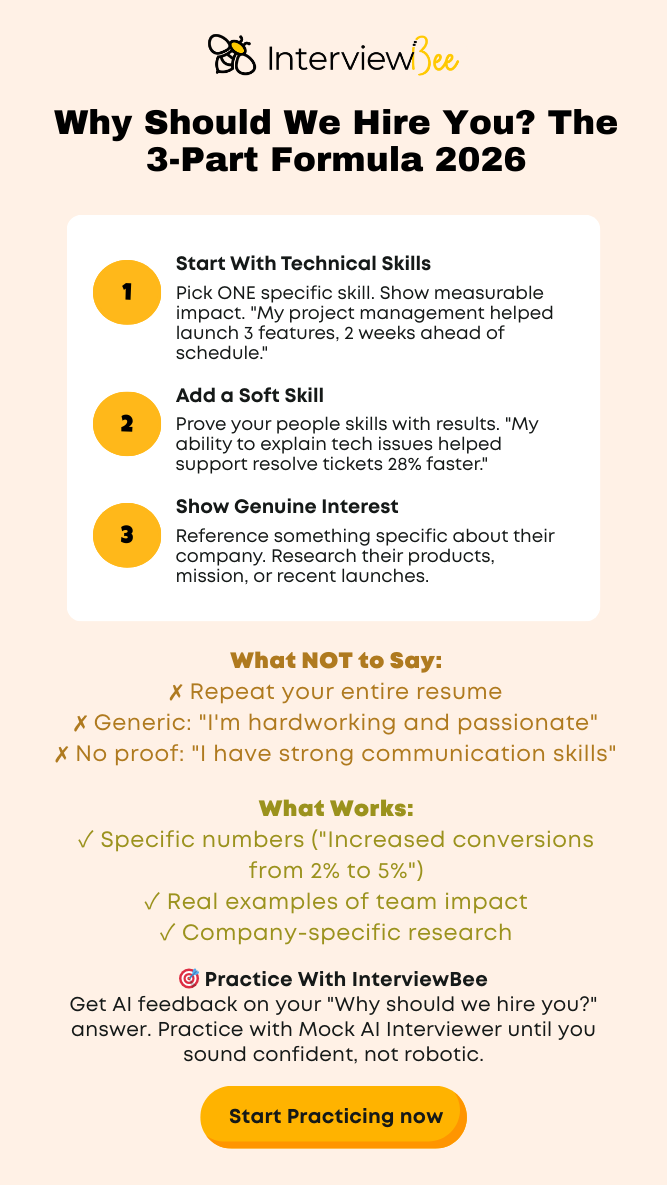
Start with one technical skill
Pick something you're genuinely good at. Back it up with what happened because of that skill.
Bad answer:"I have strong project management skills."
Better answer:"My project management approach helped our team launch three major features in Q4, two weeks ahead of schedule, by cutting unnecessary meetings and implementing daily standups."
See the difference? One's vague. The other shows exactly what you did and what changes were made.
Next, highlight a soft skill
Technical abilities open doors. Your soft skills convince teams they want you around. Pick one communication or people skill and prove its value.
Bad answer:"I communicate well."
Better answer:"My ability to explain technical issues in plain English helped our support team resolve tickets 28% faster without always escalating to engineering."
Things like coaching teammates, working across departments, or explaining complex stuff simply, these matter more than most people realise.
Finish by showing you actually want this job
Generic enthusiasm doesn't work. Show that you researched this specific company.
Bad answer:"I'm really excited about this opportunity."
Better answer:"Your recent shift toward privacy-first products caught my attention. I've been reading your blog series on data ethics, and that's actually why I left ad tech for privacy tech 18 months ago."
Reference something real, a product launch, their mission, or a problem they're solving. It proves you're not just mass-applying everywhere.
How to practice without sounding robotic
Don't just read it in your head. Actually, say it out loud a few times. You'll catch weird phrasing or spots where you stumble. If you want, record yourself on your phone; it's awkward to watch, but you'll spot nervous habits you didn't know you had. Or just practice with InterviewBee's Mock AI Interviewer and get instant feedback on how you come across.
Here's what the full answer looks like
"So I worked on marketing automation at my last company and managed to bump our email conversions from about 2% to almost 5% over six months. The big thing was rethinking how we grouped our audience segments. But beyond just the technical stuff, I spent a lot of time showing our non-technical teammates how to actually use these tools, which cut our onboarding time way down from three weeks to about five days.
That'd probably help here since I know your marketing team's about to double. What really got me interested is your focus on AI-powered personalization. I've been following your recent product updates, and the way you're using machine learning to improve customer experience is exactly the direction I want to grow in. That's actually what pushed me to dive deeper into data science over the past year."
If you're changing careers
The formula still works, but frame your experience differently. Instead of saying "in my marketing role," say "when I led customer acquisition strategies" to emphasize the transferable skill. If you managed a $500K budget in retail and you're moving to tech, that's still budget management at scale. Focus on what you accomplished, not where you did it.
What kills otherwise strong answers
Repeating your resume word-for-word, giving generic qualities without proof, or sounding arrogant about your qualifications. These mistakes happen even to experienced candidates who've prepared everything else perfectly. The difference between candidates who land offers and those who don't often comes down to this single question. According to workplace experts at CNBC, showing your values match the company's matters as much as your skills. Career advisors at Indeed found that specific numbers stick in interviewers' minds while generic claims disappear immediately.
Here's what separates good answers from great ones: specificity beats generalities every time, research shows you're genuinely interested, and confidence without arrogance makes you memorable for the right reasons. This three-part structure technical skill with results, soft skill with team impact, genuine excitement about the company addresses exactly what hiring managers evaluate. They're not just asking if you can do the job. They're asking if you understand your own value well enough to explain it clearly, if you've researched them specifically, and if you'll actually stick around if they invest in hiring and training you. Master this formula and you transform from someone hoping to get picked into someone making a compelling case for why hiring you is the smart choice. That shift in how you present yourself changes everything.
Get Practice That Actually Helps
Reading about this stuff is different from doing it under pressure. Most people struggle when they have to tell their stories live in an interview and get follow-up questions they didn't expect.
InterviewBee has a Google question bank with the leadership and Googleyness questions that actually come up in interviews. The AI interviewer asks questions and evaluates how you answer, not just what you say, but whether you are showing the traits Google looks for or just listing things you did.
You get feedback on your answers in real-time. If you are being vague about your role on a team project, it tells you. If your STAR story lacks impact, you will know before the actual interview.
The platform covers technical rounds and behavioral questions, so you can practice the full range of what Google will ask. When interview day comes, you will know what to expect and how to handle it.