How Do You Handle Stress and Pressure in Interviews - 2025
- Author: Anindita Ghosh
- Published On: Oct 29, 2025
- Category:Interview Guide
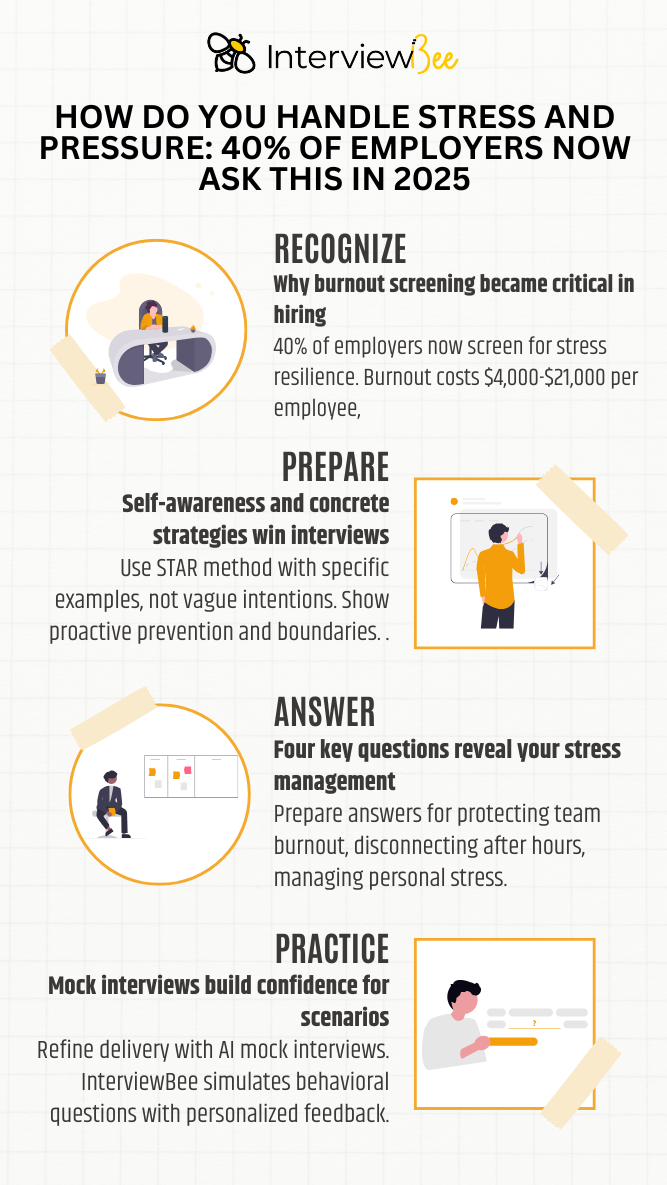
The job interview landscape has transformed dramatically. If you've recently interviewed for a position, you've likely encountered questions like "how do you handle stress and pressure?" This isn't coincidental; over 40% of employers now actively screen candidates for burnout prevention strategies, stress management capabilities, and mental health resilience during the hiring process.
This shift represents more than a passing trend. With 82% of the US workforce at risk of burnout and 62% of Indian employees experiencing regular burnout (triple the global average), organizations have recognized that hiring someone destined to burn out costs between $4,000 and $21,000 annually per employee.
The Business Case Behind Burnout Screening
Employers aren't asking work-life balance interview questions out of pure altruism. The return on investment tells a compelling story: every dollar invested in mental health programs yields approximately $4 in productivity gains, according to the World Health Organization.
The financial consequences of ignoring burnout have become impossible to dismiss. Depression and anxiety cost the global economy $1 trillion annually in lost productivity. When employees burn out, productivity drops by 35%, absenteeism increases dramatically, and turnover rates surge. For companies operating on thin margins, these losses can prove devastating.
Certain professions face particularly intense scrutiny in burnout screening. Healthcare workers report the highest burnout rates, 57.6% among primary care physicians and 48.2% overall in 2023. Technology sector burnout rates hover at 42-47%, driven by long hours and pressure to innovate constantly. For these high-stress industries, pre-employment screening for burnout resilience has become essential.
What Stress Management Interview Questions 2025 Look Like
Modern interviews increasingly feature behavioral questions designed to assess genuine stress resilience. When employers ask "how do you handle stress and pressure," they're evaluating multiple dimensions:
Common burnout-related questions include:
- "How do you prevent a situation from getting too stressful to manage?"
- "Describe a time when you took proactive measures to prevent stress or burnout in a team setting."
- "What strategies do you use to disconnect from work during personal time?"
- "How do you ensure stressful situations in your personal life don't affect your work performance?"
These questions serve multiple purposes beyond simple screening. Employers want to understand whether candidates possess self-awareness about stress triggers, have developed effective coping mechanisms, can maintain boundaries between work and personal life, and demonstrate resilience in recovering from setbacks.
How to Prepare for Stress and Pressure Questions
When faced with work-life balance interview questions or stress management interview questions 2025, strong candidates demonstrate:
- Self-Awareness: Understanding personal stress triggers and early warning signs of overload
- Concrete Strategies: Specific examples of stress-reduction techniques, not vague intentions. Mention time management systems, mindfulness practices, exercise routines, or hobbies that provide genuine recovery.
- Proactive Approaches: Evidence of preventing stress before it reaches crisis point, rather than just reactive crisis handling.
- Knowledge of Resources: Awareness of Employee Assistance Programs, mental health benefits, and organizational support systems.
Sample Answers to Common Stress Management Questions
Here are effective responses to the most frequently asked burnout prevention questions:
"How do you prevent a situation from getting too stressful to manage?"
I am of the opinion that I practice proactive stress management. I avoid overwhelming circumstances by making big projects smaller with a deadline to the end. I have a priority matrix that allows me to distinguish between what is really urgent and what can be put off. To illustrate, in one of our product launches, I observed that our schedule was getting tightened. I did not allow the stress to mount up but I brought up a team discussion of achievable deliverables and we redefined our scope. I also have frequent meetings with my boss to mention the possible bottlenecks at an early stage. I also monitor my energy and, in case I start to experience such indicators as inability to focus or getting irritated, I use it as an indication that I shouldn't increase my workload and it may become overwhelming."Describe a time when you took proactive measures to prevent stress or burnout in a team setting."
As my former position, I have observed that our department always had to work late when closing the accounts at the end of the month. Instead of considering this the status quo, I performed a workflow analysis and found three manual processes which could be automated. I have offered the leadership these improvements and proposed leading the implementation. Our data reconciliation process was automated thereby cutting the amount of work done at the end of the month by an average of 15 hours per individual. In addition to the technical solution, I also created no meeting Fridays during closing week so that the team was able to work without distraction. These transformations minimized the overtime by half and enhanced the team morale greatly. This experience also taught me that not only dealing with individual coping strategies can help prevent burnout, but also systemic issues.
"What strategies do you use to disconnect from work during personal time?"
I have also come up with a number of purposeful borders to guard my personal time. To begin with, I switch off work email messages on my phone after half past six and do not read messages until the next working day. I have explained these boundaries to my staff and I have set up a condition that in case something was really urgent they can contact me through a phone call. Second, I make plans based on activities that demand my utmost attention, I will go on evening walks, do yoga three times a week and I belong to a book club that meets once in a week. This is because of these commitments which require one to mentally get out of work mode. I also follow a shut down ritual, at the end of the working day, I check what I need to do tomorrow, shut down all my work applications and write three things I achieved. The practice of this 10-minute routine makes me feel done, as opposed to having incomplete mental tabs into my evening.
"How do you ensure stressful situations in your personal life don't affect your work performance?"
I am fully aware that stress in my life is unavoidable and I have learned how to deal with personal stress at work. To start with, I am proactive in terms of communication, in case I am facing a major personal issue, I update my manager without giving too much information, and it would create the right expectations. Personal stress makes me more conscious of my self-care: I am more focused on sleep, exercise routine, and occasionally can shift my schedule depending on the necessity, such as waking up earlier to be on time to an appointment. I take stress as another chance to observe compartmentalization as well. Indicatively, whenever my family was in a health crisis last year I set specific timeframes during which I would address personal issues and not allow them to disrupt my work schedule in a random way. During the work hours, I would set aside 30 minutes at lunch to make some calls and check in and then give my full attention to the work tasks. Lastly, I resort to my employee assistance program when necessary, I have sought the advice of a counselor during some of my most stressful times, and it has allowed me to have more effective coping mechanisms.
Practice Makes Perfect: Just like preparing for any critical interview question, practicing with AI-powered mock interviews helps refine your responses. InterviewBee's Mock AI Interviewer simulates realistic stress management interview questions 2025 scenarios, providing real-time feedback on your vocal confidence, response authenticity, and stress indicators, the same signals that actual hiring managers evaluate. Upload your resume and job description to receive personalized practice questions tailored to your role.
The Bottom Line
The question "how do you handle stress and pressure" has evolved from a nice-to-have interview question to a critical screening tool. Organizations that invest in burnout prevention see higher retention rates, attract stronger talent, experience greater engagement, and build more resilient teams.
For professionals, particularly those in healthcare, technology, finance, and customer-facing positions, developing authentic stress management capabilities has become essential for career sustainability. The workplace mental health revolution isn't coming; it has arrived. Those who demonstrate genuine resilience and proactive wellness strategies will thrive in 2025's competitive job market.
Preparation is key to confidently answering these critical questions. Practice your responses to stress and pressure scenarios with InterviewBee's Mock AI Interviewer, which provides personalized feedback on your answers and helps you refine your delivery before the actual interview. The platform simulates realistic behavioral questions specific to your role, ensuring you're ready to showcase your stress management capabilities when it matters most.