




Why Skills-Based Hiring Is Winning in 2026 (And Resumes Matter Less Than Ever)
- Author: Anshika
- Published On: Apr 12, 2026
- Category:Interview Tips
The Resume Was Never a Perfect Signal
70% of employers now use skills-based hiring — up from 65% just one year ago, according to NACE's Job Outlook 2026 survey.
That number did not emerge from nowhere. It reflects a quiet but significant reckoning across HR and talent acquisition about what a resume actually tells you and, more critically, what it does not.
The resume was always a convenient shorthand. But credentials signal prior access to opportunity as much as they signal capability. In a labor market shaped by rapidly evolving skill demands, that distinction matters more than ever.
What Skills-Based Hiring Actually Means
Skills-based hiring prioritizes demonstrated ability over proxies like degree status, job titles, or years of experience.
Instead of filtering through credentials, employers assess what candidates can actually do through:
Structured skills assessments and work samples
Competency-based and behavioral interviews
Verified skills portfolios and certifications
Real-time performance tasks tied to the role
This is not simply about removing degree requirements from job postings, though many companies have done exactly that. Google, IBM, Apple, and a growing number of enterprise organizations have publicly dropped the four-year degree requirement for significant portions of their roles.
IBM's SkillsBuild initiative is one of the more ambitious examples, connecting learners to credentials that feed directly into hiring pipelines based on demonstrated competency.
At its core, skills-based hiring asks a different question at the start of the process:
Not "where did this person study?" but "can this person do the job?"
Why 2026 Marks an Inflection Point
Several forces are converging this year that make skills-based approaches not just preferable but necessary.
The speed of skill change has outpaced credential cycles
The World Economic Forum estimates over 120 million workers globally face medium-term role redundancy due to automation and AI
University curricula cannot keep pace with the tooling, cloud-native architectures, and AI integrations defining today's roles
A degree earned in 2020 does not certify competency in what employers need in 2026
GPA screening has nearly collapsed as a hiring proxy
In 2019, 73% of employers screened candidates by GPA
In 2026, that figure has fallen to just 42% (NACE Job Outlook 2026)
Employers are not abandoning academic performance because it is irrelevant; they have found better signals
Talent pools are genuinely constrained
Skills gaps, rising application volumes, and extra evaluation steps continue to complicate hiring (Robert Half, 2026)
Organizations restricting searches to degree holders from narrow institutions cut themselves off from large portions of viable talent
There is no evidence-based justification for maintaining these restrictions when better assessment methods exist
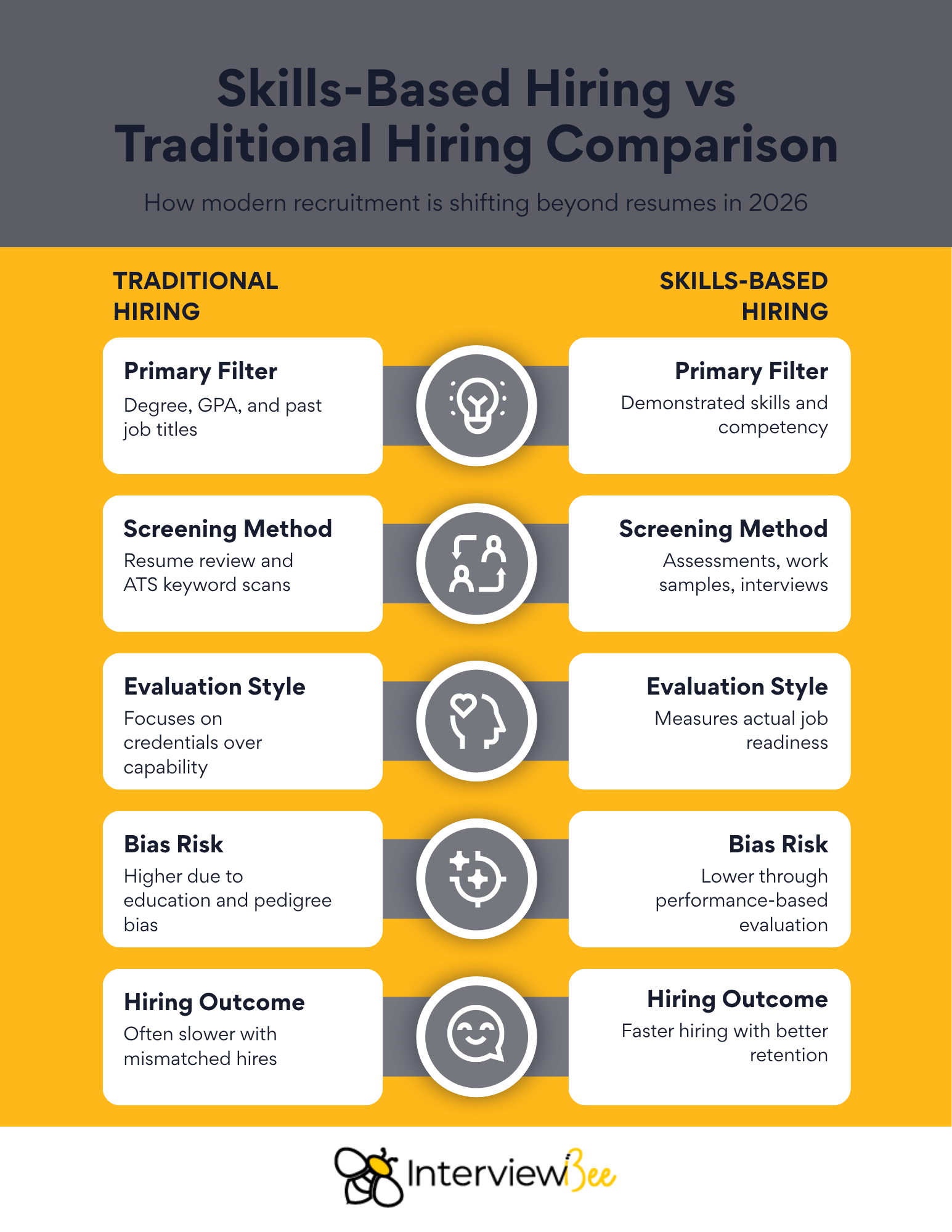
Traditional Hiring vs. Skills-Based Hiring
| Dimension | Traditional Hiring | Skills-Based Hiring |
|---|---|---|
| Primary filter | Degree, GPA, institutional brand | Demonstrated competency |
| Screening method | Resume review, ATS keyword match | Skills assessments, work samples |
| Bias risk | High (name, institution, GPA) | Lower (performance-based) |
| Talent pool | Narrow (credential-gated) | Broader (alternative pathways included) |
| Predictive validity | Low to moderate | Up to 5x more predictive of job performance |
| Time-to-productivity | Longer (training gaps common) | Shorter (role-ready candidates) |
| Retention outcomes | Industry average | Up to 35% improvement reported |
The AI Resume Problem: When the Signal Becomes Noise
The collapse of trust in resumes as authentic documents is a second force accelerating the skills-based shift.
The numbers tell the story clearly:
Between 40% and 80% of job applicants now use AI to write or substantially enhance their resumes (SHRM, 2025)
LinkedIn saw application volumes spike more than 45% over the past year, driven largely by AI-powered mass-apply tools
74% of hiring managers have encountered AI-generated content in applications (Resume Genius, 2026)
62% are more likely to reject AI-generated resumes that lack personalization (Resume Now, 2025)
65% of US hiring managers have caught applicants using AI deceptively, including prompt injections and deepfake interviews (Greenhouse, 2025)
The result, as one hiring platform CEO put it: "Trust is at an all-time low for both job seekers and recruiters."
The irony is sharp. AI tools were supposed to democratize access to professional-quality applications. Instead, they have flooded inboxes with nearly identical, keyword-optimized documents that tell recruiters very little about the actual human behind them. When everyone's resume sounds the same, the resume stops functioning as a differentiator.
Resume Screening vs. Skills Assessments
| Factor | Resume Screening | Skills Assessments |
|---|---|---|
| Signal reliability in 2026 | Declining (AI inflation) | Higher (performance-based) |
| Candidate differentiation | Low (homogenized outputs) | High (demonstrates real ability) |
| Bias vectors | Significant (presentation, formatting) | Reduced (task-based evaluation) |
| Fraud risk | High (AI fabrication, embellishment) | Lower (real-time performance) |
| Candidate experience | Opaque, passive | Transparent, active |
| Scalability | High, but low signal quality | Moderate, improving with automation |
How Top Companies Are Changing Their Hiring Processes
Leading organizations have restructured intake pipelines to weight skills demonstrations far more heavily than credential scanning. Here is what that looks like in practice:
What modern, skills-first hiring processes include:
Competency-based job descriptions written around actual role requirements (not wish lists)
Behavioral and situational interview frameworks that probe specific skill application
Pre-hire technical or functional assessments scored against defined benchmarks
Structured AI interview tools that evaluate candidates across standardized dimensions
Portfolio or project reviews replacing or supplementing the resume entirely
Companies like IBM, Microsoft, and Accenture are actively investing in candidate assessment tools and interview intelligence platforms that go beyond what any resume can surface.
Candidates navigating these environments need more than a well-formatted resume. They need to prepare for structured, performance-based evaluation. InterviewBee's AI-powered mock interview platform is built specifically for this, helping candidates practice the competency-based and behavioral questions that skills-first employers are now prioritizing.
Benefits for Employers
Better predictive accuracy: Skills-based hiring is 5x more predictive of job performance than education-based filtering
Faster hiring: Companies using structured assessments report time-to-hire reductions of up to 25% (Burning Glass Institute)
Greater diversity: Organizations adopting skills-first approaches have seen candidate diversity improve by up to 45% (CompTIA, 2025)
Stronger retention: Up to 35% improvement in retention rates when candidates are assessed for actual role fit
Cost savings: Organizations save an average of 30% on recruitment expenses by using pre-screened candidate pools and automated assessment tools (Deloitte)
Benefits for Candidates
Non-traditional paths are no longer a disadvantage. Bootcamp graduates, self-taught professionals, and career changers can now compete on merit
Performance replaces pedigree. What you can demonstrate matters more than where you studied or what your GPA was
Greater transparency. Skills-based processes often come with clearer evaluation criteria, so candidates know what they are being assessed on
Better job fit. When roles are defined by competencies, the chances of landing a role that actually matches your strengths improve significantly
The caveat is that candidates must prepare differently. Skills-based processes reward preparation, not polish. Reviewing InterviewBee's curated interview question banks is a strong starting point for candidates preparing for structured interviews across different roles and industries.
Challenges and Limitations Worth Acknowledging
Skills-based hiring is not a solved problem. Several real challenges remain:
Assessment design is hard. There is a meaningful difference between a well-constructed work sample test and a generic online quiz. The latter can introduce its own distortions and screen out capable candidates unfairly
Manager buy-in is a genuine barrier. NACE research identifies lack of buy-in from hiring managers and cultural resistance as the top implementation challenges organizations face
Equity questions remain open. If assessments are designed without attention to how they are administered across different groups, skills-based processes can replicate the biases they were meant to displace
Standardization is inconsistent. Across industries and company sizes, the quality and validity of skills assessments varies widely, making benchmarking difficult
What the Future of Hiring Looks Like
The trajectory is clear even if the timeline remains uncertain. What replaces the credential-first model is a more layered evaluation architecture:
Structured, competency-based interviews as the default, not the exception
Verified skills portfolios and alternative credentials with real market weight
Hiring process automation handling volume, with human judgment reserved for final decisions
Interview intelligence platforms that assess reasoning and response patterns, not just credentials
Continuous skills data feeding into talent planning, not just point-in-time hiring
LinkedIn projects that by 2030, over 75% of entry-level tech roles will prioritize skills over degrees. The organizations and candidates who build around this now will be measurably better positioned as the shift deepens.
Conclusion
The resume served its purpose for a long time. But it was always a proxy, and like most proxies, it worked better in some conditions than others.
In 2026, those conditions have changed:
AI has inflated application volumes and eroded document authenticity
Skill demands are shifting faster than credentials can track
Employers using skills-first models are reporting better retention, faster hiring, and access to talent the old logic screened out
For candidates: preparation matters more than presentation now. For recruiters: the tools and frameworks to support this shift are available and improving.
The future of recruitment is not about finding someone with the right degree. It is about finding someone who can do the job. That sounds obvious. It is only now becoming standard practice.
FAQ
Q1. What is skills-based hiring and how is it different from traditional hiring?
Skills-based hiring evaluates candidates on what they can actually do, through assessments, work samples, and competency-based interviews, rather than filtering by degrees, GPA, or job titles. Traditional hiring uses credentials as a shortcut to predict potential. Skills-based hiring replaces that shortcut with direct evidence. The result is a process that is more predictive of job performance and less dependent on where someone studied or how their resume is formatted.
Q2. Why are resumes becoming less reliable as a hiring tool in 2026?
Two things have happened simultaneously. First, between 40% and 80% of applicants now use AI to write or enhance their resumes, flooding hiring pipelines with near-identical, keyword-optimized documents that reveal very little about the actual candidate. Second, application volumes have surged, with LinkedIn recording over 11,000 applications per minute at peak. When every resume looks and sounds the same, the document stops functioning as a meaningful signal. Recruiters are responding by shifting weight toward assessments and structured interviews that are harder to fabricate.
Q3. Does skills-based hiring only benefit employers, or do candidates gain too?
Both sides benefit, though in different ways. Employers get better predictive accuracy, faster hiring, and stronger retention. Candidates, particularly those from non-traditional backgrounds, bootcamps, or career changes, gain access to opportunities that credential-first processes would have screened them out of entirely. The shift rewards what you can demonstrate over where you went to school. That said, candidates need to prepare differently. Skills-based processes are performance-based, not presentation-based, which is exactly why structured interview preparation matters more now than ever.
Q4. What are the biggest challenges companies face when implementing skills-based hiring?
Three challenges come up consistently. First, designing valid assessments is harder than it looks. A poorly constructed test can introduce its own bias and screen out strong candidates. Second, getting buy-in from hiring managers who have relied on credential shortcuts for years is a genuine cultural hurdle. NACE's research identifies this as one of the top barriers organizations report. Third, standardization is uneven. The quality and rigor of skills assessments varies significantly across industries and company sizes, which makes it difficult to benchmark or compare results consistently.
Q5. How should job seekers prepare for a skills-based hiring process?
The core shift is from polishing your resume to demonstrating your competency. Practically, that means:
Practicing behavioral and situational interview questions that probe how you have applied specific skills in real scenarios
Building a portfolio or project record that shows your work, not just your titles
Researching the specific competencies a role requires and preparing concrete examples for each
Using AI-powered mock interview tools to simulate structured, performance-based interviews before the real thing
InterviewBee's interview question banks and AI mock interview platform are built for exactly this kind of preparation, helping candidates get comfortable with the format that skills-first employers now use as standard.