


Will AI Replace Recruiters? The Truth Behind the Hiring Revolution
- Author: InterviewBee Editorial Team
- Published On: Feb 14, 2026
- Category:Career Advice
Will AI Replace Recruiters? The Truth Behind the Hiring Revolution
The question “Will AI replace recruiters?” continues to circulate across the hiring industry. As artificial intelligence becomes more advanced, many professionals are wondering whether recruitment will eventually become fully automated. Companies are integrating smart systems into their hiring workflows, and automation is no longer optional in many organizations.
But does this mean recruiters are becoming obsolete, or is something else happening?
When Technology Entered the Hiring Process
Picture a recruiter named Sarah starting her day.
She opens her dashboard expecting the usual flood of resumes. Instead, she sees a clean shortlist of top candidates already ranked and filtered. The system has scanned hundreds of applications, compared skills with job requirements, and highlighted strong matches.
What once required hours of manual review now takes only minutes.
Artificial intelligence has clearly changed how recruitment works. Modern systems can analyze experience, identify relevant qualifications, and detect keyword alignment quickly.
From a business standpoint, the advantages are clear:
- Faster resume screening
- Reduced hiring timelines
- Automated interview coordination
- Structured data analysis
These improvements make hiring more efficient and less time-consuming.
However, recruitment has never been only about efficiency.
What Technology Does Well
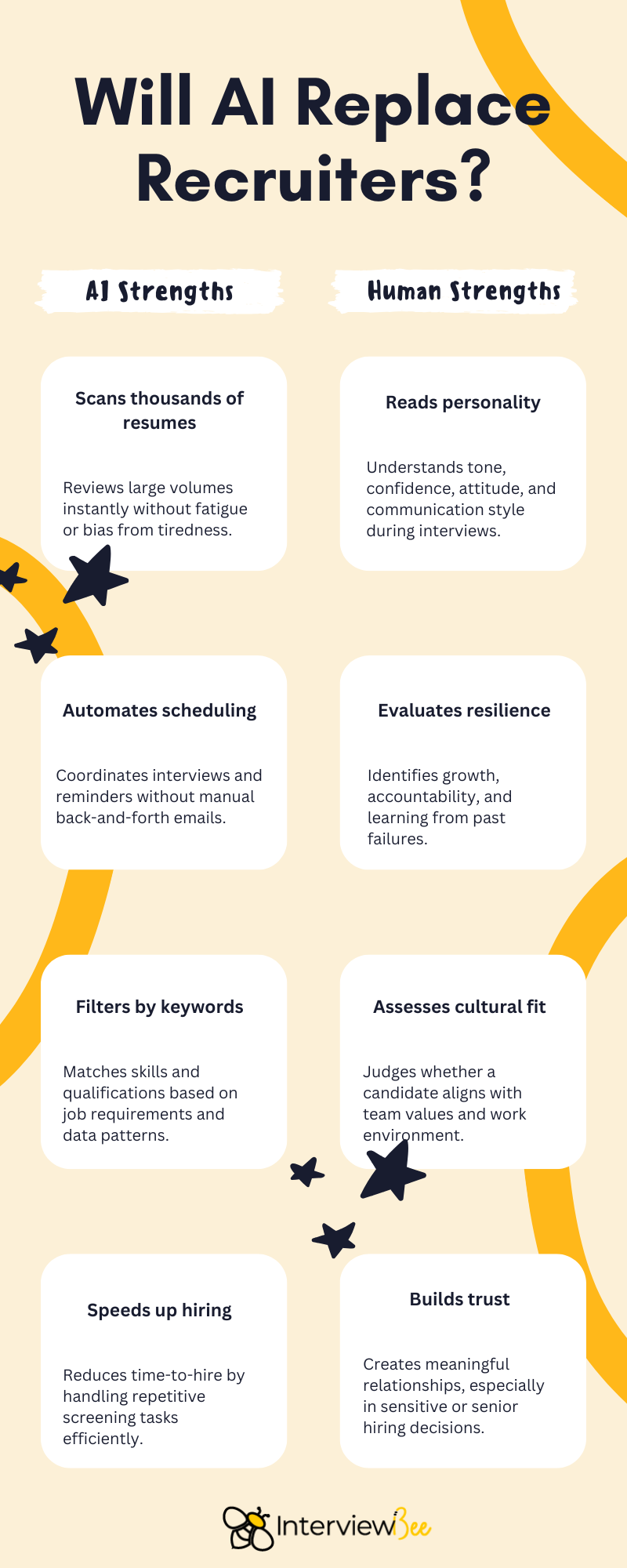
Artificial intelligence performs exceptionally well when handling large volumes of information. It can review thousands of resumes without fatigue. It can recognize patterns based on historical hiring data. It can organize candidates into structured categories.
Automation also manages routine tasks such as scheduling interviews, sending reminders, and tracking candidate progress. This reduces administrative pressure on HR teams and allows processes to move smoothly.
There is no doubt that technology strengthens operational performance. Yet hiring is more than pattern recognition.
The Human Side of Hiring
Later that week, Sarah interviews one of the recommended candidates. His resume ranks near the top. His qualifications meet the criteria. But during the conversation, something unexpected stands out.
He talks openly about a project that failed early in his career. Instead of shifting blame, he explains what he learned and how he improved his leadership skills afterward.
The system evaluated measurable experience. Sarah recognized character. That distinction matters.
Recruitment involves understanding personality, resilience, and long-term potential. Emotional intelligence plays a major role in evaluating candidates. Cultural alignment and relationship building also remain essential in hiring decisions.
The Risks of Overdependence
Artificial intelligence operates within the limits of its training data. If historical hiring patterns include bias, algorithms may unintentionally reflect those patterns. Human oversight is necessary to maintain ethical standards.
Technology is a powerful tool, but it should not replace judgment.
The Future of Recruitment
Artificial intelligence is transforming recruitment. It increases efficiency and provides valuable insights. Yet it does not replace the human qualities that define effective hiring.
The shift is not about elimination. It is about evolution.
Recruiters who integrate technology into their workflow will become more strategic and impactful. As long as organizations hire people rather than simply process data, recruiters will remain essential.
FAQ
1. Will AI completely automate hiring in the future?
AI will automate many repetitive tasks such as resume screening and scheduling, but full automation is unlikely. Final hiring decisions require human judgment.
2. What parts of recruitment are most likely to be automated?
Resume parsing, candidate ranking, interview scheduling, and reporting are already heavily automated.
3. What skills should recruiters develop to stay relevant?
Strategic hiring, relationship building, and data literacy are key skills for modern recruiters.
4. Can AI reduce hiring bias?
AI can help reduce bias, but only with careful monitoring and proper data training.
5. Is AI a threat or an opportunity for recruiters?
AI is primarily an opportunity because it removes repetitive work and allows recruiters to focus on human-centered hiring decisions.
Frequently Asked Questions
1. Will AI completely replace human recruiters in the future?
No, AI is unlikely to completely replace human recruiters. While it can automate tasks like resume screening and interview scheduling, it cannot replicate emotional intelligence, relationship-building, and complex decision-making. Recruitment involves understanding people, and that human element remains essential.
2. What tasks can AI handle in recruitment?
AI can efficiently manage repetitive and data-driven tasks such as parsing resumes, ranking candidates, analyzing qualifications, scheduling interviews, and sending automated responses. These tools improve speed and accuracy but still require human supervision for final hiring decisions.
3. Is AI recruitment more accurate than traditional hiring methods?
AI can improve consistency and reduce manual errors by analyzing large amounts of data quickly. However, its accuracy depends heavily on the quality of the data it is trained on. Human oversight ensures fairness, context, and ethical judgment remain part of the process.
4. How should recruiters adapt to AI technology?
Recruiters should focus on developing strategic thinking, emotional intelligence, and data literacy. Learning how to interpret AI-driven insights and combine them with human judgment will make recruiters more valuable in modern organizations.
5. Does AI improve the candidate experience?
When used properly, AI can improve the candidate experience by providing faster responses and smoother scheduling. However, meaningful engagement and personalized communication still depend on human recruiters to create trust and connection.