



The Psychology Behind Every Interview Question
- Author: InterviewBee Editorial Team
- Published On: Feb 22, 2026
- Category:Career Advice
The Psychology Behind Every Interview Question
A candidate walks out of an interview feeling great. She answered every question. She smiled. She made eye contact. Two days later, she gets the rejection email.
Sound familiar? The problem is rarely the answers themselves. It's that most candidates answer what was asked, not what was meant. Once you understand the psychology behind interview questions, the whole game changes.
By the end of this post, you will be able to decode interviewer intent, recognize hidden signals in how questions are framed, and deliver answers that hit the scoring criteria interviewers use, whether they realize it or not.
How Interviewers Use Questions to Test What Matters
Every question an interviewer asks serves at least one of four purposes. Understanding these four intents is the foundation of better interview preparation.
1. Skill fit — Can you actually do the job?
Example: "Walk me through how you'd manage a project with three competing deadlines."
The mental model: The interviewer is testing technical competence and process thinking. They want evidence, not theory.
2. Cultural fit — Will you thrive here?
Example: "How do you handle feedback from a manager you disagree with?"
The mental model: The interviewer is checking whether your working style aligns with the team's norms.
3. Cognitive style — How do you think?
Example: "If you were starting our marketing from scratch, where would you begin?"
The mental model: The interviewer wants to see how you structure ambiguity.
4. Risk signals — Are there red flags?
Example: "Why did you leave your last role so quickly?"
The mental model: The interviewer is checking for instability or defensiveness.
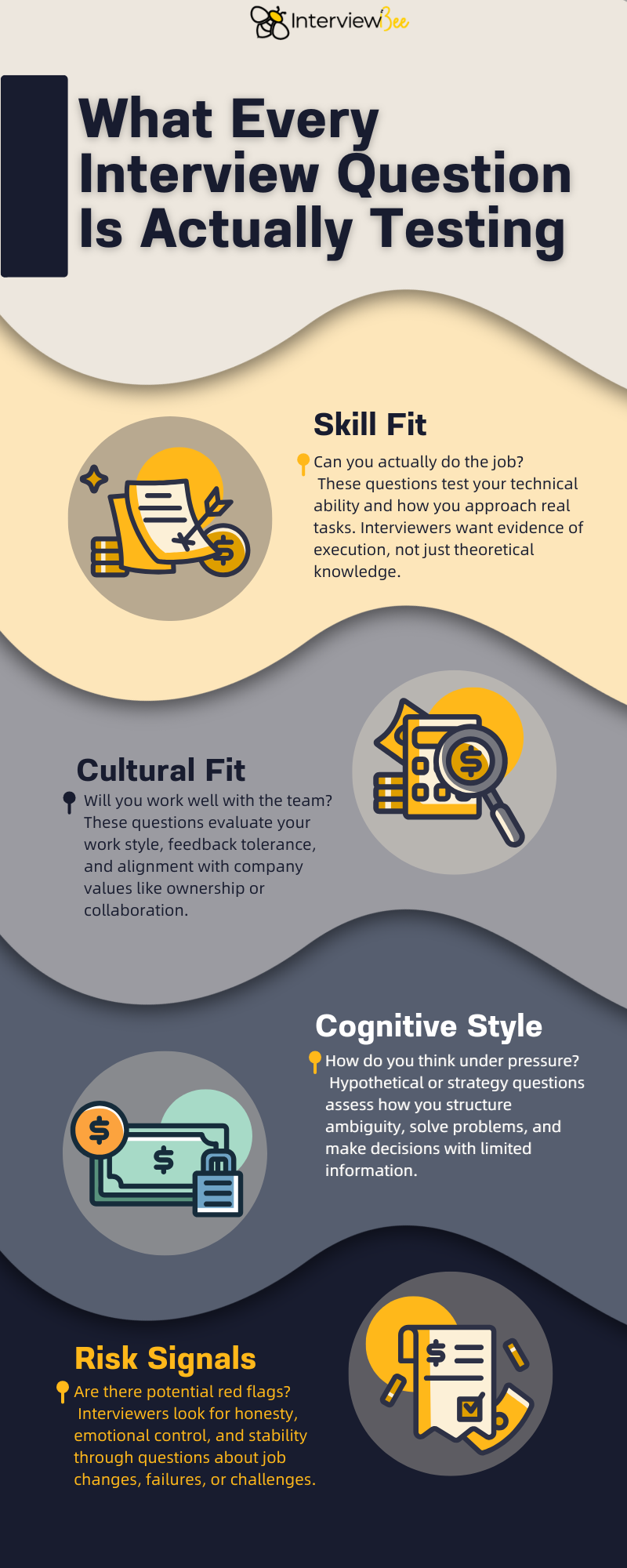
When you hear a question, your first instinct should be to ask yourself which of these four intents is driving it. That single habit changes how you answer everything.
How Hiring Managers Score Answers (The Unseen Rubric)
Most interviewers do not use an explicit rubric. But what hiring managers look for follows a consistent pattern. Answers are judged across five dimensions:
1. Relevance — Does the answer address what was actually asked?
2. Specificity — Is there real detail or just general claims?
3. Impact — What changed as a result?
4. Concision — Can this person communicate clearly?
5. Coachability — Does this person learn from mistakes?
The Most Common Question Types and What They Really Mean
Behavioral Questions ("Tell Me About a Time…")
These questions force candidates to move from claims to evidence. Interviewers use them because past behavior is the strongest predictor of future behavior.
The STAR framework (with intent):
Situation — Brief context
Task — Your responsibility
Action — What you actually did
Result — Quantified outcome
Reflection — What you learned
Example:
"We had a product launch delayed by a vendor. I renegotiated directly with the decision-maker and recovered six days, saving roughly $40K. I learned to escalate faster next time."
Strengths and Weaknesses
These questions test self-awareness and emotional intelligence, not modesty or bragging.
Weak answers:
"I work too hard."
"I care too much about quality."
Strong answers:
Honest weakness + awareness + action + current state.
Interviewers want honesty without defensiveness.
Hypothetical and Case Questions
These questions test how you think, not whether you land on the perfect answer.
4-step framework:
Clarify the goal
State assumptions
Walk through logic
Acknowledge trade-offs
Psychological Traps Candidates Fall Into
Trap 1: Rehearsed answers — Prepare themes, not scripts.
Trap 2: Oversharing — Stop once you've answered the question.
Trap 3: Defensive tone — Pause before answering hard questions.
Trap 4: Ignoring job context — Tailor examples to the role.
Quick Prep Template
10-Minute Daily Prep
- Read one company or industry update
- Bullet one interview answer
- Review one job description
1-Hour Role Study
- Map role requirements to past work
- Identify top five achievements
2-Hour STAR Practice
- Write five STAR stories
- Time each to 90 seconds
FAQ
Q1: Why do interviewers ask the same questions?
Standardized questions allow fair comparison and reduce bias across candidates.
Q2: How long should answers be?
Most answers should be 60–90 seconds. Beyond two minutes risks losing attention.
Q3: Is it okay to pause before answering?
Yes. A short pause signals composure and thoughtfulness.
Q4: What if I lack direct experience?
Be honest, then bridge to the closest relevant experience you have.
Q5: Biggest interview mistake?
Answering what was asked instead of what was meant.